Assam Eviction Drives and Land Encroachment Governance
Source:Indian Express ↗
Why It Matters
The issue touches upon multiple UPSC themes: internal security challenges stemming from illegal immigration in border states (GS3), the constitutional validity of state eviction actions versus the right to residence and life (GS2), and the governance challenge of balancing land administration with the rehabilitation of displaced vulnerable sections.
Summary
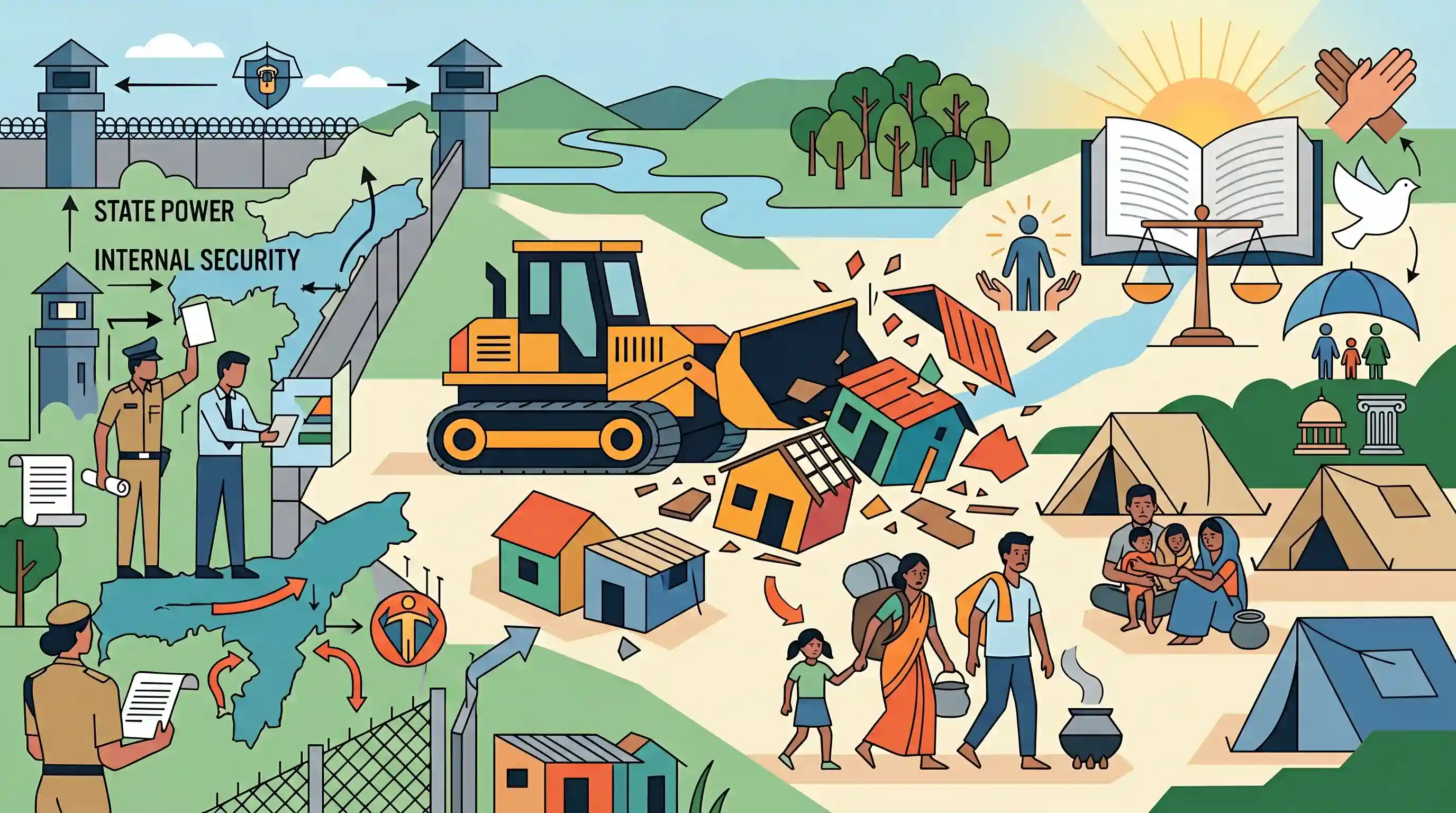
A recent eviction drive in Assam resulted in the displacement of over 90 families and the bulldozing of their homes to clear alleged encroachments on state land. Such operations in Assam are deeply tied to the state's complex demographic landscape and concerns over illegal immigration. However, they also trigger substantial human rights and constitutional debates regarding due process, the state's use of "bulldozer action," and the fundamental right to housing and rehabilitation for marginalized or displaced populations.
Key Points
- The Assam government conducted an eviction drive, displacing over 90 families and demolishing their homes using bulldozers.
- The administration justifies the evictions as necessary measures to clear illegal encroachments from government, forest, or institutional lands.
- In Assam, land encroachment is a sensitive issue heavily linked to demographic anxieties and the challenges of illegal transborder migration.
- Critics and rights groups argue that forced evictions without comprehensive rehabilitation violate fundamental rights, particularly the right to life and housing (Article 21).
- The increasing use of bulldozers for state-led demolitions raises constitutional debates surrounding due process, natural justice, and the fundamental right to residence under Article 19.
Important Terms
Forest Rights Act, 2006 (FRA)

Statute recognizing land and resource rights of Scheduled Tribes and traditional forest dwellers who have inhabited forest lands for generations but lacked formal titles.
UPSC context
GS Paper II (Vulnerable Sections); GS Paper III (Environment). Tests understanding of community-centric forest governance and land tenure security.
LARR Act, 2013
The 2013 law governing land acquisition by the State, mandating fair compensation, social impact assessments, and mandatory rehabilitation and resettlement for displaced families.
UPSC context
GS Paper II (Governance). Tests knowledge of procedural safeguards and the State's obligations during displacement and rehabilitation.
Due Process of Law
A constitutional doctrine (interpreted under Article 21) requiring the State to follow procedures that are fair, just, and reasonable, rather than arbitrary, before depriving individuals of rights.
UPSC context
GS Paper II (Polity). Tests the evolution of Article 21 and judicial checks on executive "bulldozer action."
Right to Shelter
An integral part of the Right to Life (Article 21) as per the Supreme Court, ensuring individuals have a secure and dignified place to reside.
UPSC context
GS Paper II (Social Justice/Judiciary). Tests landmark judgements (e.g., Olga Tellis case) regarding the state's duty toward evicted populations.
Encroachment
Unauthorized occupation of government or public land, often governed by state-specific acts that provide the legal basis for eviction and demolition.
UPSC context
GS Paper II (Governance). Relevant for understanding the legal pretext used by administrations for clearing land.
Illegal Immigration (Assam Context)
In the Northeast context, refers to non-citizens (primarily from Bangladesh) entering without valid documents, impacting local demographics and driving land-related administrative policies.
UPSC context
GS Paper III (Internal Security). Essential for understanding the socio-political drivers behind eviction drives and the NRC/CAA debate.
Prelims Trap
The Supreme Court has declared all state-led demolitions of unauthorized structures unconstitutional.
The SC only banned punitive "bulldozer justice." Routine municipal demolitions of illegal encroachments remain lawful if due process (like a 15-day notice and hearing) is followed.
Static Concepts Connected
How does the Constitution balance the Right to Reside with state eviction powers?
- Article 19(1)(e): Grants citizens the fundamental right to reside and settle in any part of the territory of India.
- Article 19(5): Allows the state to impose reasonable restrictions to protect the interests of Scheduled Tribes or the general public (e.g., clearing illegal encroachments).
- Article 21: Expanded by the SC (Olga Tellis, 1985) to include the right to livelihood and shelter, requiring humane procedures and often rehabilitation before eviction.
What protections does the Forest Rights Act (FRA) 2006 offer against arbitrary eviction?
- Statutory Cut-off: Recognizes and vests land rights to forest dwellers who occupied forest land prior to December 13, 2005.
- Gram Sabha Authority: Empowered to initiate the process of determining the nature and extent of individual and community forest rights.
- Eviction Protection: Legally prohibits the eviction or resettlement of forest dwellers until the rights recognition and verification process is complete.
Cross-Topic Patterns
Border Security & Demographic Anxiety
Eviction drives in Assam are heavily driven by historical anxieties over illegal transborder migration from Bangladesh, linking constitutional rights directly to internal security and border management challenges.
Rule of Law vs Executive Action
The trend of using "bulldozer action" tests the boundaries of natural justice, blurring the lines between legitimate executive encroachment clearance and extra-judicial punitive demolitions.

Expect a 2026 prelims question mixing Art 19(1)(e) restrictions, Art 21 right to shelter, and the new SC statutory demolition guidelines.
Linked PYQs · 4
Linked PYQs · 4
- 2014MainsGS3
How does illegal transborder migration pose a threat to India's security? Discuss the strategies to curb this, bringing out the factors which give impetus to such migration.
- 2013PrelimsGS1
Under the Scheduled Tribes and Other Traditional Forest Dwellers (Recognition of Forest Rights) Act, 2006, who shall be the authority to initiate the process for determining the nature and extent of individual or community forest rights or both?
- 2022MainsGS2
“Right of movement and residence throughout the territory of India are freely available to the Indian citizens, but these rights are not absolute.” Comment.
- 2019MainsGS3
Cross-border movement of insurgents is only one of the several security challenges facing the policing of the border in North-East India. Examine the various challenges currently emanating across the India-Myanmar border. Also, discuss the steps to counter the challenges.
