Global Negotiations on Plastic Pollution Reach Impasse
Source:The Hindu ↗
Why It Matters
Highlights the ongoing challenges in international environmental diplomacy and provides crucial statistics and analytical angles on plastic pollution, which is highly relevant for GS3 questions on solid waste management, marine pollution, and climate change.
Summary
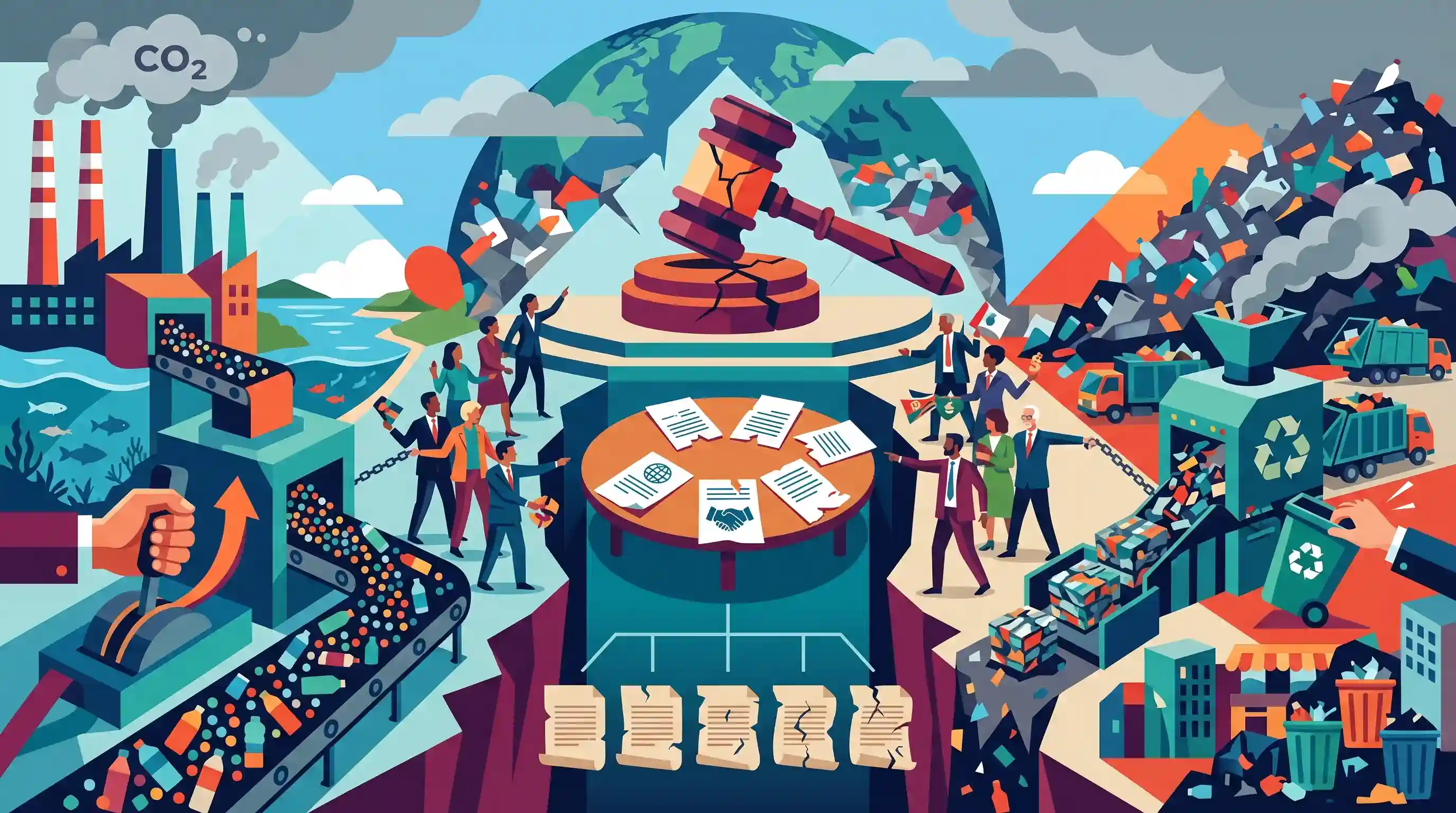
The sixth attempt by the United Nations Environment Programme to negotiate a universal treaty addressing plastic pollution has ended in a familiar impasse. The primary contention is whether combating the crisis requires a fundamental reduction in plastic production or simply better downstream waste management and recycling. While global plastic production surpasses 430 million tonnes annually and contributes significantly to greenhouse gas emissions, efforts like India's ban on single-use plastics demonstrate the limits of consumption-side measures without comprehensive waste infrastructure. The failure to reach a consensus underscores the challenges of overcoming trade concerns, varying national interests, and a lack of mutual trust in global environmental governance.
Key Points
- The United Nations Environment Programme's sixth attempt to finalize a global treaty on plastic pollution ended in an impasse over whether to cap plastic production.
- Globally, over 430 million tonnes of plastic are produced annually, with 46% landfilled and 22% mismanaged, while also contributing to 3.4% of total greenhouse gas emissions.
- India generates roughly 3.4 million tonnes of plastic waste and recycles about 30%; a ban on 20 single-use plastic items has driven behavioural shifts but barely improved overall waste management.
- A deep division remains between countries that view plastic purely as a downstream waste management issue and those arguing for source reduction to curb marine toxicity and microplastics.
- The lack of mutual trust and fears that production caps could act as covert trade barriers present major obstacles to establishing a binding environmental treaty.
Important Terms
Intergovernmental Negotiating Committee (INC)

Intergovernmental body established by UNEA-5.2 to negotiate a legally binding global instrument to end plastic pollution, addressing the entire plastic lifecycle from production to disposal.
UPSC context
GS Paper III (Environment); tests knowledge of international environmental governance and the source-to-sea approach to plastic waste.
Global Plastics Treaty (proposed)
Proposed legally binding international agreement aimed at ending plastic pollution. Currently deadlocked over whether to include production caps (upstream) or focus solely on waste management (downstream).
UPSC context
GS Paper III/International Relations; critical for understanding global environmental treaties and the North-South divide in environmental obligations.
United Nations Environment Programme (UNEP)
Principal UN authority that sets the global environmental agenda. It hosts the INC secretariat and manages the "Triple Planetary Crisis" framework of pollution, climate change, and biodiversity loss.
UPSC context
GS Paper II & III; fundamental organization for environmental policy, international institutions, and global governance.
Single-use Plastics (SUP)
Plastics designed for one-time use before disposal. India banned 19 specific high-littering items (e.g., cutlery, straws) in 2022 under its Plastic Waste Management Rules.
UPSC context
GS Paper III (Environmental Pollution); tests understanding of domestic regulations and the challenge of balancing utility against environmental impact.
Extended Producer Responsibility (EPR)
Policy mechanism making producers responsible for the post-consumer stage of a product's life cycle, including collection and recycling. It is mandated in India for plastic packaging.
UPSC context
GS Paper III (Waste Management); a core concept testing the 'Polluter Pays' principle and formalization of the recycling sector.
Circular Economy
Economic system aimed at eliminating waste through the continual use of resources. It prioritizes reuse and recycling to minimize virgin material production and environmental leakage.
UPSC context
GS Paper III (Economy & Environment); central to Sustainable Development Goal 12 (Responsible Consumption and Production).
Prelims Trap
The UN has adopted a legally binding Global Plastics Treaty capping virgin plastic production.
The treaty is still in the Intergovernmental Negotiating Committee (INC) stage. The current impasse exists precisely because nations cannot agree on upstream production caps.
Static Concepts Connected
What is Extended Producer Responsibility (EPR) in India's Plastic Waste Rules?
- Obligation: Producers, importers, and brand owners must ensure the collection, recycling, and end-of-life processing of their plastic packaging waste.
- Market Mechanism: The framework allows for the generation and trading of EPR certificates, creating a market-based mechanism to meet recycling targets.
- Categories Covered: Mandates specific targets for rigid, flexible, multi-layered plastic packaging, and compostable plastics, shifting the burden away from municipalities.
How are microplastics classified and why are they an ecological threat?
- Primary Microplastics: Intentionally manufactured tiny plastics smaller than 5mm, such as microbeads in cosmetics, personal care products, and industrial scrubbers.
- Secondary Microplastics: Formed by the fragmentation of larger plastic items (like nets, tyres, or bottles) through UV radiation and environmental weathering.
- Bioaccumulation: They absorb toxic persistent organic pollutants (POPs) from water, entering the food chain and causing bioaccumulation in marine life.
Cross-Topic Patterns
Plastics as a fossil fuel derivative
The upstream vs downstream debate mirrors UNFCCC fossil fuel phase-out clashes, as capping virgin plastic directly challenges petrochemical-reliant economies and their long-term energy transition strategies.
Environmental caps as WTO trade barriers
Developing nations often argue that mandatory production caps are disguised trade restrictions, linking multilateral environmental agreements to WTO disputes over Technical Barriers to Trade (TBT).

Expect a 2026 prelims question mixing India's EPR targets with the mandate and current impasse of the UN Global Plastics Treaty.
Linked PYQs · 3
Linked PYQs · 3
- 2019PrelimsGS1
Why is there a great concern about the 'microbeads' that are released into environment?
- 2025PrelimsGS1
Consider the following: I. Cigarette butts II. Eyeglass lenses III. Car tyres How many of them contain plastic?
- 2018MainsGS3
What are the impediments in disposing the huge quantities of discarded solid wastes which are continuously being generated? How do we remove safely the toxic wastes that have been accumulating in our habitable environment?
