Election Commission orders full repoll in Falta assembly constituency
Source:Indian Express ↗
Why It Matters
This case serves as a practical example of the Election Commission utilizing its powers to order repolls in response to electoral malpractices and voter intimidation. It highlights the persistent challenges of muscle power, political violence, and EVM manipulation allegations in Indian elections, which are recurring themes in GS2 Governance and Polity.
Summary
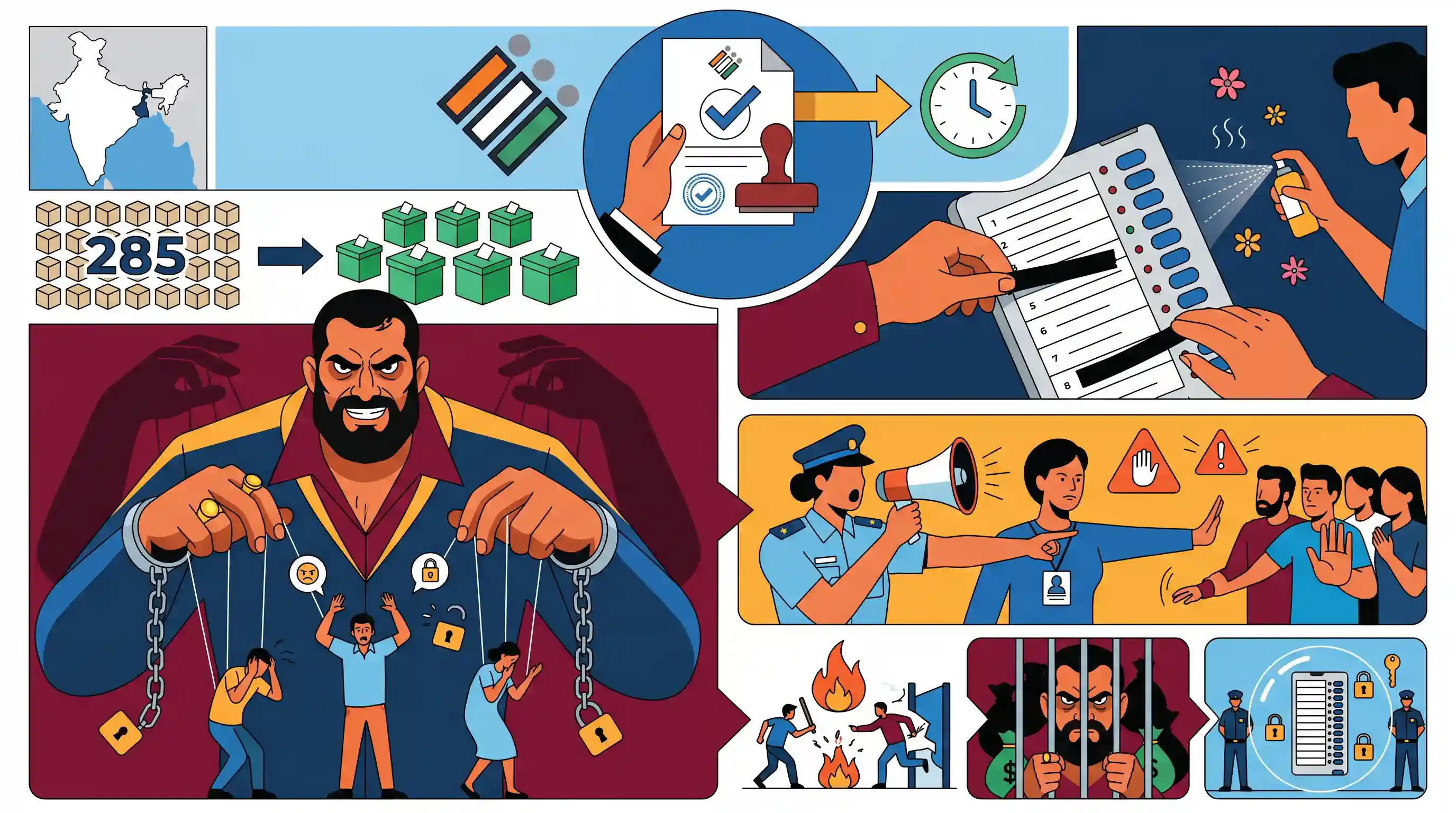
The Election Commission of India (ECI) has ordered a rare full repoll in all 285 polling stations of the Falta Assembly constituency in West Bengal, citing severe electoral offenses and subversion of the democratic process. Opposition parties alleged manipulation of EVM ballot units using black tape and perfume. The constituency is a stronghold of TMC strongman Jahangir Khan, who is accused of using fear and muscle power to dominate the area. The incident also highlighted the critical role of election observers, as Police Observer Ajay Pal Sharma issued public warnings to Khan's associates against voter intimidation. The case underscores ongoing challenges related to electoral violence, EVM security, and the criminalisation of politics in India.
Key Points
- The Election Commission ordered a full repoll in all 285 polling stations in the Falta Assembly constituency due to severe electoral offenses and subversion of the democratic process.
- Opposition candidates alleged that EVM ballot units were manipulated using black tape and perfume to influence the voting process.
- TMC strongman Jahangir Khan is accused of maintaining an iron grip over the Falta region through muscle power and fear, leading to allegations of voter intimidation.
- Police observer Ajay Pal Sharma issued stern warnings against political violence and coercion, highlighting the enforcement role of EC observers in volatile areas.
Important Terms
Election Commission of India (ECI)

The autonomous constitutional authority established under Article 324, responsible for administering elections to India’s Parliament, State Legislatures, and the offices of the President and Vice-President.
UPSC context
GS Paper II: Constitutional bodies; critical for understanding the mechanics of Indian democracy and electoral governance.
Repoll
A fresh election ordered by the ECI under Sections 58 or 58A of the Representation of the People Act, 1951, due to booth capturing, EVM tampering, or procedural irregularities.
UPSC context
GS Paper II: Electoral reforms and provisions of the RPA 1951 regarding the integrity of the polling process.
Election Observers
Senior officers (IAS, IPS, IRS) appointed under Section 20B of the RPA 1951 to act as the ECI’s "eyes and ears" on the ground to ensure free and fair polls.
UPSC context
GS Paper II: Appointment and role of constitutional/statutory functionaries in ensuring administrative transparency during elections.
Model Code of Conduct (MCC)
A set of guidelines issued by the ECI to regulate the conduct of political parties and candidates during elections to ensure fairness and prevent the misuse of official machinery.
UPSC context
GS Paper II: Governance and electoral reforms; specifically the ECI’s regulatory powers and ethical campaigning standards.
Criminalisation of Politics
The entry of individuals with criminal backgrounds into the electoral process and legislatures, often using money and muscle power to influence outcomes and undermine the rule of law.
UPSC context
GS Paper II: Salient features of the RPA and challenges to the Indian democratic system.
Electronic Voting Machine (EVM)
A microcontroller-based device used for recording and counting votes. It includes a Ballot Unit, Control Unit, and often a VVPAT for paper-based verification of the cast vote.
UPSC context
GS Paper II: Use of technology in elections and administrative measures to ensure electoral transparency.
Prelims Trap
Election Observers have independent statutory powers to declare a poll void and order a constituency-wide repoll.
Observers can direct the Returning Officer to halt counting under Section 20B, but declaring a poll void and ordering a repoll is strictly the ECI's statutory power under Sections 58/58A.
Static Concepts Connected
What is the legal basis for the ECI to order a repoll?
- RPA 1951: Sections 58 and 58A empower the ECI to void a poll and mandate fresh polling due to EVM tampering, ballot destruction, or booth capturing.
- Article 324: The Supreme Court views this article as a 'reservoir of power' enabling the ECI to act in contingencies not explicitly covered by statutory law.
What are the statutory powers of ECI Election Observers?
- Section 20B: Under the RPA 1951, Observers are statutory authorities nominated directly by the ECI to oversee the electoral process.
- Intervention powers: They possess the power to direct the Returning Officer to halt vote counting or withhold result declarations if booth capturing or ballot tampering occurs.
Cross-Topic Patterns
EVM Security and VVPAT debates
Allegations of physical EVM manipulation highlight Section 61A of the RPA 1951, often tested alongside cyber-security and the Supreme Court's VVPAT cross-verification guidelines.
Undue Influence & Criminalisation of Politics
Voter intimidation by political strongmen connects to 'undue influence' defined as a corrupt practice under Section 123(2) of the RPA, linking to ADR guidelines on candidate criminal records.

Expect a 2026 Prelims question contrasting statutory powers of Election Observers (Sec 20B) vs ECI's repoll powers under RPA Sec 58/58A.
Linked PYQs · 4
Linked PYQs · 4
- 2018MainsGS2
In the light of recent controversy regarding the use of Electronic Voting Machines (EVM), what are the challenges before the Election Commission of India to ensure the trustworthiness of elections in India?
- 2022MainsGS2
Discuss the role of the Election Commission of India in the light of the evolution of the Model Code of Conduct.
- 2024MainsGS2
Examine the need for electoral reforms as suggested by various committees with particular reference to "one nation one election" principle.
- 2025MainsGS2
Discuss the 'corrupt practices' for the purpose of the Representation of the People Act, 1951. Analyze whether the increase in the assets of the legislators and/or their associates, disproportionate to their known sources of income, would constitute 'undue influence' and consequently a corrupt practice.
