PUCL Condemns Census Data Manipulation in Rajasthan
Source:sabrangindia ↗
Why It Matters
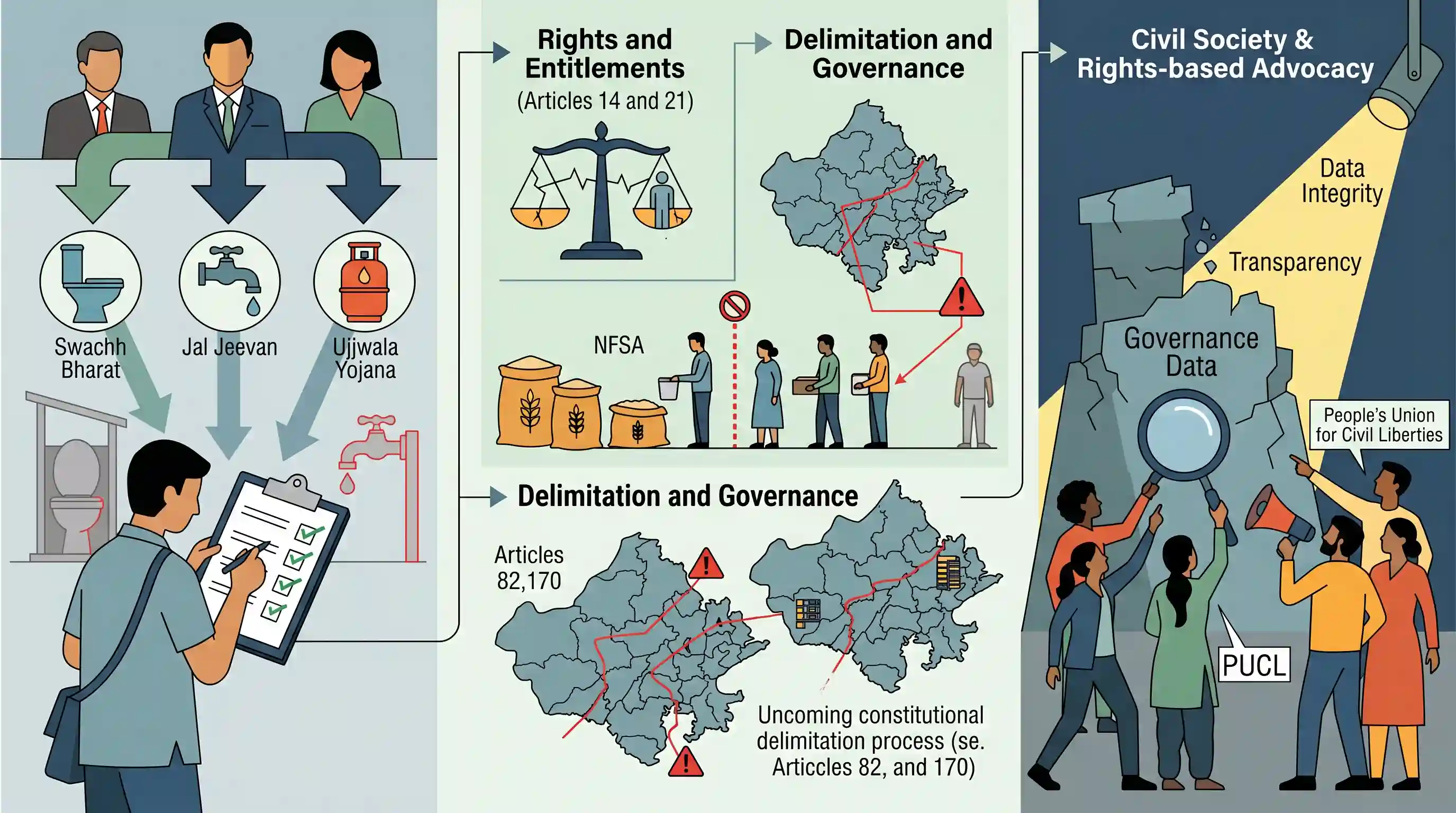
This issue highlights a fundamental governance and policy conflict: the pressure on lower administration to report inflated performance statistics versus the need for objective national demographic data. Manipulating such data directly compromises federal devolution, welfare targeting (like NFSA food subsidies), and electoral representation (delimitation).
Summary
The People's Union for Civil Liberties (PUCL) has raised major alarms regarding alleged administrative manipulation of the Census House listing Operations in Rajasthan. According to PUCL, enumerators are being pressured to record false data to align with high government targets under schemes like Swachh Bharat, Jal Jeevan, and PM Ujjwala Yojana. PUCL stresses that falsified statistics threaten fundamental human rights (Articles 14 and 21), distort entitlement programs like the National Food Security Act, and undermine the upcoming constitutional delimitation process.
Key Points
- PUCL Rajasthan has condemned systematic data manipulation in the Census House listing Operations (HLO) in Rajasthan, alleging pressure on enumerators to distort ground realities.
- A letter from the Director of Census Operations, Rajasthan, issued on June 2, 2026, reportedly directed district officials to 'correct discrepancies'—which PUCL claims is code for altering data to match state flagship scheme claims.
- Enumerators (mainly teachers and Anganwadi workers) are allegedly forced to falsify digital data on the CMMS portal, marking open-defecation households as toilet-owners, firewood users as LPG users, and mud houses as concrete structures.
- PUCL argues that manipulating census statistics violates Article 14 (Equality) and Article 21 (Dignity) by excluding genuine beneficiaries from critical schemes, including the National Food Security Act (NFSA).
- Census data has long-term constitutional significance under Articles 82 and 170, as it underpins upcoming delimitation of electoral constituencies, legislative seats, and central financial resource allocation.
Important Terms
Census Act 1948

A 1948 statute establishing the legal framework for conducting India's population census. It mandates public cooperation and guarantees absolute data confidentiality, preventing census records from being used as legal evidence.
UPSC context
GS Paper II (Polity & Governance). Tests understanding of demographic governance, statutory frameworks for nationwide statistical exercises, and privacy safeguards.
Office of the Registrar General and Census Commissioner
An office under the Ministry of Home Affairs responsible for conducting India’s decennial census and coordinating the registration of births and deaths under the civil registration system.
UPSC context
GS Paper II (Polity & Governance). Tests knowledge of administrative structures executing crucial data-gathering exercises that underpin welfare allocation and constituency delimitation.
National Food Security Act (NFSA) 2013
A landmark law shifting India's food security from a welfare to a rights-based approach. It legally entitles up to 75% of rural and 50% of urban populations to highly subsidized foodgrains.
UPSC context
GS Paper II (Social Justice/Welfare Schemes). Tests knowledge of rights-based legislation, food security challenges, and nutrition governance.
Articles 82 and 170 of the Constitution
Constitutional provisions detailing delimitation. Article 82 empowers Parliament to enact a Delimitation Act post-census, while Article 170 mandates corresponding division of states into territorial constituencies.
UPSC context
GS Paper II (Constitutional Provisions/Elections). Tests understanding of federal representation, redrawing electoral boundaries, and demographic linkages to legislative seats.
People's Union for Civil Liberties (PUCL)
A prominent human rights organization formed in 1976 by Jayaprakash Narayan to defend fundamental civil liberties, challenge state overreach, and advocate for democratic rights and marginalized communities in India.
UPSC context
GS Paper II (Polity/Civil Society). Tests knowledge of the role of non-governmental groups, public advocacy, and key judicial interventions in protecting fundamental rights.
Jal Jeevan Mission (JJM)
A flagship initiative under the Ministry of Jal Shakti aiming to provide safe and adequate drinking water through Functional Household Tap Connections (FHTCs) to all rural households in India.
UPSC context
GS Paper II & III (Welfare Schemes/Infrastructure). Tests knowledge of rural development, decentralised water governance, and public health policies.
Pradhan Mantri Ujjwala Yojana (PMUY)
A flagship scheme launched in 2016 to provide clean cooking fuel (LPG connections) to women of below-poverty-line (BPL) households, mitigating indoor air pollution and protecting health.
UPSC context
GS Paper II & III (Welfare Schemes/Energy Access). Tests understanding of gender empowerment, energy transition, clean cooking, and public health policies.
Prelims Trap
Individual census records collected under the Census Act, 1948 are open to judicial inspection and can be used as evidence in courts.
Section 17A of the Census Act, 1948 imposes an absolute statutory bar of confidentiality; individual census records are inadmissible as evidence and closed to inspection.
Static Concepts Connected
What is the constitutional and statutory framework governing the Census in India?
- Union Subject: Listed under Entry 69 of the Union List (List I) in the Seventh Schedule, making it an exclusive central subject.
- Statutory Base: Conducted under the Census Act, 1948, which guarantees absolute statutory confidentiality of individual data.
- Administrative Authority: Headed by the Registrar General and Census Commissioner of India under the Ministry of Home Affairs.
What is the constitutional position of the Delimitation Commission?
- Constitutional Mandate: Constituency boundaries are redrawn under Articles 82 (Parliament) and 170 (State Assemblies) based on post-census demographic shifts.
- Judicial Immunity: Article 329(a) bars any court from questioning the validity of laws relating to the delimitation of constituencies.
- Binding Orders: Its orders have the force of law and cannot be modified or vetoed even by Parliament once published.
Cross-Topic Patterns
Target-driven data skewing vs Welfare outcomes
Inflating administrative performance indicators leads to systematic exclusion of genuine beneficiaries from rights-based safety nets like the NFSA.
Demographics, Delimitation, and Federalism
Using updated census data for delimitation under Articles 82 and 170 creates representation imbalances between fast-growing and demographically stabilized states.

The constitutional link between Census data, Article 82 delimitation, and the absolute bar under Article 329(a) is highly likely for 2026 Polity.
Linked PYQs · 3
Linked PYQs · 3
- 2024RPSC_PRELIMSGS1
Consider the following statements regarding 'National Food Security Act': A. It legally entitles up to 75% of the rural population and 50% of the urban population to receive subsidized food grains. B. It covers up to 67 cross persons.
- 2023RPSC_PRELIMSGS1
Identify the incorrect statement regarding the Menaka Gandhi case, 1978, concerning the judicial interpretation of Article 21.
- 2023RPSC_PRELIMSGS1
Consider the following statements regarding the Rajasthan State Human Rights Commission: (i) According to the provisions of the Human Rights Protection (Amendment) Act, 2006, the Commission has one Chairman and four members. (ii) Currently, Justice Gopal Krishna Vyas is the Chairman.
