Policy gaps and technology transfer in India electric vehicle push
Source:The Hindu ↗
Why It Matters
EV transition and domestic manufacturing are key components of India's industrial and climate policy. Understanding the shortcomings of schemes like SPMEPCI and FAME, especially regarding technology transfer and supply chain resilience (batteries), is vital for GS Paper 3 (Economy, Technology, and Environment).
Summary
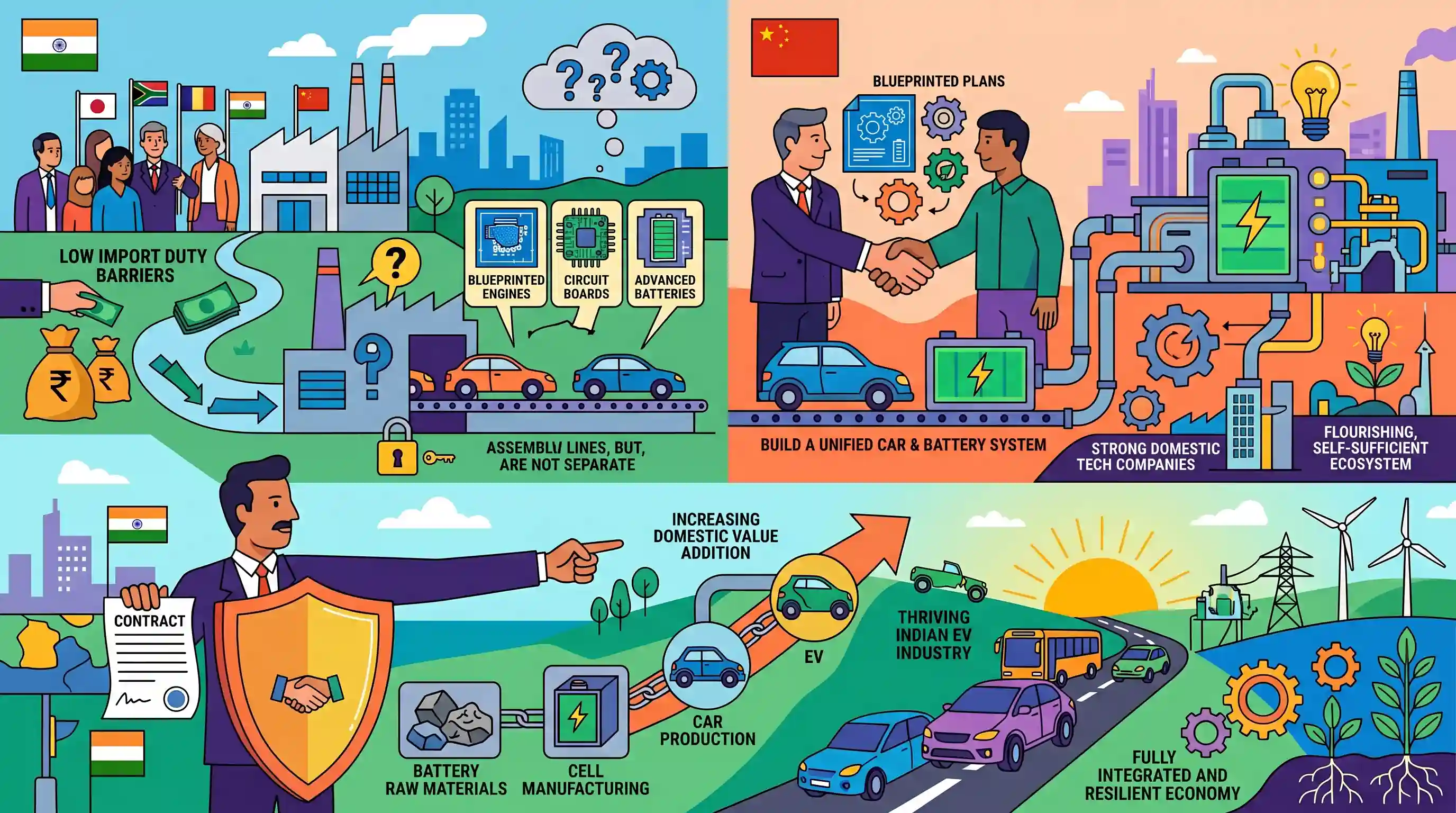
The editorial critiques India's approach to electric vehicle (EV) manufacturing, specifically analyzing the new Scheme to Promote Manufacturing of Electric Passenger Cars in India (SPMEPCI). While the scheme aims to attract foreign investment by offering concessional import duties tied to domestic value addition targets, it crucially fails to mandate technology transfer. The author contrasts this with China's successful strategy of forcing foreign automakers into joint ventures to acquire critical technology, particularly in battery manufacturing. The article argues that India's previous initiatives, like the FAME scheme, missed the opportunity to develop indigenous battery technology, and urges the government to enforce joint ventures to secure essential technological know-how for a self-reliant EV ecosystem.
Key Points
- The new Scheme to Promote Manufacturing of Electric Passenger Cars in India (SPMEPCI) offers a concessional 15% import duty linked to local investment and Domestic Value Addition (DVA) targets.
- A critical shortcoming of the SPMEPCI is its failure to mandate technology transfer, particularly for EV battery manufacturing.
- India's EV journey, starting with the FAME scheme in 2015, focused on subsidies and component localization but neglected core battery technology development.
- China successfully built a dominant EV ecosystem by mandating joint ventures that forced technology transfer alongside massive subsidies.
- India should leverage its domestic market size to mandate joint ventures in the EV sector, ensuring the acquisition of crucial battery technology similar to its historical success in ICE vehicle manufacturing.
Important Terms
Scheme to Promote Manufacturing of Electric Passenger Cars in India (SPMEPCI)

A 2024 policy by the Ministry of Heavy Industries providing 15% concessional import duties for EVs to manufacturers investing at least $500 million and meeting local manufacturing targets.
UPSC context
GS Paper 3 (Industrial Policy); tests understanding of investment-linked incentives and 'Make in India' in the automotive sector.
Faster Adoption and Manufacturing of (Hybrid and) Electric Vehicles (FAME)
India's flagship subsidy scheme launched in 2015 to incentivize the purchase of electric/hybrid vehicles and develop charging infrastructure under the National Electric Mobility Mission Plan.
UPSC context
GS Paper 3 (Environment/Infrastructure); evaluates demand-side interventions for climate goals and sustainable urban transport.
Production Linked Incentive (PLI)
A scheme providing financial incentives to manufacturers based on incremental sales of locally produced goods, covering 14 sectors including 'Automobile and Auto Components' and 'Advanced Chemistry Cells.'
UPSC context
GS Paper 3 (Economy); core to discussions on Atmanirbhar Bharat, manufacturing competitiveness, and supply chain resilience.
Domestic Value Addition (DVA)
The share of a product's value added during domestic manufacturing; it is a mandatory metric for firms to qualify for incentives under India's recent industrial policies.
UPSC context
GS Paper 3 (Industrial Development); measures the effectiveness of localization and indigenization strategies in global value chains.
Technology Transfer
The process of acquiring technical know-how and intellectual property from foreign firms, often facilitated through joint ventures to build indigenous manufacturing and R&D capabilities.
UPSC context
GS Paper 3 (Science & Tech); critical for analyzing India's transition from an assembly hub to a high-tech manufacturer.
Advanced Chemistry Cell (ACC)
Next-generation energy storage technologies (e.g., lithium-ion) targeted under a specific ₹18,100 crore PLI scheme to reduce India's reliance on imported battery cells.
UPSC context
GS Paper 3 (Energy Security); relates to critical minerals and the technological backbone of the electric mobility transition.
Prelims Trap
Under SPMEPCI, foreign automakers must transfer core battery technology to Indian partners to avail concessional 15% import duty.
SPMEPCI mandates minimum investment (₹4,150 crore) and 50% Domestic Value Addition (DVA) within five years, but explicitly lacks mandatory technology transfer.
Static Concepts Connected
How does the FAME scheme differ from PLI/SPMEPCI in the EV sector?
- FAME Scheme: Focuses primarily on demand-side subsidies to reduce upfront EV purchase costs and supports the rollout of charging infrastructure.
- PLI and SPMEPCI: Supply-side interventions targeting domestic manufacturing, offering incentives/duty cuts linked to Domestic Value Addition (DVA) and fresh capital investments.
What is Domestic Value Addition (DVA) in India's industrial schemes?
- Definition: The percentage of a product's final value that is added within the domestic economy through local sourcing, labor, and manufacturing processes.
- Policy Purpose: Prevents mere "screwdriver assembly" of imported knocked-down kits by forcing manufacturers to develop a deeper, localized supply chain over time.
Cross-Topic Patterns
DVA targets + PLI scheme architecture
The SPMEPCI’s reliance on DVA rather than technology transfer mirrors India's broader PLI strategy, which often incentivizes localized assembly without securing foundational intellectual property.
Battery Tech + Critical Mineral Diplomacy
The lack of indigenous battery cell technology heightens the strategic importance of India's Mines Ministry (KABIL) securing upstream lithium and cobalt assets in Argentina and Australia.

Expect a 2026 prelims question contrasting SPMEPCI's supply-side DVA targets with FAME's demand subsidies, noting the tech-transfer gap.
Linked PYQs · 2
Linked PYQs · 2
- 2023MainsGS3
The adoption of electric vehicles is rapidly growing worldwide. How do electric vehicles contribute to reducing carbon emissions and what are the key benefits they offer compared to traditional combustion engine vehicles?
- 2025MainsGS3
Discuss the rationale of the Production Linked Incentive (PLI) scheme. What are its achievements? In what way can the functioning and outcomes of the scheme be improved?
