Mumbai Urban Infrastructure Vulnerability to Monsoons
Source:The Hindu ↗
Why It Matters
The article is highly relevant for UPSC aspirants as it combines elements of physical geography (monsoonal behavior, coastal topography), disaster management (urban flooding dynamics), and urban planning/governance (split institutional accountability). It provides a case study of how legacy infrastructure systems designed on historical trends are failing under climate-induced extreme weather events.
Summary
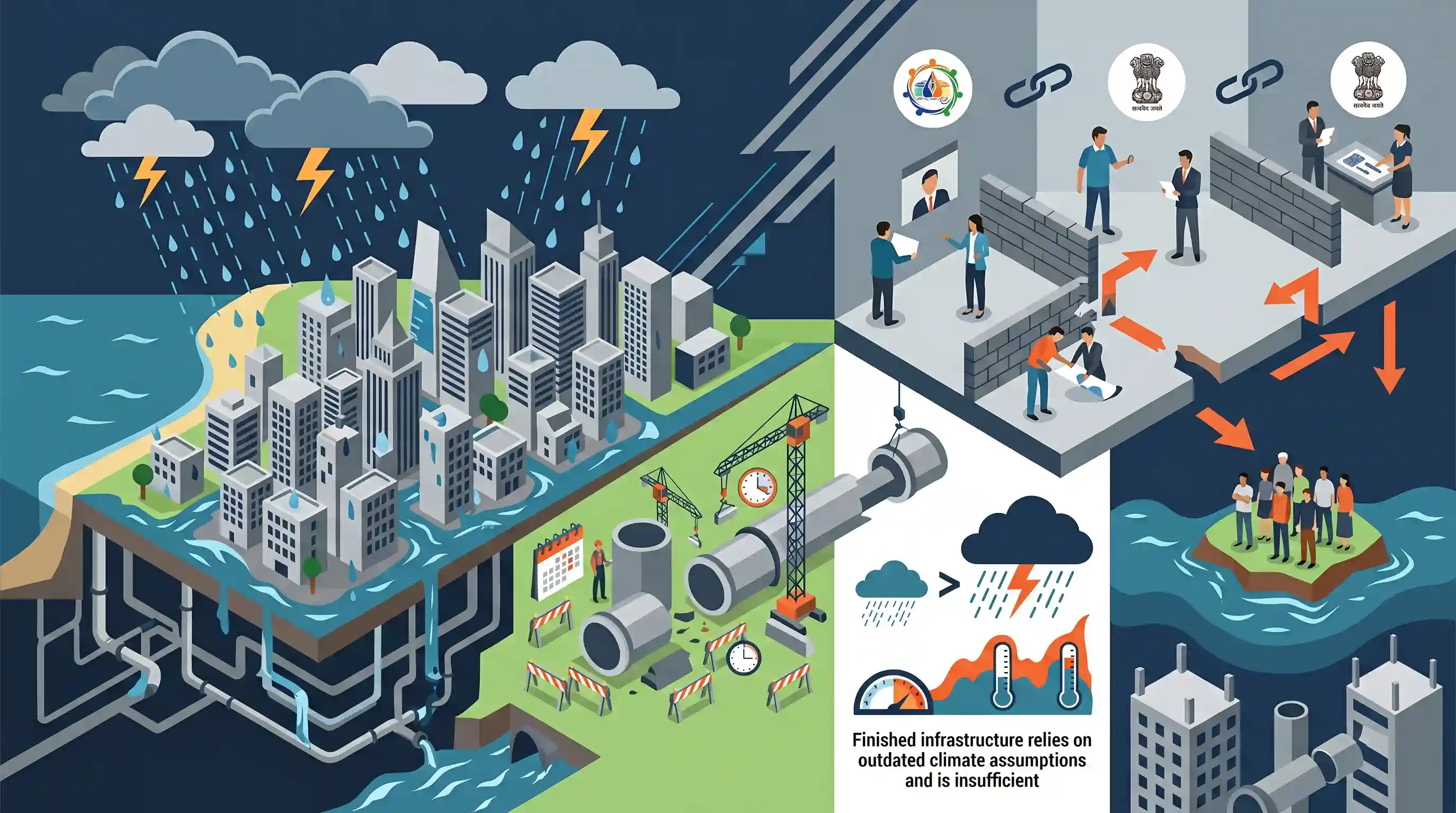
The editorial examines the systemic vulnerabilities of Mumbai's infrastructure in the face of intense Southwest monsoon rainfall. It highlights how the city's low-lying coastal geography, rapid but haphazard urbanisation, and concrete-driven land use overwhelm municipal drainage capacity. Despite launching the BRIMSTOWAD drainage project after the 2005 floods, execution remains sluggish, and finished systems rely on outdated climate assumptions. Furthermore, fragmented governance across various local, state, and central agencies severely hampers comprehensive flood mitigation and risk-reduction efforts, illustrating that simply waiting for infrastructure capacity to catch up is a failing climate strategy.
Key Points
- The highly active Southwest monsoon and southwesterly winds routed extreme moisture over the Western Ghats and Konkan coast, highlighting that high-intensity rainfall bursts are far more destructive to urban networks than overall rainfall volume.
- Mumbai's geography—predominantly constructed on reclaimed land, tidal flats, former marshes, and low-lying coastal areas—naturally causes severe flooding when extreme rainfall events coincide with high tides that block drainage outlets.
- Haphazard urbanisation has drastically reduced natural ground permeability, amplifying surface runoff and exceeding the limits of municipal drainage networks.
- The BRIMSTOWAD drainage project, launched in the wake of Mumbai's historic July 2005 deluge, remains incomplete. Moreover, the completed sections are based on legacy meteorological assumptions that have since been outdated by climate change-induced variations in rainfall intensity.
- Linear infrastructure projects (highways, expressways, and railways) are highly vulnerable to monsoon impacts, as seen in landslides at Bhor Ghat and severe flooding on key expressways, leading to cascading transportation failures.
- Urban disaster management suffers from split and fragmented accountability across multiple agencies including the BMC, the IMD, the state government, railway zones, and highway authorities, highlighting a structural governance lapse in metropolitan planning.
Important Terms
BRIMSTOWAD project (Brihanmumbai Storm Water Disposal System)

A comprehensive master plan and infrastructure project designed to upgrade Mumbai's outdated drainage system, increasing its stormwater disposal capacity from 25 mm/hour to 50 mm/hour with pumping stations.
UPSC context
GS-3 (Disaster Management, Infrastructure) and GS-1 (Urbanisation); tests knowledge of urban flooding mitigation strategies and municipal infrastructure challenges.
Brihanmumbai Municipal Corporation (BMC)
Also known as the Municipal Corporation of Greater Mumbai, it is India’s richest civic body, responsible for the municipal administration, urban planning, and civic infrastructure of Mumbai.
UPSC context
GS-2 (Urban Local Governance, 74th Amendment Act); tests understanding of municipal decentralisation, administrative challenges, and local self-government in megacities.
India Meteorological Department (IMD)
Established in 1875 under the Ministry of Earth Sciences, it is the principal government agency responsible for weather forecasting, climate observations, and early warnings for natural disasters in India.
UPSC context
GS-1 (Climatology/Monsoons) and GS-3 (Disaster Management); tests knowledge of early warning systems, weather forecasting mechanisms, and disaster preparedness agencies.
National Disaster Response Force (NDRF)
A specialized, multi-disciplinary force constituted under the Disaster Management Act, 2005, tasked with delivering rapid, specialized response to natural and man-made disasters across India.
UPSC context
GS-3 (Disaster Management); tests understanding of India's statutory disaster response framework, institutional mechanisms, and emergency relief operations.
Prelims Trap
Gravity-based urban storm drainage systems can discharge runoff continuously during high tides if outlet gates are kept open.
Opening gates during high tides causes seawater intrusion rather than runoff drainage. The tide-lock effect forces gates to shut, halting gravity drainage until low tide.
Static Concepts Connected
What physical and anthropogenic factors cause the Tide-Lock effect in coastal cities?
- Astronomical Tides: Seawater levels rise above drainage outfall levels, blocking gravity-based discharge of urban runoff.
- Siltation and Debris: Estuarine outlets suffer heavy sediment deposition, reducing the gradient and cross-sectional area of drains.
- Sea Level Rise: Climate-induced sea-level rise permanently reduces the elevation head-difference needed for gravity-driven flow.
Cross-Topic Patterns
Urban Wetlands vs. Coastal Real Estate
Dilution of Coastal Regulation Zone rules compromises natural sponge infrastructure, directly compounding the disaster vulnerability of metropolitan coastal economies.
74th Amendment & Fragmented Governance
Overlapping municipal and parastatal jurisdictions highlight the weakness of Metropolitan Planning Committees in executing unified climate-resilient regional masterplans.

Mains 2026 may evaluate non-structural flood mitigation tools like IFLOWS against legacy concrete infrastructure projects like BRIMSTOWAD.
Linked PYQs · 3
Linked PYQs · 3
- 2024MainsGS3
Flooding in urban areas is an emerging climate-induced disaster. Discuss the causes of this disaster. Mention the features of two such major floods in the last two decades in India. Describe the policies and frameworks in India that aim at tackling such floods.
- 2020MainsGS1
Account for the huge flooding of million cities in India including the smart ones like Hyderabad and Pune. Suggest lasting remedial measures.
- 2016MainsGS1
Major cities of India are becoming more vulnerable to flood conditions. Discuss.
