Scheduled Caste Reservation Criteria and Religious Convert Inclusion
Source:The Hindu ↗
Why It Matters
The article covers a critical intersection of religion, caste, and constitutional rights. The debate over whether to grant Scheduled Caste status to Dalit Christians and Muslims directly ties to the UPSC themes of social justice, the evolution of constitutional provisions (Article 341), and the limits of judicial versus legislative power in defining vulnerable sections for reservation and protection.
Summary
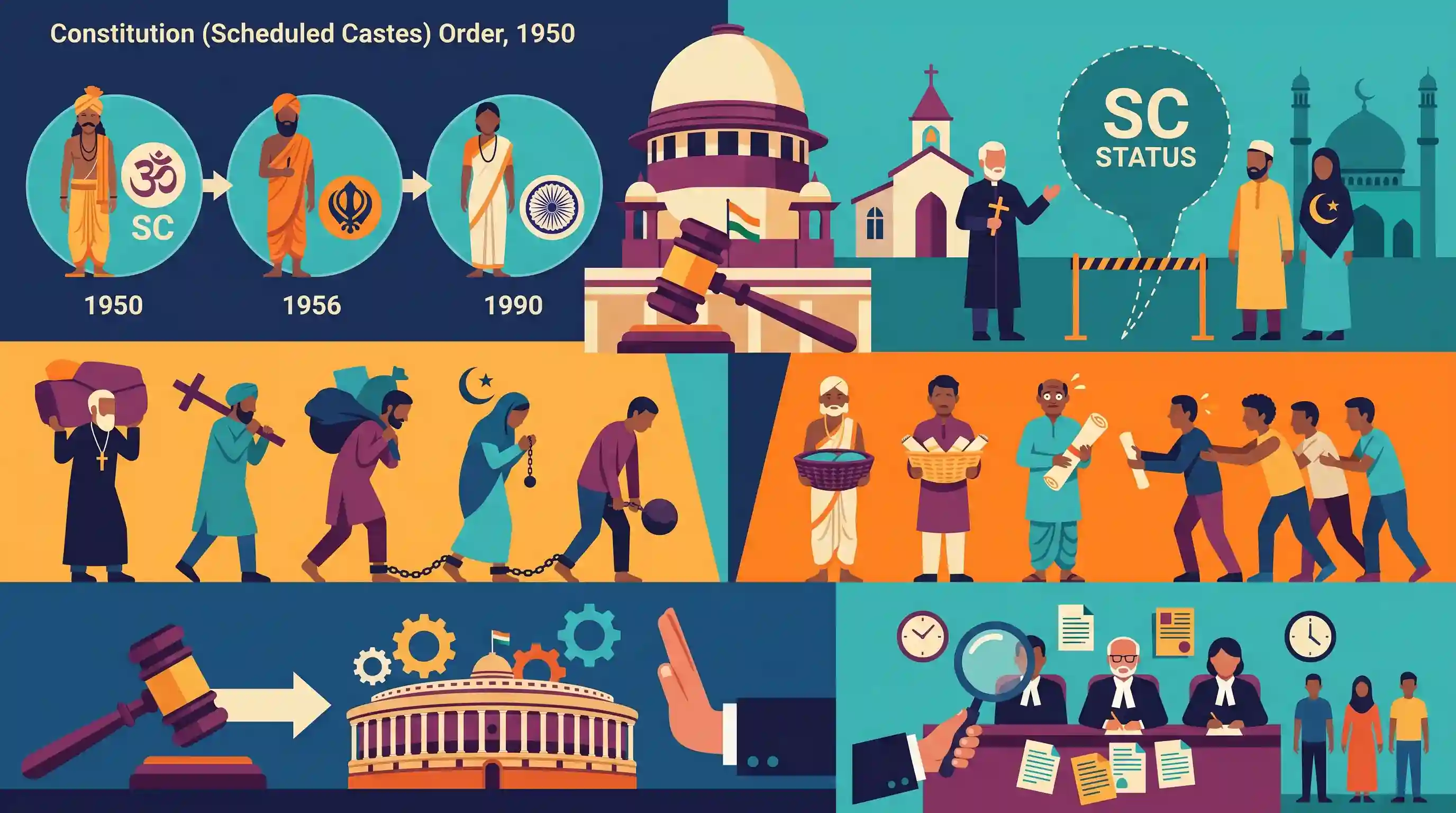
The Supreme Court of India recently reiterated that protections afforded to Scheduled Castes (SCs), such as those under the SC/ST (Prevention of Atrocities) Act, are legally restricted to Hindus, Sikhs, and Buddhists, excluding Dalit Christians and Muslims. Stemming from a case involving a Christian pastor in Andhra Pradesh, the ruling highlights the framework of the Constitution (Scheduled Castes) Order, 1950, which initially recognized only Hindu Dalits and was later amended to include Sikhs (1956) and Buddhists (1990). The Court emphasized that expanding the definition to include other religions falls outside judicial purview and requires legislative action by Parliament. This exclusion remains highly contentious; advocates argue that untouchability and discrimination persist despite religious conversion, while opponents fear current SCs would face diluted benefits. The ongoing K.G. Balakrishnan Commission is tasked with comprehensively examining this complex issue of granting SC status to Dalits converted to Christianity and Islam.
Key Points
- The Supreme Court reaffirmed that Scheduled Caste (SC) protections, including the SC/ST Act, apply exclusively to individuals practising Hinduism, Sikhism, or Buddhism.
- The Constitution (Scheduled Castes) Order, 1950 originally recognized only Hindu Dalits, later adding Sikhs (1956) and Buddhists (1990) via amendments.
- The Court ruled it cannot judicially expand the SC definition to include Dalit Christians and Muslims; any such change requires legislative action by Parliament.
- Proponents of inclusion argue that caste-based discrimination continues post-conversion, while opponents argue inclusion would dilute benefits for existing SCs.
- The K.G. Balakrishnan Commission is currently examining the socio-legal implications of granting SC status to Dalits who converted to Islam and Christianity.
Important Terms
Constitution (Scheduled Castes) Order, 1950

A 1950 Presidential Order issued under Article 341 specifying which communities are deemed Scheduled Castes. It currently restricts SC status to followers of Hinduism, Sikhism, and Buddhism.
UPSC context
GS Paper II (Polity); understanding the constitutional and religious basis of reservation and affirmative action in India.
SC/ST (Prevention of Atrocities) Act, 1989
A landmark social justice law aimed at preventing crimes, discrimination, and humiliation against SC/ST members, providing for special courts and relief for victims.
UPSC context
GS Paper II (Social Justice); critical for topics on vulnerable sections and legal mechanisms for their protection.
K.G. Balakrishnan Commission
A three-member panel appointed in 2022 to examine if Scheduled Caste status should be extended to Dalits who converted to religions like Christianity and Islam.
UPSC context
GS Paper II (Social Justice/Current Affairs); relevant for debates on the intersection of religion, caste, and reservation policy.
Article 341
Empowers the President to notify Scheduled Castes for a State/UT; it also stipulates that only Parliament can subsequently include or exclude any caste from the list.
UPSC context
GS Paper II (Polity); essential for understanding the distribution of power between the Executive, Legislature, and States regarding reservation.
Judicial Purview
The authority of courts to review and interpret laws; the Supreme Court recently clarified that modifying the SC list falls outside this and remains a legislative function.
UPSC context
GS Paper II (Judiciary); relates to the separation of powers and the doctrine of judicial restraint in policy matters.
Prelims Trap
"The President has the power to amend the Scheduled Castes list to include new castes."
Trap! The President only notifies the initial list. Article 341(2) vests exclusive power to amend (include/exclude) the SC list entirely with the Parliament.
Static Concepts Connected
What are the constitutional provisions for identifying Scheduled Castes?
- Article 341(1): The President notifies the initial list of SCs for a State/UT after consulting the Governor.
- Article 341(2): Only Parliament can enact legislation to include or exclude any caste from the President's initial list.
- Constitution Order 1950: Restricts SC eligibility to Hinduism, Sikhism, and Buddhism, excluding conceptually casteless religions like Islam and Christianity.
How does religious conversion affect ST and OBC status in India?
- ST status: ST classification is entirely religion-neutral. A person retains ST status even after converting to Christianity or Islam.
- OBC status: Central and state OBC lists are not restricted by religion. Many Dalit Muslims and Christians currently receive OBC reservations.
Cross-Topic Patterns
Article 15, 25 vs SC Order
Denying SC status upon conversion raises a constitutional tension between statutory reservation rules and Fundamental Rights (Articles 15 and 25) regarding religious discrimination and freedom of conscience.
Committees on minority backwardness
K.G. Balakrishnan joins a lineage of committees (Sachar, Ranganath Mishra) probing socio-economic marginalization post-conversion, linking Social Justice directly to Minority Affairs.

A 2026 prelims multi-statement question contrasting the religion-neutral ST criteria against the religion-restricted SC criteria is highly probable.
Linked PYQs · 3
Linked PYQs · 3
- 2018MainsGS2
Whether National Commission for Scheduled Castes (NCSC) can enforce the implementation of constitutional reservation for the Scheduled Castes in the religious minority institutions? Examine.
- 2015MainsGS1
Debate the issue of whether and how contemporary movements for assertion of Dalit identity work towards annihilation of caste.
- 2023PrelimsGS1
Consider the following statements: Statement-I: The Supreme Court of India has held in some judgements that the reservation policies made under Article 16(4) of the Constitution of India would be limited by Article 335 for maintenance of efficiency of administration. Statement-II: Article 335 of the Constitution of India defines the term 'efficiency of administration'. Which one of the following is correct in respect of the above statements?
