Scheduled Caste reservation benefits and religious conversion debate
Source:The Hindu ↗
Why It Matters
The intersection of religion, caste, and reservation is a critical aspect of India's social justice framework. Understanding the legal, constitutional (Article 341), and sociological dimensions of extending SC status to religious converts is highly relevant for both GS1 (Society) and GS2 (Polity and Governance).
Summary
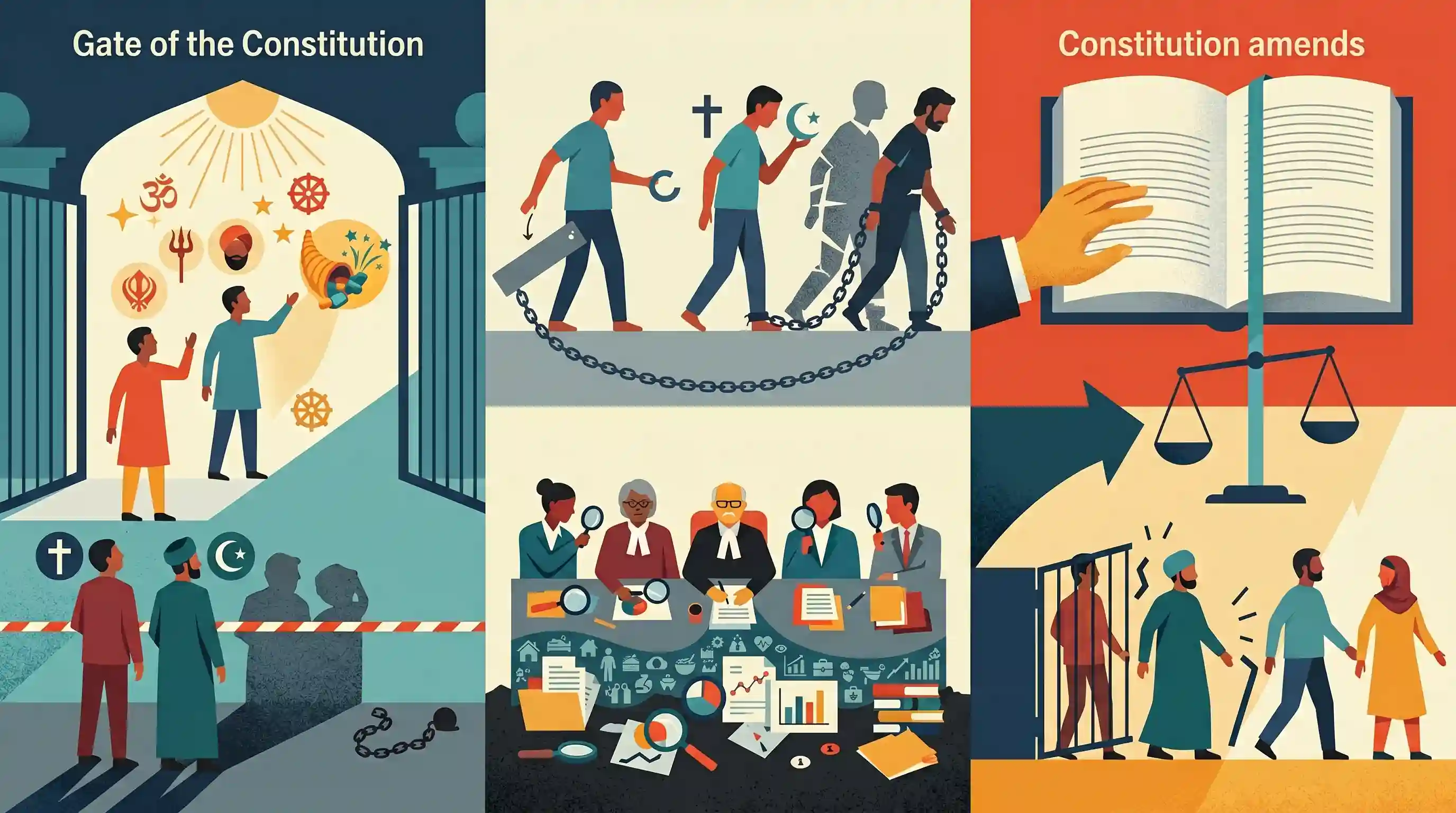
The editorial analyzes the ongoing debate and legal battle regarding the exclusion of Dalit Christians and Muslims from the benefits of Scheduled Caste (SC) reservations. Under the Constitution (Scheduled Castes) Order of 1950, only Hindus, Sikhs, and Buddhists are recognized as SCs, based on the assumption that caste and untouchability are unique to these religions. However, advocates argue that conversion to Christianity or Islam does not erase the entrenched social stigma and backwardness faced by Dalits. The article highlights the role of the K.G. Balakrishnan Commission, which is currently examining this issue, and argues that the assessment should rely on empirical realities of discrimination rather than theoretical religious tenets.
Key Points
- The Constitution (Scheduled Castes) Order, 1950 limits SC reservation to Hindus, Sikhs (added 1956), and Buddhists (added 1990), excluding Dalit Christians and Muslims.
- Petitions seeking to extend SC status to Christian and Muslim converts from SC backgrounds are currently pending before the Supreme Court.
- The K.G. Balakrishnan Commission was formed to study the sociological and historical aspects of extending SC status to Dalit Christians and Muslims.
- A key debate centers on whether the social stigma of untouchability disappears upon conversion to egalitarian religions like Islam and Christianity.
- The editorial suggests that empirical evidence of ongoing social backwardness and discrimination should take precedence over theological arguments about caste in egalitarian religions.
Important Terms
Constitution (Scheduled Castes) Order, 1950

A Presidential Order issued under Article 341 identifying castes eligible for reservation. Its Paragraph 3 restricts Scheduled Caste status to those professing Hindu, Sikh, or Buddhist religions.
UPSC context
GS Paper II (Polity/Social Justice); crucial for understanding the legal basis and religious limitations of SC reservations.
Article 341
Constitutional provision empowering the President to specify Scheduled Castes via public notification. It mandates that any subsequent inclusion or exclusion from this list requires an Act of Parliament.
UPSC context
GS Paper II (Polity); tests knowledge of the executive vs. legislative powers in defining vulnerable sections.
K.G. Balakrishnan Commission
A three-member panel established in 2022 to examine whether Scheduled Caste status can be extended to Dalits who have converted to religions like Christianity or Islam.
UPSC context
GS Paper II (Social Justice); relevant for current developments in reservation policy and minority rights.
National Commission for Religious and Linguistic Minorities
A 2004 body (Ranganath Misra Commission) that recommended delinking Scheduled Caste status from religion, advocating for a religion-neutral approach similar to that used for Scheduled Tribes.
UPSC context
GS Paper II (Governance/Social Justice); provides historical/recommendation context for the Dalit Christian/Muslim reservation debate.
Paragraph 3 (SC Order)
The specific provision in the 1950 Order that mandates only Hindus, Sikhs, and Buddhists can be deemed members of a Scheduled Caste, excluding Dalit converts to other faiths.
UPSC context
GS Paper II (Polity); the specific legal 'bar' currently under judicial and commission review.
Article 25(2)(b)
Empowers the State to make laws for social reform, notably including Sikhs, Jains, and Buddhists within the definition of 'Hindus' for the purpose of opening public religious institutions.
UPSC context
GS Paper II (Fundamental Rights); highlights the constitutional precedent for treating specific religions as part of the broader Hindu social framework.
Prelims Trap
"Conversion to Christianity or Islam strips a person of both their Scheduled Caste (SC) and Scheduled Tribe (ST) status."
ST and OBC categories are completely religion-neutral. Only the Scheduled Caste (SC) category is restricted to Hindus, Sikhs, and Buddhists under the 1950 Presidential Order.
Static Concepts Connected
How are Scheduled Castes legally notified under the Indian Constitution?
- Presidential Power: Under Article 341(1), the President notifies the initial list of SCs for a State or UT after consulting the Governor.
- Parliamentary Authority: Under Article 341(2), only Parliament can include or exclude any caste from this initial Presidential list via legislation.
- Religious Restriction: The Constitution (Scheduled Castes) Order, 1950 legally restricts SC status to Hindus, Sikhs, and Buddhists.
Which key commissions have examined the SC status of Dalit converts?
- Ranganath Misra (2007): Recommended making SC status completely religion-neutral like STs, but was rejected by the government citing a lack of empirical field data.
- K.G. Balakrishnan (2022): Currently evaluating the socio-economic conditions and historical aspects of granting SC status to Dalits who converted to Christianity and Islam.
Cross-Topic Patterns
Religion-Neutrality in Quotas
While affirmative action targets backwardness, the SC Order creates a legal anomaly: ST and OBC lists are entirely religion-neutral, whereas SC lists strictly demand adherence to Hinduism, Sikhism, or Buddhism.
Article 25 vs. State Affirmative Action
The debate highlights constitutional friction: whether denying protective SC status upon conversion economically penalizes a citizen's fundamental right to freely profess and practice the religion of their choice (Article 25).

Expect a Prelims question mixing Article 341 (Parliament's power to amend SC lists) with the religious exclusions of the 1950 Order.
Linked PYQs · 4
Linked PYQs · 4
- 2018MainsGS2
Whether National Commission for Scheduled Castes (NCSC) can enforce the implementation of constitutional reservation for the Scheduled Castes in the religious minority institutions? Examine.
- 2015MainsGS1
Debate the issue of whether and how contemporary movements for assertion of Dalit identity work towards annihilation of caste.
- 2024PrelimsGS1
Consider the following statements : 1. It is the Governor of the State who recognizes and declares any community of that State as a Scheduled Tribe. 2. A community declared as a Scheduled Tribe in a State need not be so in another State. Which of the statements given above is/are correct?
- 2023PrelimsGS1
Consider the following statements: Statement-I: The Supreme Court of India has held in some judgements that the reservation policies made under Article 16(4) of the Constitution of India would be limited by Article 335 for maintenance of efficiency of administration. Statement-II: Article 335 of the Constitution of India defines the term 'efficiency of administration'. Which one of the following is correct in respect of the above statements?
