PSLV C61 EOS 09 Mission Failure Analysis and ISRO Review
Source:The Hindu ↗
Why It Matters
Understanding the causes of launch vehicle failures and the subsequent review process is crucial for UPSC aspirants, as it demonstrates India's technological resilience, the operational complexities of space missions, and ISRO's accountability and quality assurance protocols in strategic sectors.
Summary
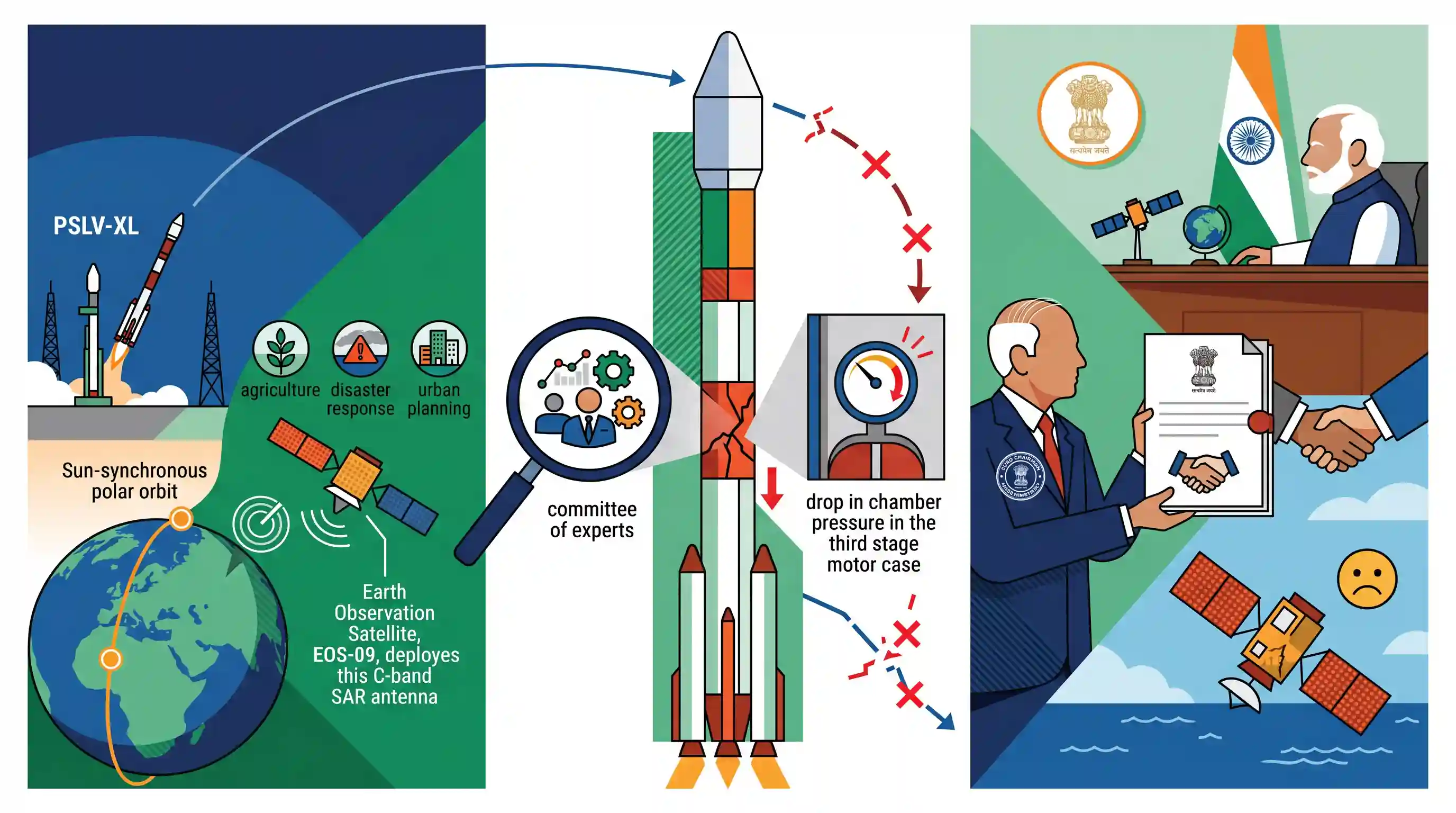
The Failure Analysis Committee investigating the May 2025 failure of ISRO's PSLV-C61/EOS-09 mission has completed its report. According to ISRO Chairman V. Narayanan, the mission failure was caused by a minor issue—a drop in chamber pressure within the motor case of the launch vehicle's third stage. The detailed report will be submitted to the Prime Minister soon. The mission's objective had been to position the Earth Observation Satellite-09 (EOS-09) in a sun-synchronous polar orbit.
Key Points
- The PSLV-C61/EOS-09 mission, launched to place the Earth Observation Satellite-09 into a sun-synchronous polar orbit, failed in May 2025.
- ISRO's Failure Analysis Committee has finalized its probe, citing a fall in chamber pressure in the third-stage motor case as the cause.
- ISRO Chairman V. Narayanan described the issue as relatively minor and confirmed that the final report will be submitted to the Prime Minister soon.
- The investigation highlights ISRO's robust post-mission review processes aimed at improving the reliability of its workhorse launch vehicles.
Important Terms
PSLV-C61/EOS-09 mission

ISRO's 101st launch attempt in May 2025, which failed when the rocket's third stage experienced a sudden drop in combustion chamber pressure, preventing it from deploying the EOS-09 satellite into orbit.
UPSC context
GS Paper III (Science & Technology): Tests knowledge of major space missions, launch vehicle reliability, and the causes of technical failures.
EOS-09 (Earth Observation Satellite-09)
An advanced 1,696 kg radar imaging satellite (RISAT-1B follow-on) designed for all-weather, day-and-night Earth observation using Synthetic Aperture Radar (SAR) for applications in agriculture, forestry, and disaster management.
UPSC context
GS Paper III (Science & Technology): Relates to satellite series, indigenous technology, and the strategic importance of Earth observation capabilities.
Failure Analysis Committee (FAC)
An expert body constituted by ISRO after a mission failure to review telemetry, identify technical or systemic root causes, and recommend corrective actions to ensure reliability in future launches.
UPSC context
GS Paper III (Science & Technology): Understanding ISRO's institutional mechanisms for accountability, quality control, and mission success assurance.
Sun-Synchronous Polar Orbit (SSPO)
A specialized geocentric orbit where a satellite passes over any given point of the Earth's surface at the same local solar time, essential for consistent illumination in Earth observation imaging.
UPSC context
GS Paper III (Space Technology): Tests conceptual understanding of different orbital regimes and their specific utility for various satellite missions.
V. Narayanan
The 11th Chairman of ISRO and Secretary of the Department of Space (assumed office Jan 2025); a cryogenic propulsion expert who previously directed the Liquid Propulsion Systems Centre (LPSC).
UPSC context
Prelims (Personalities): Identifying key leadership figures in India's premier scientific institutions and their areas of technical expertise.
PS3 (Third Stage)
A solid-propellant motor stage of the PSLV responsible for providing critical thrust in near-vacuum conditions; it was the specific site of the pressure anomaly in the PSLV-C61 failure.
UPSC context
GS Paper III (Science & Technology): In-depth understanding of launch vehicle components, stage-specific propulsion systems, and recurring technical challenges.
Prelims Trap
The PSLV's third stage uses a liquid propellant system that can be shut down during anomalies.
The PSLV is a four-stage vehicle alternating solid and liquid. The first and third stages are solid rocket motors, which cannot be throttled or shut down once ignited.
Static Concepts Connected
What is the stage configuration and propellant sequence of the PSLV?
- First Stage (PS1): Solid rocket motor, often augmented by strap-on boosters for extra thrust during lift-off.
- Second Stage (PS2): Liquid rocket engine (Vikas engine) using Earth-storable liquid propellant.
- Third Stage (PS3): Solid rocket motor providing high thrust after the atmospheric phase.
- Fourth Stage (PS4): Liquid twin-engine configuration for final orbital injection and payload positioning.
What defines a Sun-Synchronous Polar Orbit (SSPO)?
- Constant Solar Time: The satellite crosses the equator at the same local solar time on each pass, ensuring consistent sunlight angles.
- Primary Application: Used primarily for Earth Observation Satellites (EOS) because consistent illumination is vital for accurate optical remote sensing.
- Orbit Altitude: These are near-polar Low Earth Orbits (LEO), typically placed at altitudes between 600 to 800 km.
Cross-Topic Patterns
Space commercialization via NSIL
Transparent failure analysis is critical to maintaining NewSpace India Limited's (NSIL) credibility for securing international satellite launch contracts against competitors like SpaceX.
EOS and Disaster Management
Any delay in deploying Earth Observation assets directly impacts India's remote sensing capabilities, which are essential for GS-III topics like agriculture planning, forestry, and flood monitoring.

Expect a technical multi-statement question comparing solid vs liquid propulsion stages and throttle capabilities across PSLV, SSLV, and LVM3.
Linked PYQs · 2
Linked PYQs · 2
- 2018PrelimsGS1
With reference to India's satellite launch vehicles, consider the following statements: 1. PSLVs launch the satellites useful for Earth resources monitoring whereas GSLVs are designed mainly to launch communication satellites. 2. Satellites launched by PSLV appear to remain permanently fixed in the same position in the sky, as viewed from a particular location on Earth. 3. GSLV Mk III is a four-staged launch vehicle with the first and third stages using solid rocket motors; and the second and fourth stages using liquid rocket engines. Which of the statements given above is/are correct?
- 2023MainsGS3
What is the main task of India's third moon mission which could not be achieved in its earlier mission? List the countries that have achieved this task. Introduce the subsystems in the spacecraft launched and explain the role of the Virtual Launch Control Centre' at the Vikram Sarabhai Space Centre which contributed to the successful launch from Sriharikota.
