Severe Faecal Contamination Exceeds Water Quality Limits in Rivers
Source:The Hindu ↗
Why It Matters
Understanding indicators of water pollution (like coliform, BOD, and DO) and the statutory framework governing water quality (like EPA 1986 and CPCB) is highly relevant for both Prelims and Mains (GS3 Environment).
Summary
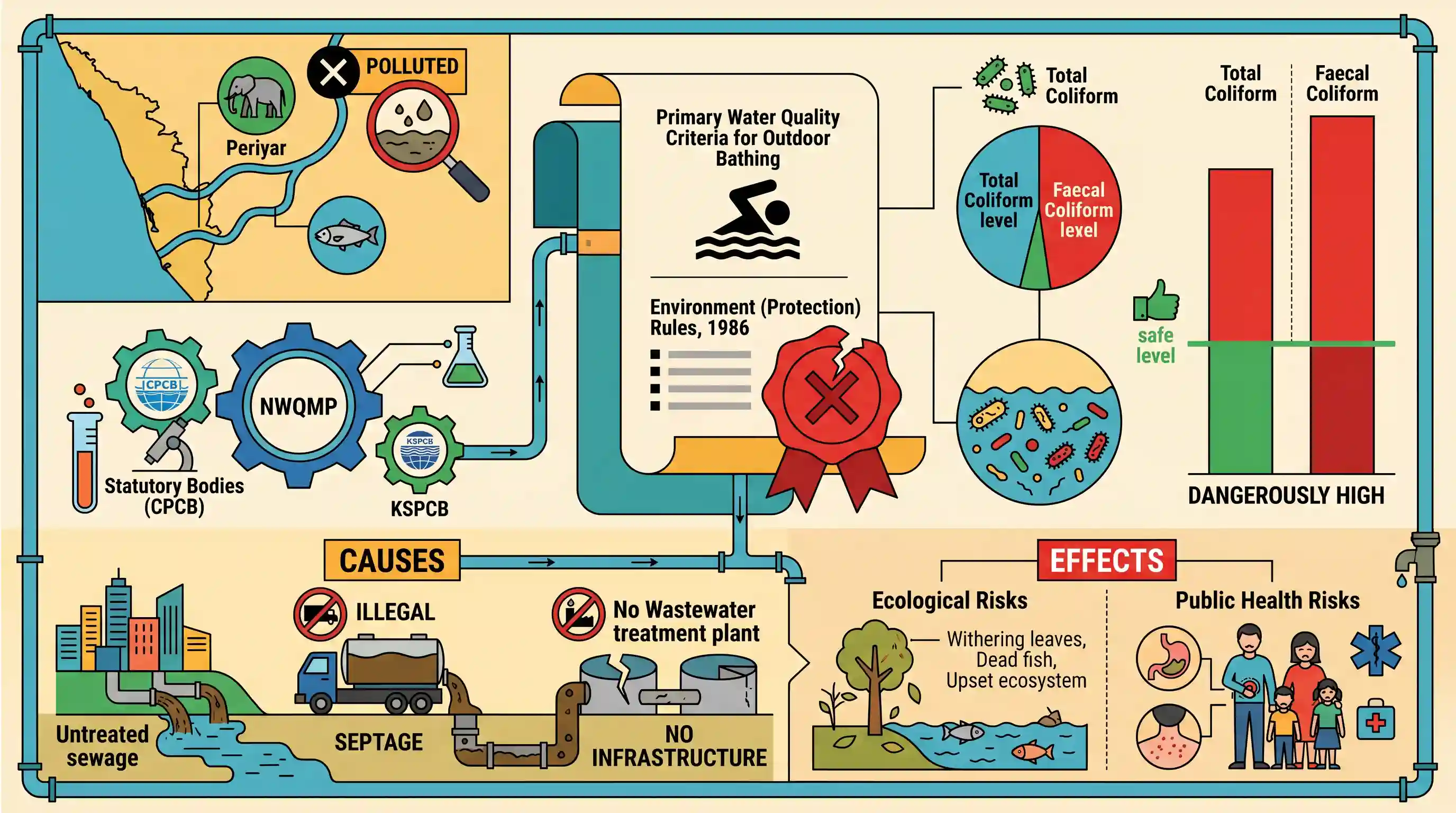
The article reports severe faecal contamination in the Periyar and Chitrapuzha rivers in Kerala, based on data from the Kerala State Pollution Control Board under the National Water Quality Monitoring Programme. The rivers failed to meet the Primary Water Quality Criteria for Outdoor Bathing set under the Environment (Protection) Rules, 1986, exhibiting dangerously high levels of total and faecal coliform. The pollution is primarily attributed to untreated sewage discharge, illegal septage dumping, and the absence of proper waste management infrastructure, posing significant ecological and public health risks.
Key Points
- Faecal contamination in the Periyar and Chitrapuzha rivers in Kerala significantly exceeded permissible limits in March 2025.
- The analysis was conducted by the KSPCB under the CPCB's National Water Quality Monitoring Programme.
- Both rivers failed to meet the Primary Water Quality Criteria for Outdoor Bathing as stipulated by the Environment (Protection) Rules, 1986.
- Total coliform count in the Periyar river reached 14,000 MPN/100 ml, far above the desirable limit of 500 MPN/100 ml or less.
- Key reasons for contamination include the discharge of untreated sewage, lack of modern slaughterhouses, and illegal dumping of septage.
Important Terms
Environment (Protection) Act, 1986

An umbrella legislation enacted under Article 253 following the 1984 Bhopal Gas Tragedy. It empowers the Central Government to protect and improve environmental quality and coordinate activities of various authorities.
UPSC context
GS Paper III: Environment & Ecology; tests understanding of the legal framework for environmental governance and pollution control in India.
Central Pollution Control Board (CPCB)
A statutory body established in 1974 under the Water Act. It serves as India's apex organization for pollution control, providing technical services to MoEFCC and maintaining national quality standards.
UPSC context
GS Paper II: Statutory Bodies; GS Paper III: Environmental Pollution. Tests knowledge of institutional mechanisms for monitoring air and water quality.
National Water Quality Monitoring Programme (NWMP)
A nationwide initiative managed by the CPCB and State Boards to assess water quality across India. It monitors parameters like BOD and coliform to identify polluted river stretches.
UPSC context
GS Paper III: Environmental Pollution & Degradation; relevant for questions on water resource management and river rejuvenation strategies.
Environment (Protection) Rules, 1986
Regulations framed under the EPA 1986 that specify discharge standards and environmental quality criteria, such as the Primary Water Quality Criteria for Outdoor Bathing used to assess river safety.
UPSC context
GS Paper II: Government Policies & Interventions. Tests understanding of specific regulatory standards used to enforce environmental compliance.
Faecal Coliform
A group of bacteria originating from the intestines of warm-blooded animals. Their presence in water serves as a critical indicator of sewage contamination and potential pathogenic risks to humans.
UPSC context
GS Paper III: Environmental Degradation & Health; tests scientific knowledge of water quality indicators and their public health implications.
Kerala State Pollution Control Board (KSPCB)
A statutory body responsible for implementing environmental laws and monitoring pollution levels within Kerala. It coordinates with the CPCB to execute water and air quality monitoring programs.
UPSC context
GS Paper II: Statutory Bodies; relevant for regional environmental governance and federal cooperation in pollution management.
Prelims Trap
"Primary Water Quality Criteria for bathing are notified under the Water (Prevention and Control of Pollution) Act, 1974."
While CPCB implements the norms and was created under the Water Act 1974, these specific water quality criteria are actually notified under the Environment (Protection) Rules, 1986.
Static Concepts Connected
What are the standard biological indicators of water pollution?
- Coliform bacteria: Presence indicates faecal contamination; high quantities signify severe pollution by untreated human or animal waste.
- BOD: Measures oxygen consumed by microbes decomposing organic matter. A polluted river stretch consistently exceeds 3 mg/L.
- Dissolved Oxygen (DO): Crucial for aquatic survival. DO levels drop as BOD and faecal/organic contamination rise.
What is the statutory backing of the Central Pollution Control Board (CPCB)?
- Water Act 1974: CPCB was originally established as a statutory organization under the Water Act of 1974.
- Air Act 1981: CPCB was subsequently entrusted with additional powers and functions to monitor air quality under this Act.
- EPA 1986: CPCB provides technical services to the MoEFCC under the Environment (Protection) Act, 1986.
Cross-Topic Patterns
Sewage, Coliform & One Health
Heavy faecal coliform loads in public water bodies serve as environmental reservoirs for Antimicrobial Resistance (AMR), directly connecting urban sanitation to the One Health approach.
West-flowing rivers & ecology
Periyar is Kerala's longest west-flowing river. UPSC often pairs regional river geography with specific ecological threats like industrial effluents, sewage, and salinity intrusion.

Expect a 2026 prelims statement confusing CPCB's origin (Water Act) with the notification rules for bathing criteria (EPA Rules 1986).
Linked PYQs · 4
Linked PYQs · 4
- 2017PrelimsGS1
Biological Oxygen Demand (BOD) is a standard criterion for
- 2022PrelimsGS1
Which one of the following has been constituted under the Environment (Protection) Act, 1986?
- 2019PrelimsGS1
Consider the following statements : The Environment Protection Act, 1986 empowers the Government of India to 1. state the requirement of public participation in the process of environmental protection, and the procedure and manner in which it is sought 2. lay down the standards for emission or discharge of environmental pollutants from various sources Which of the statements given above is/are correct?
- 2024MainsGS3
Industrial pollution of river water is a significant environmental issue in India. Discuss the various mitigation measures to deal with this problem and also the government's initiatives in this regard.
