Sugarcane Supply Chain Agreements and Farmer Payment Protections
Source:The Hindu ↗
Why It Matters
The article provides practical examples of governance interventions to secure farmers\' rights in the agro-industry supply chain, notably regarding the chronic issue of delayed sugarcane payments. It highlights the friction between Central pricing (FRP) and farmers\' income expectations, a core focus of GS3 Agriculture.
Summary
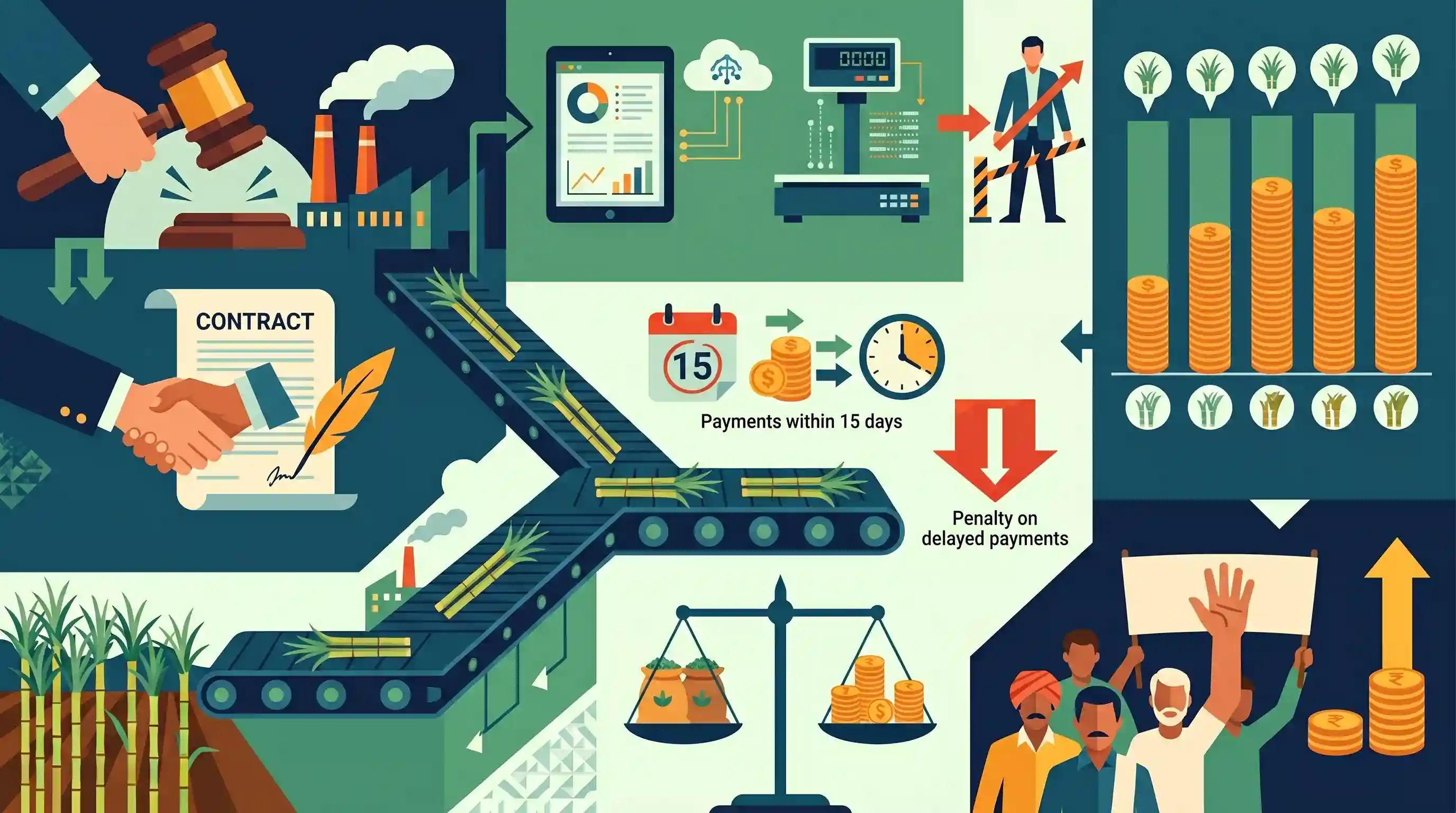
The Kalaburagi district administration has issued strict directives to sugar factories to sign bilateral agreements with sugarcane growers ahead of the crushing season. Aimed at protecting farmer interests, the rules mandate payments within 15 days of procurement with a 15% interest penalty for delays. Factories must adopt sugarcane management software and digital weighing to prevent malpractices and eliminate middlemen. Meanwhile, farmers have demanded an additional state support of ₹500 per tonne, protesting the Centre\'s Fair and Remunerative Price (FRP), which is currently fixed between ₹3,291 and ₹3,519 per tonne for the region based on recovery rates.
Key Points
- Kalaburagi district administration directed sugar factories to sign bilateral agreements with sugarcane growers by October 10, clearly detailing prices and transport costs.
- Factories must clear payments within 15 days of procurement; delays will attract a strict 15% interest penalty payable to the farmers.
- Mandatory use of sugarcane management software and digital weighing machines at factory gates aims to eliminate middlemen and weighing malpractices.
- Farmers termed the Centre's Fair and Remunerative Price (FRP) unscientific and demanded an additional State support of ₹500 per tonne.
- The FRP fixed for the 2025-26 season ranges from ₹3,291 to ₹3,519 per tonne, varying across factories based on their recovery levels.
Important Terms
Fair and Remunerative Price (FRP)

The minimum price sugar mills are legally obligated to pay farmers for sugarcane. It is determined by the Centre based on Commission for Agricultural Costs and Prices (CACP) recommendations.
UPSC context
GS3: Agricultural Pricing. Vital for understanding farm subsidies, crop economics, and government interventions in agro-industries.
State Advised Price (SAP)
The price set by state governments for sugarcane, usually higher than the Centre's FRP, reflecting regional production costs and political-economic factors.
UPSC context
GS3: Agriculture. Tests knowledge of federal pricing conflicts and the Rangarajan Committee recommendations on sugar decontrol.
Sugarcane Recovery Rate
The percentage of sugar extracted from a given weight of crushed cane. It is a critical determinant of the final price (FRP) paid to farmers.
UPSC context
GS3: Economy/Agriculture. Relevant for technical aspects of agricultural productivity and value-chain efficiency.
Sugarcane (Control) Order, 1966
A statutory order issued under the Essential Commodities Act, 1955, governing the purchase, supply, and pricing of sugarcane, including the mandatory 14-day payment rule.
UPSC context
GS2: Statutory Provisions. Important for legal frameworks governing agricultural marketing and farmer rights.
Pollution Control Board (PCB)
Statutory bodies (CPCB at the Centre and SPCBs in States) responsible for enforcing environmental standards, particularly managing industrial effluents from highly polluting 'Red' category sugar mills.
UPSC context
GS3: Environmental Regulation. Essential for understanding industrial compliance and the environmental impact of agro-based industries.
Food and Civil Supplies Department
A state government wing that monitors the distribution of essential commodities, enforces price controls, and ensures food security through the Public Distribution System (PDS).
UPSC context
GS2: Governance/PDS. Tests knowledge of administrative machinery in managing essential supplies and consumer protection.
Prelims Trap
"The Central Government procures sugarcane from farmers at the Fair and Remunerative Price (FRP)."
FRP is not a procurement price paid by the government. It is the statutory minimum price that private and cooperative sugar mills must pay directly to farmers.
Static Concepts Connected
How does the Fair and Remunerative Price (FRP) differ from standard MSP?
- Statutory backing: FRP is legally backed by the Sugarcane (Control) Order, 1966, mandating mills to pay farmers within 14 days or face a 15% interest penalty.
- Recovery link: Unlike flat MSPs, FRP is dynamically linked to a 'basic recovery rate'. Farmers get a premium if their cane yields higher sugar recovery.
- State Advised Price: Sugarcane-producing states can announce their own State Advised Price (SAP). If SAP is higher than FRP, mills are legally bound to pay the SAP.
Which bodies determine the Fair and Remunerative Price (FRP)?
- Recommendation (CACP): The Commission for Agricultural Costs and Prices (CACP) recommends the FRP based on the cost of production and inter-crop price parity.
- Final Approval (CCEA): The Cabinet Committee on Economic Affairs (CCEA), chaired by the Prime Minister, gives the final approval for the FRP.
Cross-Topic Patterns
Sugarcane Pricing & Ethanol Blended Petrol (EBP)
High FRPs and SAPs incentivize surplus sugarcane production, driving the government's push to divert excess cane stock towards ethanol production to meet the E20 blending targets.
E-technology in Agricultural Supply Chains
Mandating management software and digital weighing at mill gates directly addresses the GS3 syllabus theme of 'e-technology in the aid of farmers' to curb middleman exploitation and weighing frauds.

Expect a 2026 prelims statement testing the legal mandate of 14-day sugarcane payments and FRP's linkage to sugar recovery rates.
Linked PYQs · 2
Linked PYQs · 2
- 2015PrelimsGS1
The Fair and Remunerative Price (FRP) of sugarcane is approved by the
- 2022MainsGS3
What are the main bottlenecks in upstream and downstream process of marketing of agricultural products in India?
