US-India trade deal outlines terms for tariff reduction
Source:Indian Express ↗
Why It Matters
The United States is one of India's largest trading partners and export destinations. Any bilateral trade deal directly impacts India's economic growth, domestic manufacturing sectors, and agricultural exports. It is highly relevant for UPSC GS2 (Bilateral Agreements) and GS3 (Indian Economy & Global Trade), especially amidst the global shift from multilateralism to bilateralism.
Summary
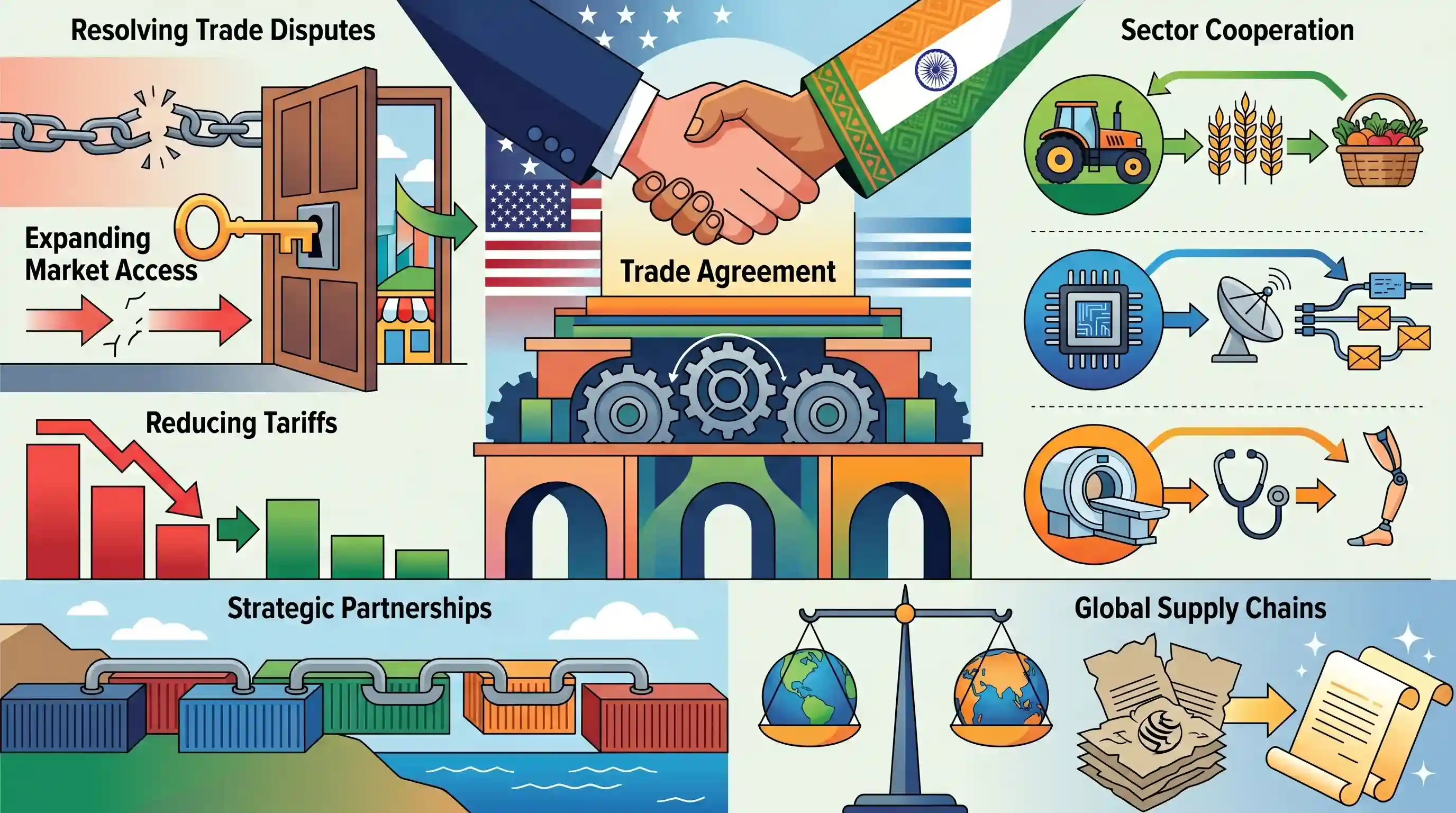
The fact sheet on the US-India trade deal outlines key terms aimed at resolving bilateral trade disputes and expanding market access for both nations. The agreement focuses on reducing tariffs, addressing non-tariff barriers, and boosting cooperation in critical sectors like agriculture, technology, and medical devices. This bilateral economic engagement underscores the shift towards strategic trade partnerships to secure resilient supply chains and counterbalance regional geopolitical shifts, while addressing legacy issues like the Generalized System of Preferences (GSP) and WTO disputes.
Key Points
- The term sheet for the US-India trade deal aims to resolve long-standing bilateral trade frictions, including disputes over tariffs and non-tariff barriers.
- Negotiations heavily feature market access concessions, particularly concerning sectors such as agriculture, medical devices, digital trade, and manufacturing.
- A critical element of bilateral negotiations traditionally revolves around the potential reinstatement of India's beneficiary status under the Generalized System of Preferences (GSP).
- The trade pact is seen as a strategic economic move to secure supply chains, reduce dependence on China, and strengthen the broader Indo-US strategic partnership.
Important Terms
Generalized System of Preferences (GSP)

A trade program allowing duty-free entry for thousands of products from developing countries to promote economic growth. India’s status was terminated in 2019 due to market access issues.
UPSC context
GS Paper II/III: Tests understanding of trade barriers and historical friction points in Indo-US economic relations.
Indo-Pacific Economic Framework (IPEF)
A US-led regional economic initiative launched in 2022. It focuses on four pillars: Trade, Supply Chains, Clean Economy, and Fair Economy. India is a member but opted out of the Trade pillar.
UPSC context
GS Paper II: Significant for Indo-Pacific geopolitics and India's refusal to join US-led digital/labor standards.
US Trade Representative (USTR)
The US government agency responsible for developing and recommending trade policy to the President and conducting bilateral/multilateral trade negotiations.
UPSC context
GS Paper II: Key institutional actor in resolving Section 301 probes and BTA negotiations.
World Trade Organization (WTO)
An international body regulating global trade. India and the US recently resolved six major disputes here, though the WTO's Appellate Body remains paralyzed due to US blocking.
UPSC context
GS Paper III: Essential for topics on multilateralism vs. bilateralism and dispute settlement mechanisms.
Ministry of Commerce and Industry (India)
The nodal Indian ministry for international trade negotiations. It coordinates with the USTR to finalize agreements like the Bilateral Trade Agreement (BTA).
UPSC context
GS Paper II: Administrative framework for India's foreign trade policy and economic diplomacy.
Free Trade Agreement (FTA)
An agreement between two or more countries to reduce or eliminate tariffs and non-tariff barriers. India and the US are currently negotiating an "Interim Agreement" as a precursor.
UPSC context
GS Paper III: Conceptual core of trade liberalization; relevant for comparing India’s FTAs (e.g., UAE, EFTA).
Prelims Trap
"GSP is a reciprocal tariff reduction mechanism negotiated bilaterally between India and the US."
GSP is a non-reciprocal trade preference program. Developed nations grant duty-free access to developing countries without demanding equivalent reciprocal market access.
Static Concepts Connected
What is the Generalized System of Preferences (GSP) under the WTO?
- Non-reciprocal basis: Developed nations grant preferential duty-free access to developing countries without expecting equivalent reciprocal market concessions.
- Enabling Clause: It is legally backed by the WTO's 'Enabling Clause', creating a permanent exception to the foundational Most Favored Nation (MFN) principle.
How do Non-Tariff Barriers (NTBs) restrict international trade?
- Regulatory mechanisms: They restrict trade using import quotas, licensing regulations, or complex technical standards rather than imposing direct import taxes.
- SPS Measures: Sanitary and Phytosanitary (SPS) measures act as NTBs to protect domestic health, frequently causing agricultural trade frictions between nations.
Cross-Topic Patterns
NPPA price caps vs Trade policy
US trade frictions historically targeted India's National Pharmaceutical Pricing Authority (NPPA) for capping medical device prices, linking domestic healthcare welfare policy to international trade barriers.
WTO paralysis forces bilateralism
India and the US settling seven disputes outside the WTO highlights the ongoing paralysis of the WTO Appellate Body, driving nations toward bilateral dispute resolution.

Expect a multi-statement question interlinking WTO's Enabling Clause, non-reciprocal GSP criteria, and 'friendshoring' supply chains.
Linked PYQs · 3
Linked PYQs · 3
- 2025MainsGS3
What are the challenges before the Indian economy when the world is moving away from free trade and multilateralism to protectionism and bilateralism? How can these challenges be met?
- 2020MainsGS2
What is the significance of Indo-US defence deals over Indo-Russian defence deals? Discuss with reference to stability in the Indo-Pacific region.
- 2023MainsGS3
What are the direct and indirect subsidies provided to farm sector in India? Discuss the issues raised by the World Trade Organization (WTO) in relation to agricultural subsidies.
