Regulatory body expands hazard zones for upcoming rocket test flights
Source:Indian Express ↗
Why It Matters
The article highlights the growing complexities of commercial space exploration, specifically the development of heavy-lift Reusable Launch Vehicles (RLVs). It bridges Science & Technology (GS3) with international regulatory challenges and liability regarding space debris falling on foreign sovereign territories (relevant to Outer Space Treaty principles in GS2), alongside map-based geography of the Caribbean region (GS1).
Summary
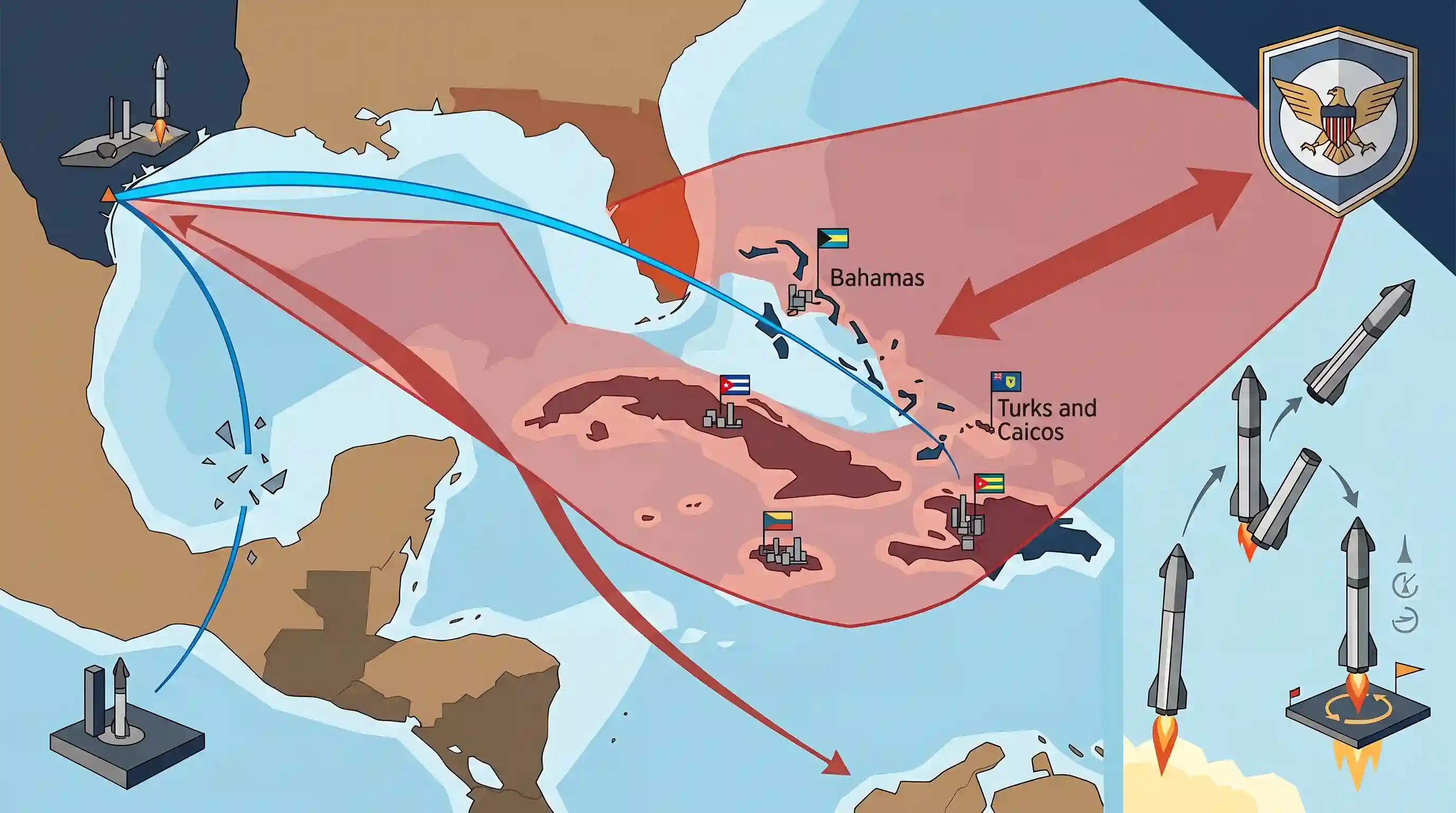
The US Federal Aviation Administration (FAA) has authorized SpaceX to resume test flights of its Starship rocket following an explosive failure in March. To ensure public safety, the FAA significantly expanded the 'Aircraft Hazard Area' along the rocket's flight trajectory, extending from the Texas launch site across the Straits of Florida and over several Caribbean nations, including the Bahamas, Cuba, and the Turks and Caicos Islands. This regulatory adjustment addresses international concerns after debris from previous tests fell on foreign territories. Additionally, the expanded zone accommodates SpaceX's pioneering attempt to reuse a Starship booster, marking a major milestone in the development of Reusable Launch Vehicles (RLVs).
Key Points
- The US FAA has approved the return to flight for SpaceX's Starship rocket after a previous test failure in March led to debris falling over the Caribbean.
- The FAA expanded the predetermined 'Aircraft Hazard Area' from 885 to 1,600 nautical miles, extending from the Texas coast through the Straits of Florida.
- The expanded hazard zone was necessitated by past debris incidents affecting territories like the Turks and Caicos Islands, requiring coordination with multiple nations including Cuba, Mexico, and the UK.
- SpaceX plans to reuse a Starship booster for the first time during this flight, a critical step toward the company's goal of developing rapidly reusable launch vehicles (RLVs).
Important Terms
Federal Aviation Administration (FAA)

The US agency regulating civil aviation and commercial space transportation, ensuring public safety during launches and reentries by US companies.
UPSC context
GS-II (Global Governance) and GS-III (Space). Tests awareness of regulatory bodies influencing the global space economy.
Reusable Launch Vehicle (RLV)
A spacecraft designed to return to Earth intact for reuse, aimed at slashing launch costs by up to 80% and increasing mission frequency.
UPSC context
GS-III (S&T). Core topic for ISRO's Pushpak project and global space competitiveness.
Space Debris
Non-functional human-made objects in orbit, like defunct satellites and rocket fragments, that threaten active space missions through potential high-speed collisions.
UPSC context
GS-III (Environment/Space). Critical for sustainability, Kessler Syndrome, and ISRO's debris-free mission 2030 goal.
Liability Convention (1972)
A 1972 treaty imposing "absolute liability" on launching nations for any damage caused by their space objects on Earth or to aircraft.
UPSC context
GS-II (International Treaties). Tests legal knowledge regarding international accountability for falling space hardware.
Straits of Florida
A strategic maritime passage between Florida, Cuba, and the Bahamas, connecting the Gulf of Mexico to the Atlantic Ocean.
UPSC context
Prelims (Geography). Frequently tested under "Places in News" and strategic maritime choke points.
Kessler Syndrome
A scenario where space debris collisions cause a cascade, creating more debris and potentially rendering certain orbits unusable for generations.
UPSC context
GS-III (Space Safety). Tests understanding of orbital mechanics and long-term space sustainability risks.
Starship
SpaceX's fully reusable, super-heavy rocket designed for carrying massive payloads and crew to the Moon and Mars.
UPSC context
GS-III (Space Tech). Significant as the world's most powerful launch vehicle impacting future lunar/interplanetary missions.
Prelims Trap
"Under international law, private space companies are held solely liable for surface damage caused by their rocket debris."
Under the Outer Space Treaty (1967) and the Space Liability Convention (1972), the launching state government bears absolute liability, even for private entities.
Static Concepts Connected
How does international law handle space debris and surface damage liability?
- Outer Space Treaty: Article VI mandates that national governments bear responsibility for all space activities, including those conducted by non-governmental private entities.
- Liability Convention (1972): The launching state is held 'absolutely liable' to pay compensation for damage caused by its space objects on the surface of the Earth or to aircraft.
What is ISRO’s Reusable Launch Vehicle-Technology Demonstrator (RLV-TD)?
- Design & Objective: A winged space plane designed to evaluate hypersonic flight, autonomous landing, and powered cruise flight.
- End Goal: To develop a Two Stage To Orbit (TSTO) fully reusable launch vehicle, significantly reducing the payload-to-orbit cost of space access.
Cross-Topic Patterns
Space Debris & Mapping Chokepoints
Debris zones often overlap with critical geographic straits. The Straits of Florida connects the Gulf of Mexico to the Atlantic, geographically separating the US from Cuba.
Space Privatization & Treaty Obligations
The rise of private actors like SpaceX tests the 1967 Outer Space Treaty, bridging domestic regulatory bodies (like IN-SPACe/FAA) with absolute international liability borne by the host state.

Expect a multi-statement question in 2026 combining ISRO's RLV-TD milestones with UN Liability Convention clauses on space debris.
Linked PYQs · 3
Linked PYQs · 3
- 2011MainsGS2
Write a short note on the 'Kessler syndrome' with reference to space debris.
- 2023MainsGS3
What is the main task of India's third moon mission which could not be achieved in its earlier mission? List the countries that have achieved this task. Introduce the subsystems in the spacecraft launched and explain the role of the Virtual Launch Control Centre' at the Vikram Sarabhai Space Centre which contributed to the successful launch from Sriharikota.
- 2014PrelimsGS1
Turkey is located between
