DTC Plans Early Morning Bus Services to Enhance Women Safety
Source:Indian Express ↗
Why It Matters
Safe, reliable, and accessible public transportation is vital for inclusive urban growth. Improving mobility options for women and securing their transit directly reduces structural barriers, encouraging higher female workforce participation and better access to education.
Summary
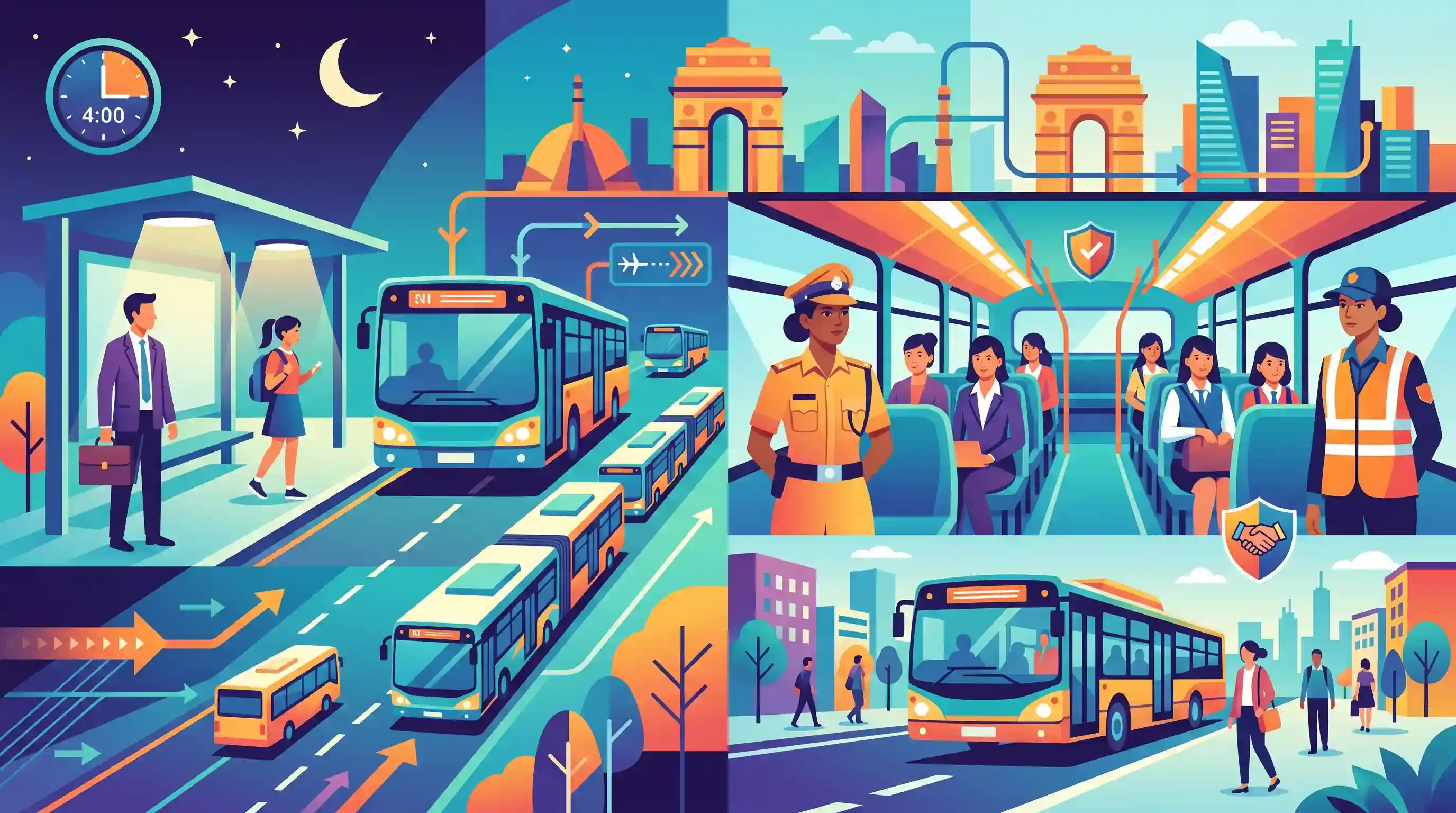
To improve connectivity for long-distance commuters and enhance women's safety, the Delhi Transport Corporation (DTC) is exploring the introduction of early-morning bus services starting at 4 am across its routes. Directed by Lieutenant Governor Taranjit Singh Sandhu, the initiative targets working professionals and students. Additionally, to ensure a secure commuting environment, women police personnel and Home Guard Marshals will be deployed in DTC ladies' special buses operating on vulnerable routes during morning and evening peak hours.
Key Points
- The Delhi Transport Corporation (DTC) is planning to start bus services at 4 am across all its routes to improve connectivity for long-distance commuters.
- The initiative aims to help working professionals, students, and industrial workers reach their destinations on time while enhancing public transit options.
- Following directives from Lieutenant Governor Taranjit Singh Sandhu, the plan places a strong emphasis on women's safety in public transportation.
- To ensure robust on-board security, women police personnel and women Home Guard Marshals will be deployed in DTC ladies\' special buses, especially on vulnerable routes with high female ridership.
Important Terms
Delhi Transport Corporation (DTC)

Statutory body under the Delhi government responsible for operating the city's public bus network. It manages one of the largest fleets of eco-friendly CNG and electric buses for urban commuting.
UPSC context
GS Paper 3: Infrastructure and Transport; GS Paper 2: Governance and Urban Administration. Tests knowledge of public utility management.
Lieutenant Governor of Delhi
The constitutional head of the National Capital Territory of Delhi, representing the President under Article 239. The LG possesses special executive powers over public order, police, and land.
UPSC context
GS Paper 2: Indian Polity. Focuses on federalism, UT administration, and constitutional provisions like Article 239AA.
Bus Marshals
Security personnel, often Home Guards or Civil Defence volunteers, deployed in public buses to deter crime, prevent harassment, and assist passengers, forming a key pillar of Delhi's women's safety initiatives.
UPSC context
GS Paper 1: Social Issues (Women Empowerment) and GS Paper 2: Public Safety. Tests understanding of social security measures.
Urban Mobility
A people-centric approach to city planning that focuses on efficient, inclusive, and sustainable transport systems like buses and metros to reduce congestion and improve environmental health.
UPSC context
GS Paper 3: Infrastructure and Economic Development. Relevant for sustainable cities (SDG 11) and urban planning.
Article 239AA
A constitutional provision added by the 69th Amendment Act (1991), granting Delhi special status as a Union Territory with a Legislative Assembly while retaining central oversight via the LG.
UPSC context
GS Paper 2: Indian Constitution. Critical for questions on the division of powers between Union and State/UT governments.
Prelims Trap
The Nirbhaya Fund is exclusively utilized for providing compensation to victims of gender-based violence.
The fund is not just for victim compensation; it extensively finances infrastructure projects like CCTV in buses, vehicle tracking, and emergency response systems.
Static Concepts Connected
What are the core principles of India's National Urban Transport Policy (NUTP)?
- People-centric: Prioritizes 'moving people rather than vehicles' by heavily promoting mass public transit systems over private automobile usage.
- Integrated planning: Mandates the integration of urban land use and transport planning to minimize overall travel distances and demand.
- Equitable road space: Focuses on the equitable allocation of road space, emphasizing non-motorized transport (NMT) infrastructure like cycling and walking paths.
How is the Nirbhaya Fund administered and utilized for urban safety?
- Financial administration: It is a non-lapsable corpus fund administered by the Department of Economic Affairs, Ministry of Finance.
- Nodal Ministry: The Ministry of Women and Child Development (MWCD) acts as the nodal authority for appraising and recommending schemes.
- Broad utilization: It finances diverse safety projects, including One Stop Centres, Vehicle Location Tracking Devices (VLTDs), and public transit panic buttons.
Cross-Topic Patterns
Urban Mobility and FLFPR linkage
Poor public transport acts as a 'safety tax' on women, heavily restricting their job choices and suppressing the overall Female Labour Force Participation Rate (FLFPR) due to spatial mismatch.
SDG 11.2 & Inclusive Smart Cities
Gender-sensitive transport initiatives map directly to SDG 11.2, highlighting a shift in urban governance from car-centric infrastructure to equitable, safe access for vulnerable demographics.

Expect Mains questions linking gender-sensitive urban transport infrastructure directly to India's Female Labour Force Participation Rate.
Linked PYQs · 2
Linked PYQs · 2
- 2014MainsGS3
National Urban Transport Policy emphasises on 'moving people' instead of 'moving vehicles'. Discuss critically the success of the various strategies of the Government in this regard.
- 2019MainsGS1
What are the continued challenges for women in India against time and space?
