Haryana Public Employment Policies for Anti Sikh Riot Victims
Source:Indian Express ↗
Why It Matters
It provides a practical case study for GS Paper 2 on how state governments utilize welfare measures and public employment policies to achieve regional political objectives, touching upon the debate surrounding targeted/discriminatory welfare schemes and constitutional principles of equality of opportunity.
Summary
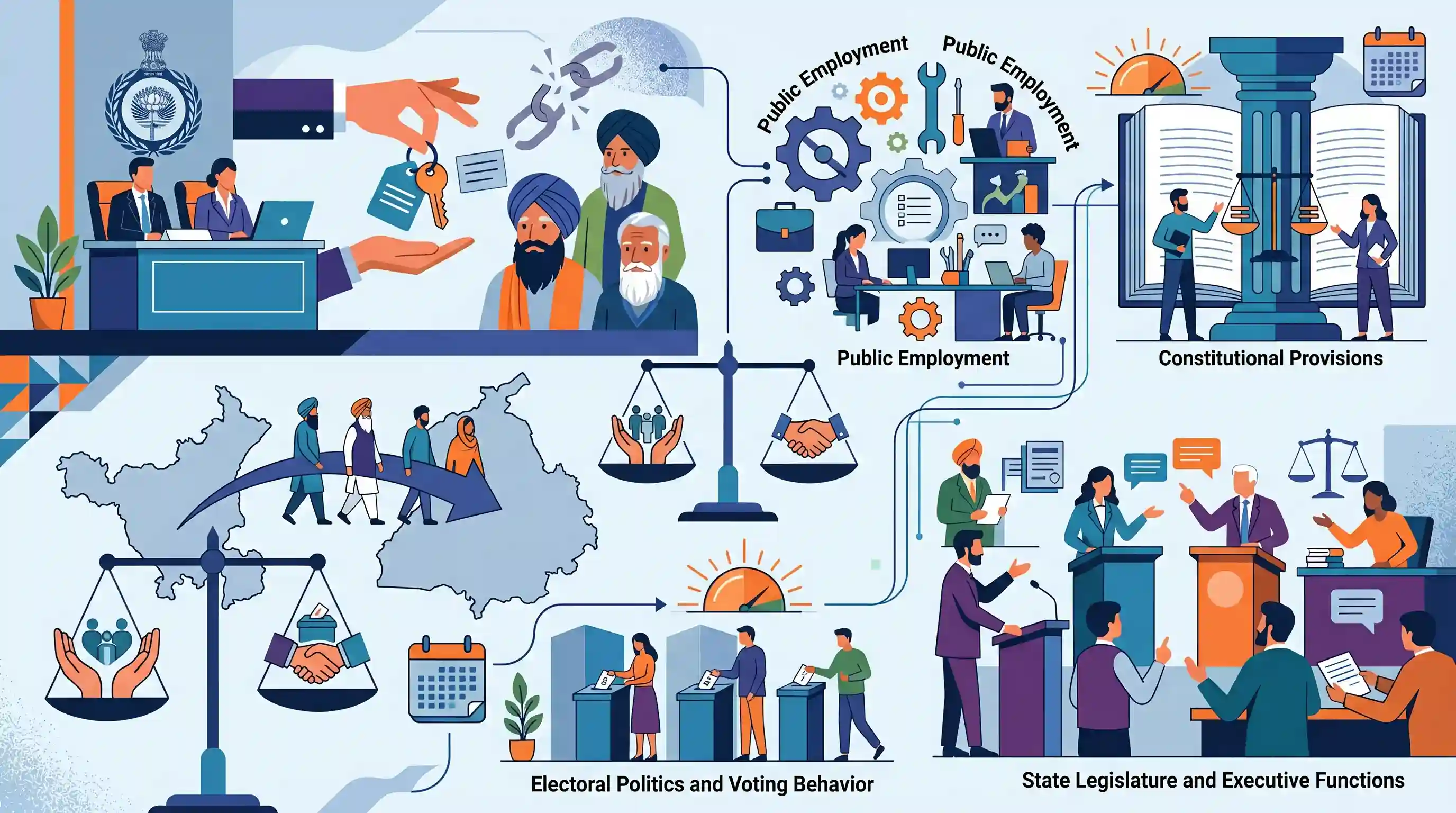
The Haryana government has announced government jobs for the victims of the 1984 anti-Sikh riots. This policy decision blends historical rehabilitation with electoral strategy, as it is seen as a deliberate attempt to appeal to the Sikh demographic in neighboring Punjab ahead of its 2027 Assembly elections. The move illustrates the intersection of targeted welfare in public employment, state-level executive powers, and regional vote-bank politics, prompting debates on the nature of affirmative action and electoral appeasement.
Key Points
- The Haryana government has announced government job provisions for the victims of the 1984 anti-Sikh riots.
- The policy decision is widely perceived as a strategic political maneuver aimed at courting the Sikh electorate ahead of the 2027 Punjab Assembly elections.
- The move highlights the use of state-level employment and rehabilitation policies as tools for regional vote-bank politics and cross-border political signaling.
- Raises governance questions regarding the constitutional validity of providing targeted public employment to specific victim groups (under Article 16) and the nature of discriminatory welfare schemes.
Important Terms
1984 Anti-Sikh Riots

A series of organized pogroms against Sikhs following the 1984 assassination of Indira Gandhi, resulting in thousands of deaths and significant internal displacement across India.
UPSC context
GS Paper I (Post-Independence History) and Paper III (Internal Security); tests understanding of communalism and state accountability.
Article 16
Guarantees equality of opportunity for all citizens in public employment and prohibits discrimination based on religion, race, caste, sex, descent, or place of birth.
UPSC context
GS Paper II (Polity); essential for questions on Fundamental Rights and the legal limits of reservation/special employment schemes.
Vote-bank Politics
Electoral strategies targeting specific community blocs (caste, religion, or language) to secure loyal voters through targeted benefits, often associated with political appeasement.
UPSC context
GS Paper II (Governance/Elections); relevant for analyzing political dynamics, representation, and the impact of identity on democratic functioning.
Affirmative Action
Policy measures like reservations or targeted recruitment designed to improve representation for historically marginalized or victimized groups in education and employment.
UPSC context
GS Paper II (Social Justice); critical for discussions on substantive equality vs. formal equality in public policy.
Operation Blue Star
A 1984 Indian military operation to remove militants from the Golden Temple in Amritsar, which served as the catalyst for the subsequent anti-Sikh violence.
UPSC context
GS Paper I (Modern History) and Paper III (Internal Security); vital for understanding Punjab insurgency and its long-term political fallout.
Haryana Kaushal Rozgar Nigam (HKRN)
A government portal established by Haryana to streamline the recruitment of contractual manpower in government departments, boards, and corporations.
UPSC context
GS Paper II (Governance); example of state-level administrative reform in public employment and welfare delivery.
Prelims Trap
"Article 16 explicitly provides exceptions for victims of communal riots or historical injustices."
Article 16 exceptions cover backward classes, residence, and religious institutions. Compassionate jobs for riot victims are judicial/executive exceptions for crisis relief, not explicit constitutional provisions.
Static Concepts Connected
How is public employment used to compensate communal violence victims under the Constitution?
- Article 21 Liability: The Delhi High Court established that failing to protect lives violates Article 21, creating an absolute liability for the State to compensate victims.
- Article 16 Exception: Courts view compassionate appointments or compensatory jobs as exceptions to the equality rules of Articles 14 and 16.
- Crisis Relief Limitation: Such jobs are legally intended for immediate financial crisis relief, not as a permanent vested right decades later, making delayed schemes constitutionally contentious.
What is the role of Commissions of Inquiry in riot rehabilitation?
- Statutory Basis: Under the Commissions of Inquiry Act, 1952, governments appoint commissions (like the Nanavati Commission for 1984 riots) to investigate public importance matters.
- Advisory Nature: Their findings are advisory and not binding, but they often form the factual foundation for state-led financial aid and ex-gratia employment packages.
Cross-Topic Patterns
Affirmative Action vs. Appeasement
The tension between vote-bank targeted welfare and Article 14's "reasonable classification" test frequently appears in Mains GS2 debates contrasting genuine rehabilitation with electoral appeasement.
Cross-border electoral signaling in Federalism
States using domestic executive powers to influence elections in neighboring states highlights a growing trend of cross-border political signaling, adding complexity to India's regional federal dynamics.

Exceptions to Article 16 (compassionate grounds vs historical redress) and State liability under Art 21 likely to feature in 2026 Polity.
Linked PYQs · 3
Linked PYQs · 3
- 2023MainsGS2
“Development and welfare schemes for the vulnerable, by its nature, are discriminatory in approach.” Do you agree? Give reasons for your answer.
- 2023PrelimsGS1
Consider the following statements: Statement-I: The Supreme Court of India has held in some judgements that the reservation policies made under Article 16(4) of the Constitution of India would be limited by Article 335 for maintenance of efficiency of administration. Statement-II: Article 335 of the Constitution of India defines the term 'efficiency of administration'. Which one of the following is correct in respect of the above statements?
- 2022MainsGS2
“While the national political parties in India favour centralisation, the regional parties are in favour of State autonomy.” Comment.
