World Bank Poverty Estimation and Welfare Scheme Impact
Source:The Hindu ↗
Why It Matters
The World Bank's revised poverty estimates and methodologies (like PPP calculations) are highly relevant for GS3 Economics and Prelims. The data demonstrating the success of food transfers in poverty alleviation directly informs GS2 (Social Justice/Welfare Schemes) and provides empirical backing for answers on inclusive growth and the rural-urban divide.
Summary
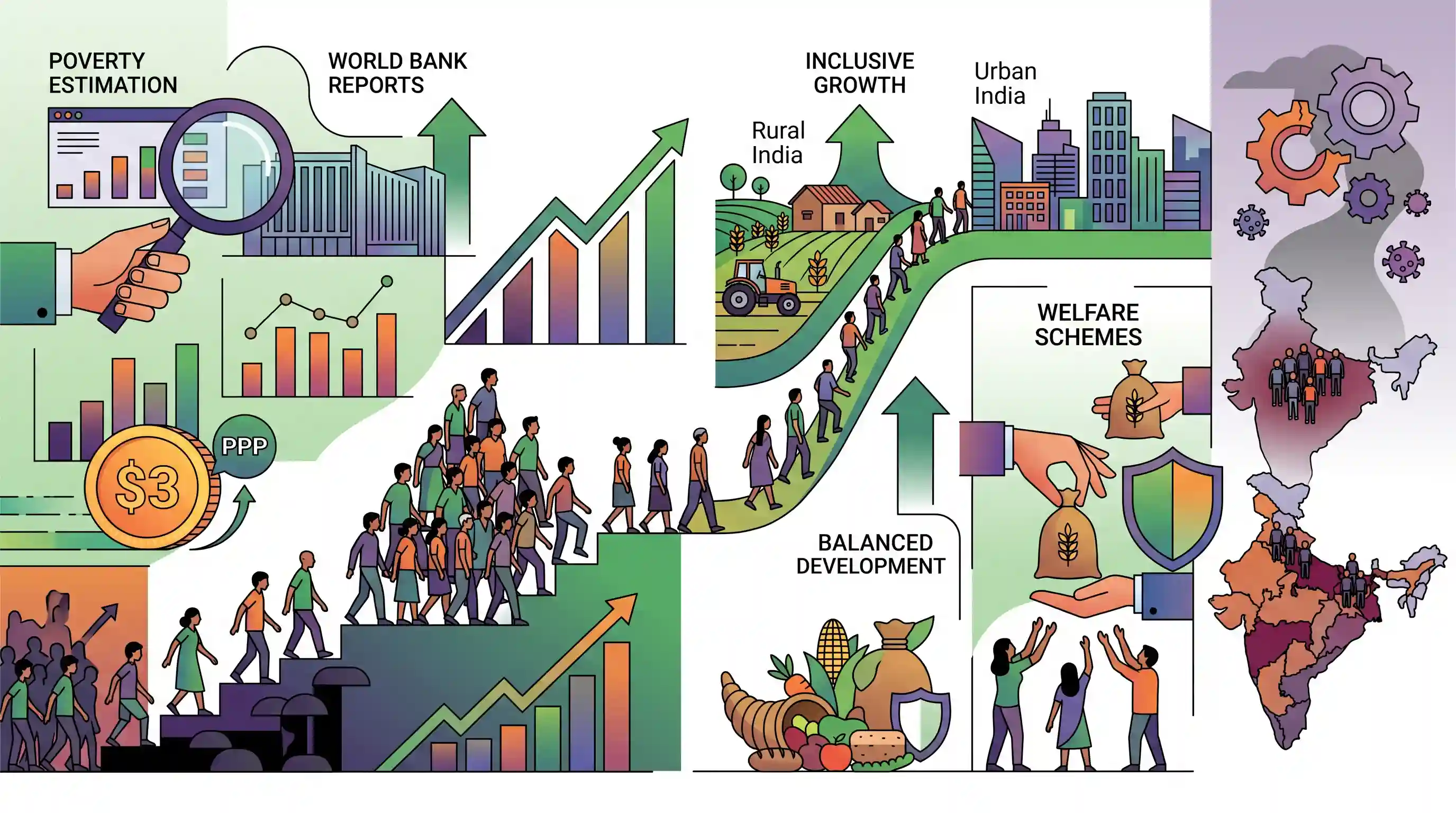
According to the World Bank, extreme poverty in India fell to 5.3% in 2022-23 from 27.1% a decade earlier. Applying the World Bank's revised threshold of $3 per day (based on 2021 PPP), 171 million people escaped extreme poverty during this period. The decline was especially pronounced in rural areas, leading to a much narrower rural-urban poverty gap. Welfare schemes, particularly subsidized food transfers, were critical drivers of this improvement, although challenges like economic scarring from the pandemic and regional concentration of poverty in highly populous states remain.
Key Points
- Extreme poverty in India dropped significantly from 27.1% in 2011-12 to 5.3% in 2022-23, lifting an estimated 171 million people out of extreme poverty.
- The World Bank's methodology utilizes a revised extreme poverty threshold of $3 per day based on 2021 Purchasing Power Parity (PPP) prices. Under the previous $2.15 per day threshold, extreme poverty fell to just 2.3%.
- The rural-urban poverty divide has narrowed substantially, with the gap shrinking from 7.7 percentage points in 2011-12 to 1.7 percentage points in 2022-23.
- Government welfare measures, notably free and subsidized food transfers, played a crucial role in mitigating poverty and supporting vulnerable populations.
- Despite the poverty decline, India's GDP in FY25 remained about 5% below its pre-pandemic trend level, and the five most populous states account for 54% of India's extremely poor.
Important Terms
World Bank

International financial organization providing development loans and grants to low-and-middle-income countries while monitoring global poverty through reports like the "Poverty and Inequality Platform."
UPSC context
GS-II: Important International Institutions; tests understanding of global governance and developmental aid roles.
Public Distribution System (PDS)
India’s food security system that distributes subsidized staples through a network of Fair Price Shops (Ration Shops) to households identified under the National Food Security Act.
UPSC context
GS-III: Food Security; tests knowledge of buffer stocks, distribution mechanisms, and welfare effectiveness.
Purchasing Power Parity (PPP)
An economic metric comparing currencies by the amount of goods they can buy in different countries, accounting for local price levels and cost of living.
UPSC context
GS-III: Indian Economy; tests understanding of national income accounting and international economic comparisons.
Extreme Poverty
A state of severe deprivation of basic human needs, defined by the World Bank as living on less than $3.00 per day at 2021 purchasing power adjusted prices.
UPSC context
GS-II: Poverty and Hunger; tests ability to analyze socio-economic indicators and social justice issues.
Inclusive Growth
Economic growth that creates opportunities for all sections of society, including marginalized groups, while ensuring that the benefits of prosperity are distributed fairly across the population.
UPSC context
GS-III: Inclusive Growth; tests understanding of sustainable development, employment generation, and social equity.
Poverty Line
The minimum level of income or consumption expenditure required to satisfy basic needs; serves as a benchmark for identifying beneficiaries of welfare schemes and social safety nets.
UPSC context
GS-II: Welfare Schemes; tests familiarity with poverty estimation methodologies and beneficiary targeting.
Prelims Trap
"The World Bank evaluates extreme poverty uniformly using the $1.90 per day threshold based on 2011 PPP."
The World Bank updated its global extreme poverty line to $2.15 and now evaluates lower-middle-income countries like India against a $3.00/day threshold based on 2021 PPP.
Static Concepts Connected
What is Purchasing Power Parity (PPP)?
- Definition: An economic theory that compares the purchasing power of different countries' currencies through a standardized "basket of goods."
- Poverty estimation link: It allows institutions like the World Bank to set uniform international poverty lines that account for local costs of living, removing exchange rate distortions.
How is poverty estimated domestically in India?
- Tendulkar Committee: Shifted poverty estimation from pure calorie-intake to a broader consumption basket including health and education expenditure.
- NITI Aayog MPI: Replaced traditional income-based lines with a broader multidimensional deprivation index tracking health, education, and standard of living (12 indicators).
Cross-Topic Patterns
PDS impact on income poverty
Subsidized food transfers (like PMGKAY) function as in-kind income, effectively raising household consumption expenditure thresholds and buffering vulnerable populations against post-pandemic economic scarring.
Regional inequality & demographic dividend
The high concentration of extreme poverty in India's five most populous states highlights regional disparities, threatening to turn the demographic dividend into a demographic disaster without targeted skilling.
NITI Aayog MPI vs World Bank
While the World Bank measures absolute monetary poverty using a uniform PPP consumption threshold, India's National MPI tracks non-income deprivations in health, education, and living standards.

A 2026 prelims question will likely test the exact difference between the World Bank's $3 PPP threshold and NITI Aayog's MPI indicators.
Linked PYQs · 4
Linked PYQs · 4
- 2019PrelimsGS1
Consider the following statements: 1. Purchasing Power Parity (PPP) exchange rates are calculated by comparing the prices of the same basket of goods and services in different countries. 2. In terms of PPP dollars, India is the sixth largest economy in the world. Which of the statements given above is/are correct?
- 2024MainsGS2
Poverty and malnutrition create a vicious cycle, adversely affecting human capital formation. What steps can be taken to break the cycle ?
- 2022MainsGS2
Besides the welfare schemes, India needs deft management of inflation and unemployment to serve the poor and the underprivileged sections of the society. Discuss.
- 2019MainsGS3
It is argued that the strategy of inclusive growth is intended to meet the objectives of inclusiveness and sustainability together. Comment on this statement.
