Extreme Heat Threatens Global Food Security and Agriculture
Source:The Hindu ↗
Why It Matters
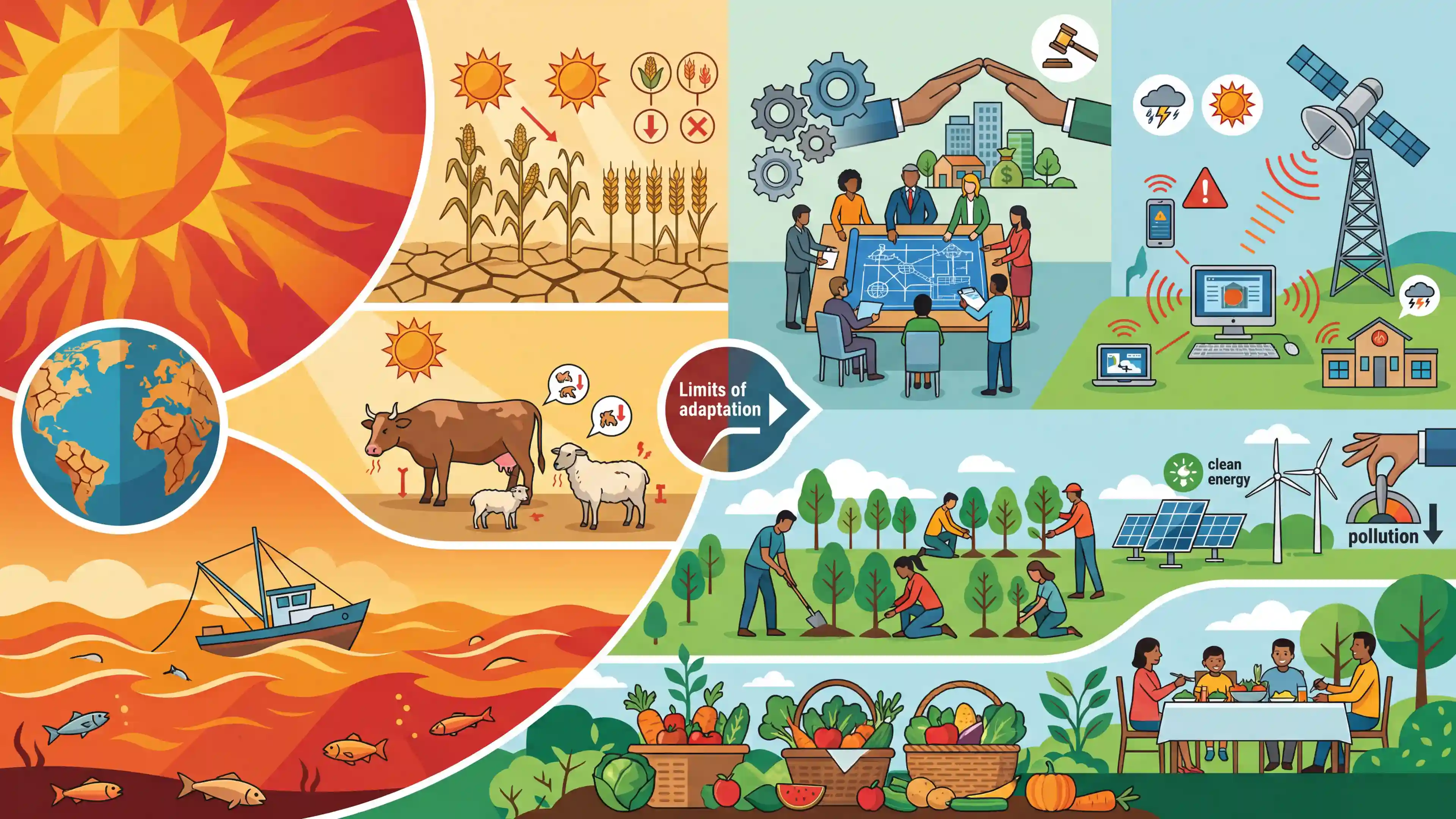
The report provides comprehensive, concrete examples of how climate extremes (particularly heat and marine heatwaves) threaten diverse food systems (crops, livestock, fisheries, forests). This directly addresses the UPSC syllabus on the consequences of climate change on food security and agriculture (GS1 and GS3).
Summary
A new report by the UN's Food and Agriculture Organization (FAO) and the World Meteorological Organization (WMO) underscores the devastating impact of extreme heat on global agrifood systems. The escalating temperatures threaten every facet of food production, from decreasing crop yields and livestock fertility to devastating marine fisheries through ocean warming. Emphasizing the limits of adaptation, the agencies call for urgent improvements in risk governance, enhanced early-warning systems, and aggressive climate change mitigation to ensure long-term global food security.
Key Points
- Extreme heat directly impairs crop growth by raising nighttime respiration rates, limiting carbon accumulation, and causing pollen sterility, leading to lower yields and reduced food quality.
- Livestock and poultry face severe heat stress, resulting in drastically lower milk production, reduced fertility, and mass mortality events.
- Marine heatwaves contribute to ocean warming and oxygen depletion, severely threatening fish stocks and coastal aquatic food systems.
- Forest ecosystems are increasingly vulnerable as extreme heat dries out biomass, substantially escalating the risk and intensity of wildfires.
- The UN report stresses the need for robust risk governance and early-warning systems, highlighting that while adaptation is necessary, deep mitigation of greenhouse gas emissions is the only lasting solution.
Important Terms
Food and Agriculture Organization (FAO)

A specialized UN agency established in 1945 (Rome) that leads international efforts to defeat hunger, achieve food security, and ensure sustainable agriculture.
UPSC context
GS Paper 2 (International Institutions); critical for topics on global food security and agriculture.
World Meteorological Organization (WMO)
The UN's specialized agency (Geneva) for international cooperation on the Earth's atmosphere, its interaction with oceans, and the resulting distribution of water resources.
UPSC context
GS Paper 2 (International Institutions) and GS Paper 3 (Disaster Management and Climate Change).
Food Security
Ensuring that all people, at all times, have physical, social, and economic access to sufficient, safe, and nutritious food for an active, healthy life.
UPSC context
GS Paper 3 (Agriculture and Food Security); linked to the National Food Security Act (NFSA), 2013.
Agrifood Systems
The entire interconnected range of activities—from production, processing, and distribution to consumption and waste—involved in getting food and agricultural products from field to fork.
UPSC context
GS Paper 3 (Agriculture); relevant to supply chain management and agricultural productivity.
Climate Change Mitigation
Actions and strategies aimed at reducing or preventing greenhouse gas emissions or enhancing carbon sinks to limit the extent of global warming.
UPSC context
GS Paper 3 (Environment); core concept for Paris Agreement and India's Net Zero targets.
Risk Governance
The system of institutions, legal frameworks, and policies that coordinate and manage disaster risk reduction, emphasizing preparedness and early warning systems.
UPSC context
GS Paper 3 (Disaster Management); aligns with the Sendai Framework for Disaster Risk Reduction.
Prelims Trap
Higher overall temperatures naturally increase plant carbon accumulation and consistently boost crop yields.
While daytime heat/CO2 can initially boost photosynthesis, higher nighttime temperatures increase nocturnal respiration, forcing plants to consume stored carbohydrates and ultimately reducing crop yield.
Static Concepts Connected
What is the physiological impact of heat stress on agricultural crops?
- C3 vs C4: C3 crops (wheat, rice) suffer more from high heat via photorespiration than C4 crops (maize, sugarcane) which have specialized CO2-concentrating mechanisms.
- Nighttime Respiration: Elevated nocturnal temperatures force plants to consume their stored sugars rapidly, reducing net biomass and nutritional quality.
- Reproductive Failure: Extreme heat spikes during the flowering phase induce pollen sterility, severely degrading grain formation and overall crop yield.
What are Marine Heatwaves (MHWs) and their ecological consequences?
- Definition: Prolonged periods of anomalously high sea surface temperatures, which can occur during both summer and winter seasons globally.
- Deoxygenation: Warmer ocean water holds less dissolved oxygen, creating hypoxic zones that suffocate marine life and restrict fish stocks.
- Bleaching & Blooms: MHWs trigger widespread coral bleaching and harmful algal blooms, fundamentally disrupting coastal aquatic food webs.
Cross-Topic Patterns
Heatwaves + Supply-side Inflation
Climate-induced crop mortality causes sudden supply shocks ('heatflation'), complicating the RBI's inflation targeting mandate. This directly bridges Physical Geography with Macroeconomic management.
Marine Heatwaves + PMMSY
Ocean warming and marine heatwaves directly threaten targets of the PM Matsya Sampada Yojana, linking global climate phenomena with the viability of India's Blue Economy and coastal livelihoods.

Expect a multi-statement Prelims question linking nighttime crop respiration, marine deoxygenation, and 'heatflation' impacts on the RBI.
Linked PYQs · 3
Linked PYQs · 3
- 2023MainsGS1
Discuss the consequences of climate change on the food security in tropical countries.
- 2019MainsGS1
Assess the impact of global warming on the coral life system with examples.
- 2022MainsGS3
Discuss global warming and mention its effects on the global climate. Explain the control measures to bring down the level of greenhouse gases which cause global warming, in the light of the Kyoto Protocol, 1997.
