Climate Change Impacts on Global Agrifood Systems
Source:The Hindu ↗
Why It Matters
This article provides excellent empirical data (e.g., a 6% crop yield drop per 1°C temperature rise, 15-25% drop in milk production) that acts as substantive fodder for Mains answers on the consequences of climate change, agricultural vulnerabilities, and the necessity of early-warning systems.
Summary
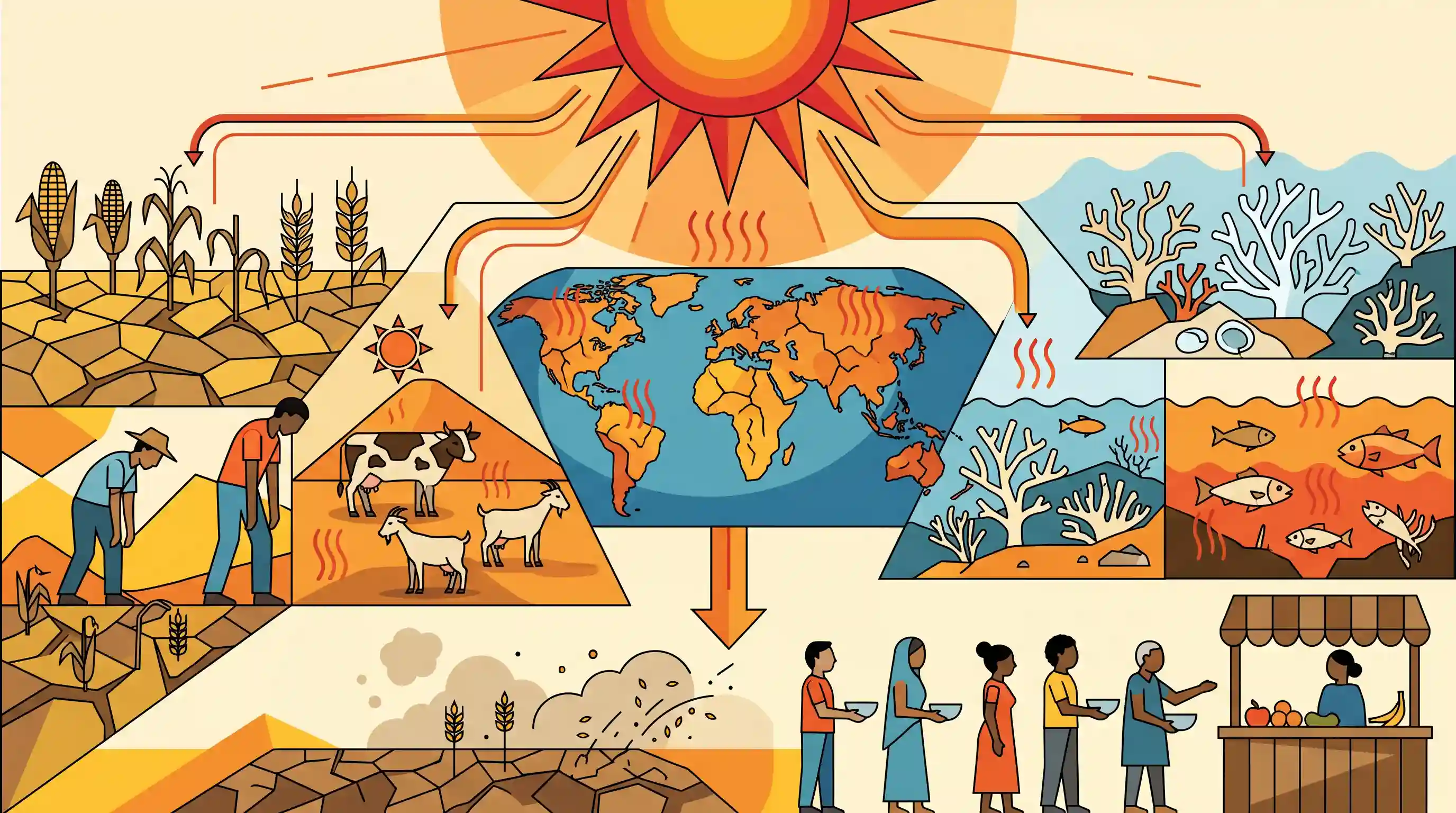
A UN report by the FAO and WMO warns that extreme heat and rising global temperatures severely threaten global agrifood systems, significantly impacting crops, livestock, and marine ecosystems, thereby jeopardizing food security.
Key Points
- Breaching the thermal humidity index triggers acute heat stress in livestock, causing a 15-25% drop in dairy cattle milk production and increasing poultry mortality.
- Temperatures exceeding 30°C cause plant yield drops. High nighttime temperatures disrupt plant rest, leading to exhaustion and pollen sterility in staple crops like maize and rice.
- A 1°C global average temperature rise is projected to cut yields of maize, rice, soya, and wheat by approximately 6%.
- Marine heatwaves, which affected 91% of oceans in 2024, are depleting oxygen levels and severely threatening fish stocks.
- The FAO and WMO emphasize the urgent need for better risk governance, early-warning weather systems, and comprehensive climate mitigation strategies.
Important Terms
Food and Agriculture Organization (FAO)

A specialized UN agency established in 1945, headquartered in Rome, dedicated to eliminating global hunger, improving nutrition, and promoting sustainable agricultural development worldwide.
UPSC context
GS Paper II (International Organizations) and GS Paper III (Agriculture & Food Security); focuses on institutional mandates and global governance.
World Meteorological Organization (WMO)
A specialized United Nations agency for meteorology, climatology, and operational hydrology, providing the framework for international cooperation on weather patterns and climate change monitoring.
UPSC context
GS Paper II (International Relations) and GS Paper III (Environment); relevant for climate data and disaster early-warning systems.
Agrifood Systems
The entire range of actors and their activities involved in the production, processing, distribution, consumption, and disposal of food products, including crops, livestock, and fisheries.
UPSC context
GS Paper III (Agriculture); tests understanding of integrated food value chains and their vulnerability to climate shocks.
Food Security
The state where all people have physical, social, and economic access to sufficient, safe, and nutritious food to meet dietary needs for an active life.
UPSC context
GS Paper III (Food Security & Buffer Stocks); critical for discussing the impact of environmental degradation on human survival.
Risk Multiplier
A phenomenon where an environmental factor, like extreme heat, does not act in isolation but aggravates and compounds existing socio-economic and ecological vulnerabilities.
UPSC context
GS Paper III (Environment & Disaster Management); used to analyze how climate hazards intensify challenges like poverty and water scarcity.
Marine Heatwaves
Prolonged periods of abnormally high sea surface temperatures that can cause mass mortality in marine life, coral bleaching, and disruption of oceanic food chains.
UPSC context
GS Paper III (Environment & Biodiversity); tests knowledge of climate change impacts on blue economy and marine ecosystems.
Prelims Trap
High daytime temperatures are the primary and sole cause of metabolic exhaustion and yield loss in staple crops.
Elevated nighttime temperatures are the hidden trap; they prevent plant respiration (rest), leading to metabolic exhaustion and pollen sterility.
Static Concepts Connected
How do high nighttime temperatures affect crop physiology?
- Respiration disruption: Plants primarily respire at night. Elevated nighttime temperatures increase respiration rates, rapidly depleting the plant's stored energy reserves.
- Pollen sterility: Heat stress during the night severely impairs pollen viability, leading to fertilization failure, often seen as 'empty husks' in cereals.
- Yield loss: This metabolic exhaustion makes it a critical climate threshold, projected to cut major staple yields by ~6% per 1°C rise.
How do Marine Heatwaves drive ocean deoxygenation?
- Decreased solubility: Warmer ocean waters inherently hold less dissolved oxygen compared to cooler waters due to basic physical chemistry principles.
- Enhanced stratification: Intense surface heating creates stable, buoyant layers, preventing oxygen-rich surface waters from mixing down into deeper ocean layers.
- Increased metabolism: Higher water temperatures raise the metabolic rates of marine life and bacteria, accelerating the rapid consumption of available dissolved oxygen.
Cross-Topic Patterns
Climate-induced Agflation
Drops in staple yields directly feed into headline CPI inflation. UPSC often links climate anomalies to RBI's monetary policy challenges and sudden agricultural export bans.
Marine heatwaves vs. Blue Economy
Ocean deoxygenation severely threatens commercial fish stocks, directly conflicting with India's PM Matsya Sampada Yojana targets and coastal livelihood security.

Expect a multi-statement Prelims question linking high nighttime temperatures to pollen sterility in crops and THI impacts on livestock.
Linked PYQs · 4
Linked PYQs · 4
- 2023MainsGS1
Discuss the consequences of climate change on the food security in tropical countries.
- 2017MainsGS3
What are the major reasons for declining rice and wheat yield in the cropping system? How crop diversification is helpful to stabilise the yield of the crops in the system?
- 2019MainsGS1
Assess the impact of global warming on the coral life system with examples.
- 2024MainsGS3
What is disaster resilience? How is it determined? Describe various elements of a resilience framework. Also mention the global targets of Sendai Framework for Disaster Risk Reduction (2015–2030).
