Global trade barriers impact on exports and bilateral US trade deal
Source:Indian Express ↗
Why It Matters
Understanding the shift from multilateral free trade to protectionism and bilateralism is critical for analyzing India's foreign trade policy and macroeconomic challenges, a recurring theme in Mains GS3 and GS2.
Summary
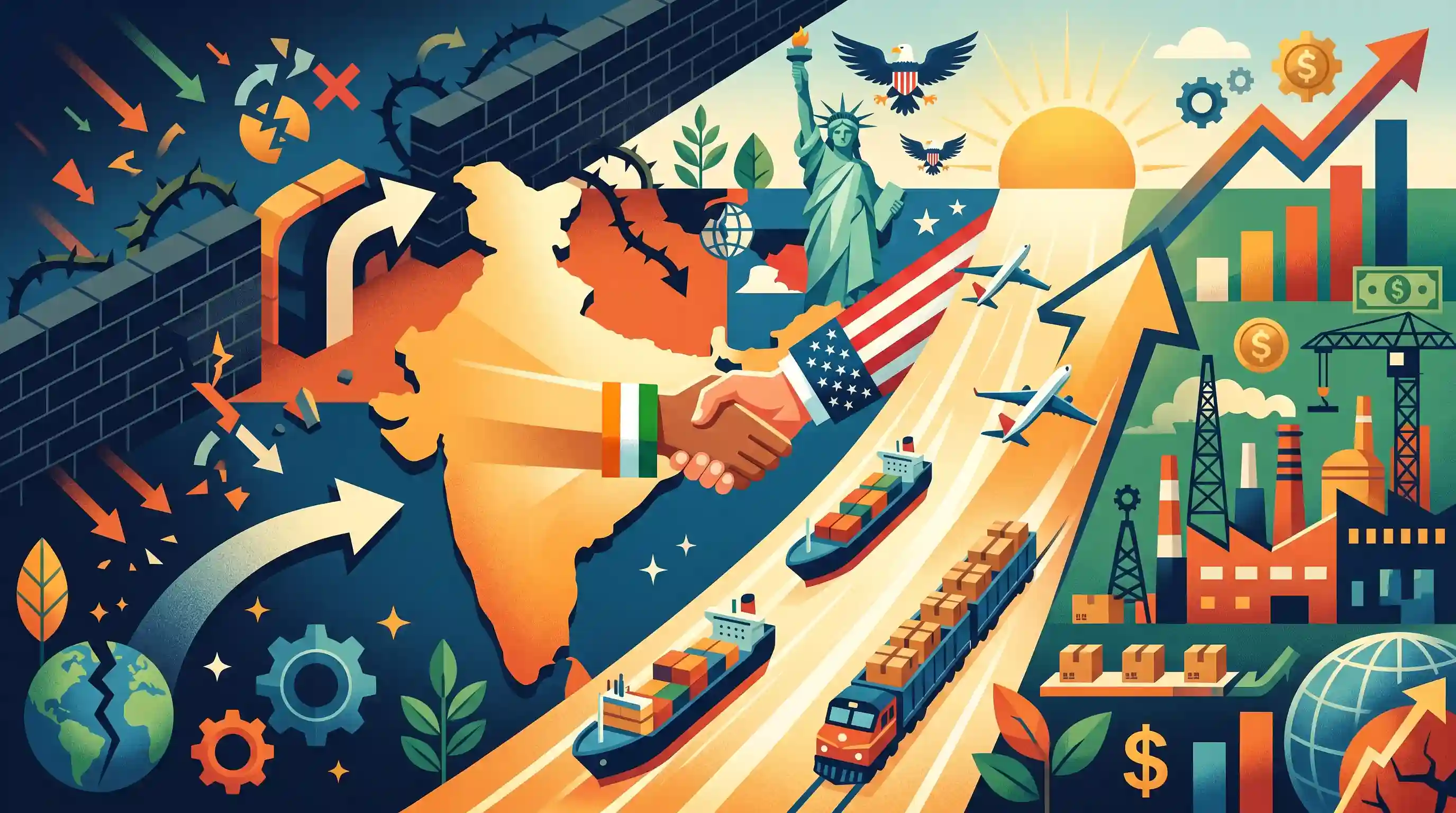
According to a Finance Ministry review, while India's economy faces external risks from growing global trade barriers and protectionist tendencies, establishing a bilateral trade deal with the United States could significantly boost India's exports. The observation highlights a strategic pivot towards bilateral agreements as a means to navigate the decline of global free trade and secure sustained economic and export growth.
Key Points
- The Finance Ministry review identifies rising global trade barriers and protectionism as significant external risks to India's export growth.
- A fragmented global trading environment and a shift away from multilateralism complicate traditional export strategies.
- Securing a bilateral trade deal with the United States is seen as a strategic measure that could substantially boost Indian exports.
- Navigating external headwinds will increasingly rely on leveraging strategic bilateral economic partnerships.
Important Terms
Free Trade Agreement (FTA)

A formal pact between nations to reduce or eliminate tariffs and non-tariff barriers on goods and services, facilitating market access while allowing members to maintain independent external trade policies.
UPSC context
GS Paper 3: Indian Economy. Tests understanding of trade liberalization, market access, and strategic economic partnerships in global trade.
Protectionism
An economic policy of shielding domestic industries from foreign competition through barriers like tariffs, quotas, and subsidies, often used to protect local jobs and strategic sectors.
UPSC context
GS Paper 3: Effects of Liberalization. Tests awareness of global trade shifts and their impact on India’s export-led growth.
Bilateral Trade Agreement
A trade arrangement between two nations designed to reduce or eliminate trade barriers for mutual economic benefit, often preferred over multilateral deals for speed and flexibility.
UPSC context
GS Paper 2: International Relations. Tests knowledge of bilateral diplomacy and India’s strategic pivot toward one-on-one trade deals.
Non-Tariff Barriers (NTBs)
Trade-restricting measures other than simple customs duties, including import quotas, licensing requirements, technical standards, and sanitary regulations that can hinder international market access.
UPSC context
GS Paper 3: International Trade. Tests understanding of complex barriers affecting Indian exports despite lower global tariff levels.
Trade Deficit
An economic condition where the value of a country's merchandise imports exceeds its exports over a specific period, potentially impacting currency stability and foreign exchange reserves.
UPSC context
GS Paper 3: Macroeconomic Stability. Tests ability to analyze Balance of Payments (BoP) components and export promotion necessity.
Macroeconomic Stability
A state where an economy's fundamental variables—such as inflation, fiscal deficit, and exchange rates—remain stable and predictable, allowing for sustained economic growth.
UPSC context
GS Paper 3: Indian Economy. Tests understanding of how external trade shocks and internal policy affect overall economic resilience.
Prelims Trap
"India maintains a persistent merchandise trade deficit with its largest trading partner, the United States."
While India suffers a massive overall trade deficit, the US is one of the few major economies with which India consistently runs a merchandise trade surplus.
Static Concepts Connected
What are the core trade remedy measures permitted under the WTO?
- Anti-dumping Duty (ADD): Imposed on imports that are deliberately priced below their normal fair market value in the exporting country.
- Countervailing Duty (CVD): Tariffs levied to neutralize the advantage of unfair financial subsidies provided by foreign governments to their exporters.
- Safeguard Duty: Temporary import restrictions invoked to protect a specific domestic industry from a sudden, unforeseen surge in imports.
How do bilateral FTAs bypass the WTO's Most-Favored-Nation (MFN) rule?
- The MFN Principle: WTO's foundational rule mandates equal trade treatment for all member nations, forbidding preferential tariff treatment to just one specific country.
- Article XXIV Exception: GATT Article XXIV allows Free Trade Agreements as a specific exception, provided they facilitate trade among parties without erecting higher barriers against non-parties.
Cross-Topic Patterns
FTAs + IPEF + Friend-shoring
The shift to bilateral pacts with the US mirrors India's participation in the Indo-Pacific Economic Framework (IPEF), emphasizing geopolitical supply chain resilience over pure cost-efficiency.
Trade deals + Currency Watchlists
Aspirants should note how the US periodically uses macroeconomic tools, like its 'currency manipulator' watchlist, as non-tariff leverage during bilateral trade negotiations with surplus-generating nations like India.

Expect a 2026 Mains question analyzing India's pivot from multilateral WTO frameworks to bilateral FTAs amidst rising global protectionism.
Linked PYQs · 4
Linked PYQs · 4
- 2025MainsGS3
What are the challenges before the Indian economy when the world is moving away from free trade and multilateralism to protectionism and bilateralism? How can these challenges be met?
- 2018MainsGS3
How would the recent phenomena of protectionism and currency manipulations in world trade affect macroeconomic stability of India?
- 2017MainsGS3
Account for the failure of manufacturing sector in achieving the goal of labour-intensive exports. Suggest measures for more labour-intensive rather than capital-intensive exports.
- 2018MainsGS2
India and USA are two large democracies. Examine the basic tenets on which the two political systems are based.
