India European Outreach and Counter Terrorism Diplomatic Strategy
Source:The Hindu ↗
Why It Matters
The article is vital for UPSC aspirants as it illustrates India's multi-aligned foreign policy approach, balancing economic ambitions (IMEC, India-EU FTA) with rigorous security diplomacy (counter-terrorism at FATF/UNSC) and strategic geopolitical messaging (Cyprus stopover, BRICS/G-7 engagements).
Summary
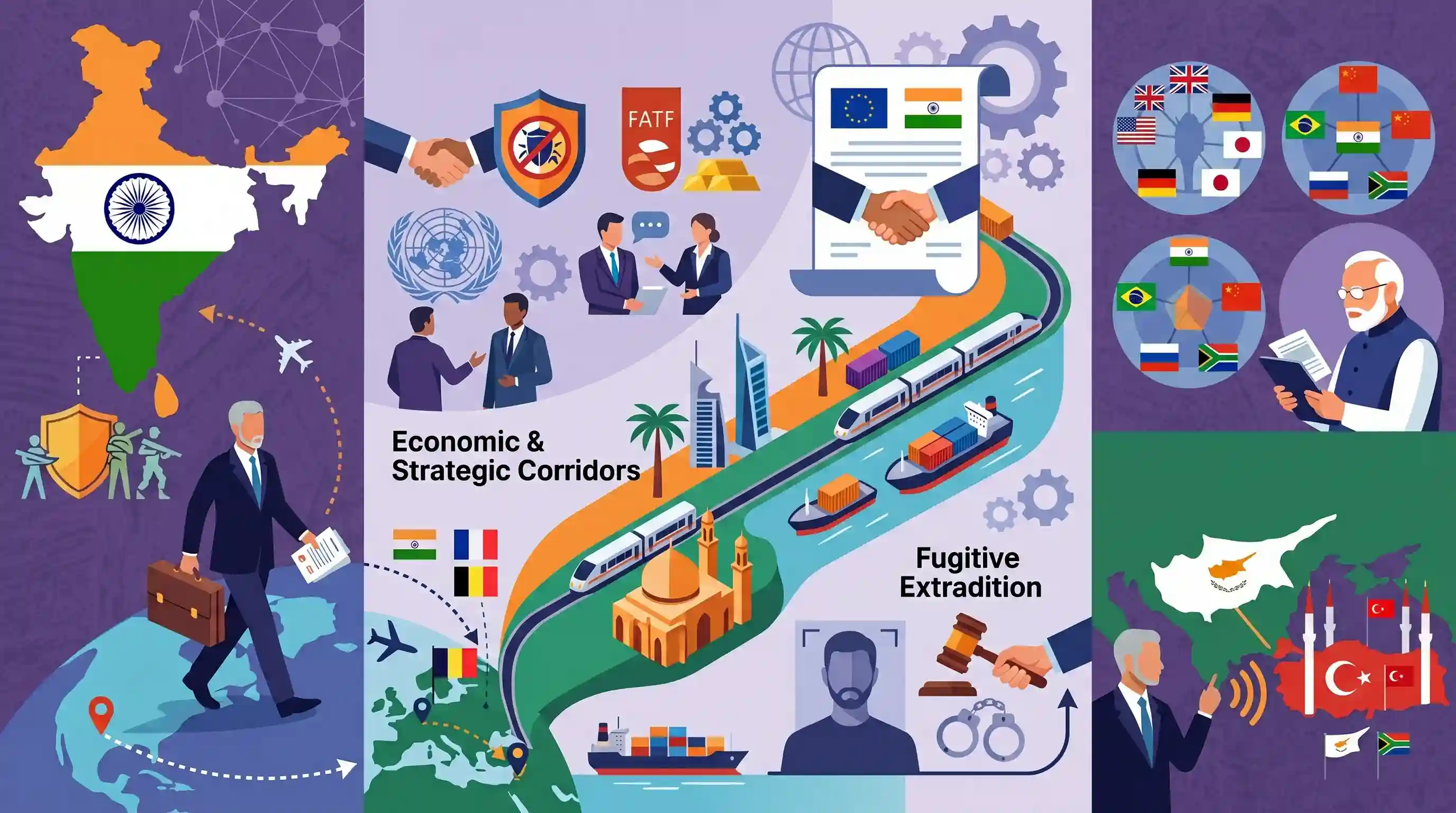
External Affairs Minister S. Jaishankar is undertaking a strategic visit to France, the EU, and Belgium starting June 8 to consolidate international support following India's 'Operation Sindoor'. The diplomatic outreach aims to bolster cooperation on counter-terrorism through platforms like FATF and the UN Security Council. Beyond security, the agenda is packed with economic and strategic priorities, including sustaining momentum for the India-Middle East-Europe Economic Corridor (IMEC), advancing the India-EU Free Trade Agreement, and seeking the extradition of fugitive Mehul Choksi. The visit will also prepare the ground for PM Modi's attendance at the upcoming G-7 and BRICS summits, while a calculated stopover in Cyprus serves as a strategic signal to Türkiye.
Key Points
- India is mobilizing diplomatic support at multilateral forums like the UN Security Council and FATF against cross-border terrorism following 'Operation Sindoor'.
- Talks will focus on the India-Middle East-Europe Economic Corridor (IMEC), though its progress has been dampened by the Israel-Gaza conflict.
- Bilateral discussions will cover the India-EU Free Trade Agreement, economic partnerships, and the extradition of fugitives like Mehul Choksi from Belgium.
- The trip lays the groundwork for India's participation in upcoming major international events, including the G-7 summit in Canada and the BRICS summit in Brazil.
- A strategic refuelling stopover in Cyprus sends a subtle geopolitical message to Türkiye amidst shifting regional alignments.
Important Terms
India-EU Free Trade Agreement

A comprehensive pact signed in January 2026 to liberalize trade in goods, services, and investment. It covers 96% of traded goods and represents a strategic economic shift between the world’s major democracies.
UPSC context
GS Paper II (International Relations) & III (Economy); tests bilateral trade strategy, India-EU ties, and economic integration in a multipolar world.
Operation Sindoor
India’s May 2025 "non-contact" military operation involving precision strikes against nine terror infrastructure sites in Pakistan and PoJK. Launched after the Pahalgam attack, it established a new doctrinal response to cross-border terrorism.
UPSC context
GS Paper III (Security); tests counter-terrorism doctrine, surgical strike capabilities, and India’s strategic shift in handling cross-border threats.
India-Middle East-Europe Economic Corridor (IMEC)
A multimodal connectivity project linking India, the Middle East, and Europe through rail, shipping, and digital infrastructure. Launched at the 2023 G20, it serves as a strategic alternative to China's Belt and Road Initiative.
UPSC context
GS Paper II (International Relations); tests global connectivity initiatives, Middle East geopolitics, and India’s role in resilient supply chains.
Financial Action Task Force (FATF)
An intergovernmental body that sets global standards to combat money laundering and terror financing. India leverages FATF to pressure nations supporting cross-border terrorism and to bolster its own counter-terrorism framework.
UPSC context
GS Paper II (IR) & III (Security); tests awareness of global regulatory bodies and India's efforts to curb international terror financing.
G-7 (Group of Seven)
An informal forum of leading advanced economies (US, UK, France, Germany, Italy, Canada, Japan, and the EU). India participates as a regular invitee, discussing global security, economic governance, and climate action.
UPSC context
GS Paper II (International Relations); tests knowledge of global groupings, India’s strategic partnerships with developed nations, and multilateral diplomacy.
BRICS
A grouping of major emerging economies (Brazil, Russia, India, China, South Africa, and new members). It promotes South-South cooperation, reforms to global financial institutions, and a multipolar world order.
UPSC context
GS Paper II (International Relations); tests multilateralism and India’s balancing act between Western-led (G-7) and non-Western (BRICS) blocs.
UN Security Council (UNSC)
The United Nations’ principal organ for maintaining international peace. India utilizes this platform to build consensus against cross-border terrorism and to justify its defensive military actions like Operation Sindoor.
UPSC context
GS Paper II (International Relations); tests mandate of international institutions and India’s push for global counter-terrorism regimes.
Prelims Trap
The principle of 'dual criminality' requires the fugitive to be a citizen of both nations.
Dual criminality relates to the offence, not the offender's citizenship. It dictates that the alleged act must be legally punishable in both the requesting and requested countries.
Static Concepts Connected
What are the core legal conditions for extraditing a fugitive to India?
- Dual Criminality: The alleged act must constitute a recognized criminal offence under the laws of both the requesting and the requested jurisdictions.
- Rule of Specialty: The extradited person can only be prosecuted for the specific offence for which the extradition was officially granted by the host country.
- Legal Framework: Governed by the Extradition Act of 1962; can proceed via bilateral treaties, multilateral international conventions, or ad-hoc mutual arrangements.
What is the structure and objective of the India-Middle East-Europe Economic Corridor (IMEC)?
- Two Corridors: Comprises an Eastern Corridor connecting India to the Arabian Gulf by sea, and a Northern Corridor connecting the Gulf to Europe via rail.
- Multimodal Design: Integrates ship-to-rail transit, trans-border electricity grids, digital connectivity cables, and clean hydrogen export pipelines.
- Strategic Counterbalance: Launched under the G20's Partnership for Global Infrastructure and Investment (PGII) to offer a transparent, sustainable alternative to China's BRI.
Cross-Topic Patterns
Mediterranean counterbalance to Türkiye
India's deepening engagements with Cyprus and Greece act as strategic pressure points against Türkiye's pro-Pakistan stance on Kashmir and its traditional diplomatic obstructionism at forums like the UN and FATF.
Geoeconomics held hostage by geopolitics
The stalling of the IMEC transit network highlights how grand geoeconomic connectivity projects (like G20's PGII initiatives) are highly vulnerable to regional hard-security crises such as the Israel-Gaza conflict.

IMEC's Mediterranean route, bypassing Türkiye, paired with India's strategic push in Cyprus/Greece, is a prime 2026 Prelims candidate.
Linked PYQs · 3
Linked PYQs · 3
- 2024MainsGS2
‘Terrorism has become a significant threat to global peace and security.’ Evaluate the effectiveness of the United Nations Security Council's Counter Terrorism Committee (CTC) and its associated bodies in addressing and mitigating this threat at the international level.
- 2023MainsGS3
Give out the major sources of terror funding in India and the efforts being made to curtail these sources. In the light of this, also discuss the aim and objective of the 'No Money for Terror (NMFT)' Conference recently held at New Delhi in November 2022.
- 2014MainsGS2
India has recently signed to become founding member of New Development Bank (NDB) and also the Asian Infrastructure Investment Bank (AIIB). How will the role of the two Banks be different ? Discuss the strategic significance of these two Banks for India.
