India US Bilateral Relations and Quad Strategic Agenda Coordination
Source:The Hindu ↗
Why It Matters
Understanding the evolving dynamics of India-US relations, particularly regarding the Quad and strategic agreements, is highly relevant for GS Paper 2 (International Relations). It underscores India's foreign policy priorities and its approach to navigating changes in US administrations while pursuing its national interests such as the mobility of professionals and strategic autonomy.
Summary
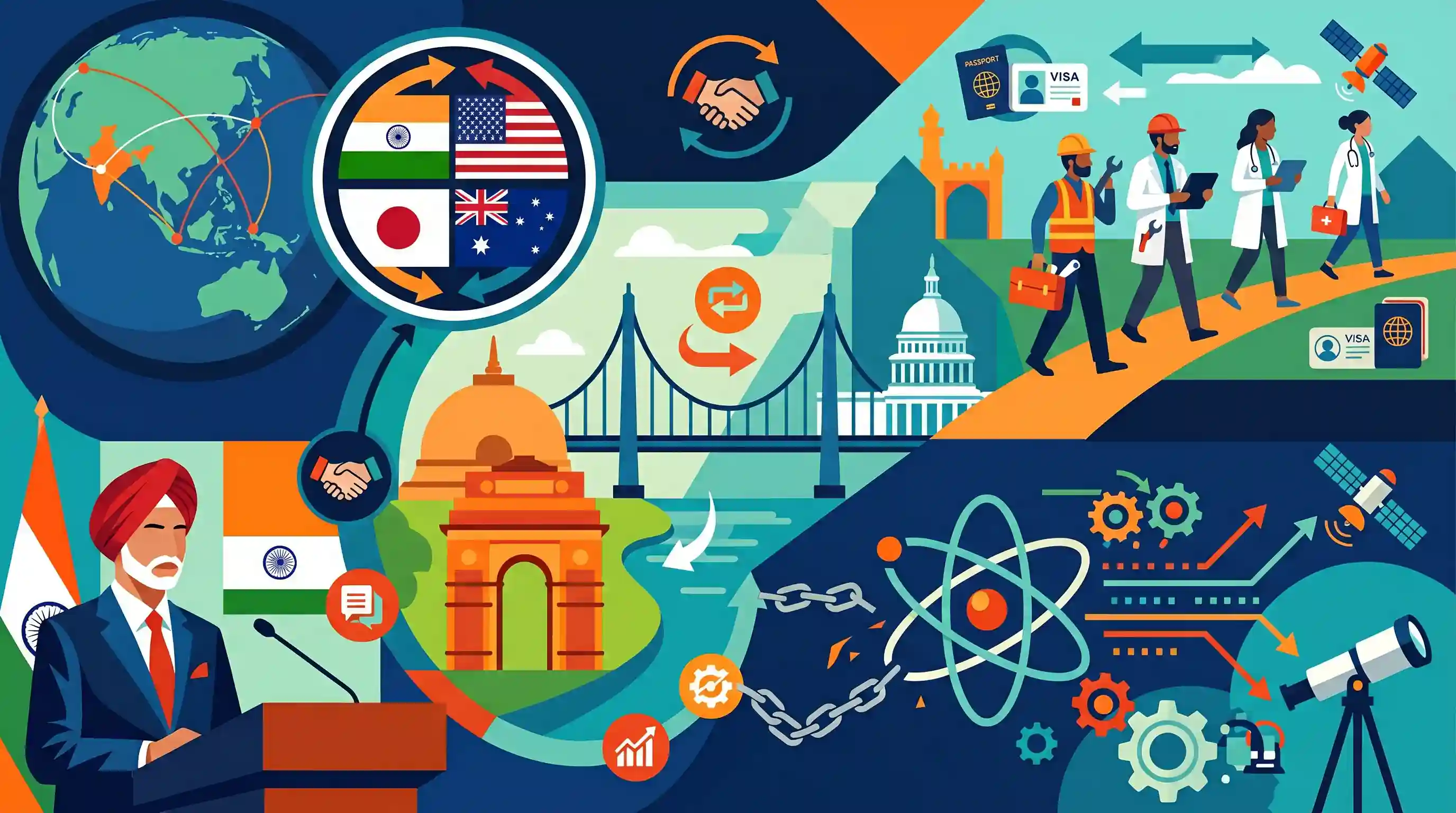
External Affairs Minister S. Jaishankar is set to attend the swearing-in ceremony of US President-elect Donald Trump, representing the Government of India. The presence of Foreign Ministers from Japan and Australia indicates a strong underlying focus on the Quad partnership. Jaishankar is expected to engage with incoming US administration officials to discuss hosting the 5th Quad leaders' summit in India, addressing concerns around skilled professionals' mobility (H-1B visas), and advancing bilateral strategic cooperation following the recent US decision to lift restrictions on Indian nuclear and scientific entities.
Key Points
- External Affairs Minister S. Jaishankar will represent India at the inauguration of US President-elect Donald Trump.
- Foreign Ministers from fellow Quad member nations (Japan and Australia) will also attend, signalling strong geopolitical alignment.
- India is preparing to host the 5th Quad Leaders' Summit and will hold bilateral talks with incoming US officials to lay the groundwork.
- Key bilateral issues include the mobility of skilled professionals (H-1B visas) and the removal of US restrictions on Indian nuclear and scientific entities.
Important Terms
H-1B Visa

A non-immigrant US visa allowing employers to hire foreign workers in 'specialty occupations' (STEM, IT) requiring a bachelor's degree. Indians typically secure ~70% of these visas annually.
UPSC context
GS II: Effect of policies of developed countries on India's interests and Indian Diaspora; GS III: Remittances and IT sector.
Quad (Quadrilateral Security Dialogue)
An informal strategic forum of India, USA, Japan, and Australia committed to a 'free, open, and inclusive' Indo-Pacific, focusing on maritime security and critical technologies.
UPSC context
GS II: Bilateral, regional and global groupings and agreements involving India and/or affecting India’s interests.
iCET (Initiative on Critical and Emerging Technology)
A landmark bilateral framework launched to enhance cooperation in AI, semiconductors, and space, aimed at building resilient supply chains and fostering strategic tech-sharing.
UPSC context
GS II: Bilateral agreements; GS III: Science and Technology developments and their applications in everyday life.
Major Defense Partner (MDP)
A unique status granted to India by the US in 2016, allowing for advanced defense technology transfers and interoperability previously reserved for treaty allies.
UPSC context
GS II: India-US bilateral relations; Security challenges and their management in the Indo-Pacific.
Indian Diaspora
The community of over 4 million Indian-origin individuals in the US who influence bilateral trade, high-tech innovation, and American domestic policy towards India.
UPSC context
GS II: Importance of the Indian diaspora in the politics and economy of the US; people-to-people ties.
Prelims Trap
India became a member of the Nuclear Suppliers Group (NSG) following the India-US Civil Nuclear Agreement.
India received an exclusive NSG waiver in 2008 allowing nuclear commerce, but it is still NOT a member of the NSG because it hasn't signed the NPT.
Static Concepts Connected
What are the core features of the India-US Civil Nuclear Agreement (123 Agreement)?
- NSG Waiver: Secured a unique exemption allowing India to participate in global nuclear commerce without signing the Non-Proliferation Treaty (NPT).
- IAEA Safeguards: Required India to officially separate its civilian and military nuclear facilities, placing the civilian reactors under permanent IAEA oversight.
- Tech Normalization: Removed major US export control barriers on dual-use technology, setting the stage for modern strategic partnerships like iCET.
What are the primary maritime capacity initiatives undertaken by the Quad framework?
- IPMDA: Indo-Pacific Partnership for Maritime Domain Awareness offers near-real-time satellite tracking to regional partners to curb dark shipping and illegal fishing.
- MAITRI: Maritime Initiative for Training in the Indo-Pacific focuses on capacity building and law enforcement training for regional partners.
- Observer Missions: A forthcoming framework intended to improve interoperability and joint maritime security coordination among the coast guards of the four nations.
Cross-Topic Patterns
Nuclear Diplomacy + Climate Commitments
Removing US export curbs on Indian nuclear entities directly ties bilateral strategic tech cooperation to India’s clean energy transition and its UNFCCC Panchamrit targets.
Visa Policies + Tech Geopolitics
H-1B visa mobility is no longer just a diaspora or economic issue; it is now a foundational pillar of the India-US Initiative on Critical and Emerging Technology (iCET).

Expect a 2026 prelims question merging Quad's new maritime initiatives (MAITRI, IPMDA) with recent changes in US-India export controls.
Linked PYQs · 3
Linked PYQs · 3
- 2020MainsGS2
Quadrilateral Security Dialogue (Quad)' is transforming itself into a trade bloc from a military alliance, in present times - Discuss.
- 2020MainsGS2
What is the significance of Indo-US defence deals over Indo-Russian defence deals? Discuss with reference to stability in the Indo-Pacific region.
- 2023MainsGS2
Indian diaspora has scaled new heights in the West. Describe its economic and political benefits for India.
