Unilateral Sanctions Impact on Strategic Energy Autonomy
Source:The Hindu ↗
Why It Matters
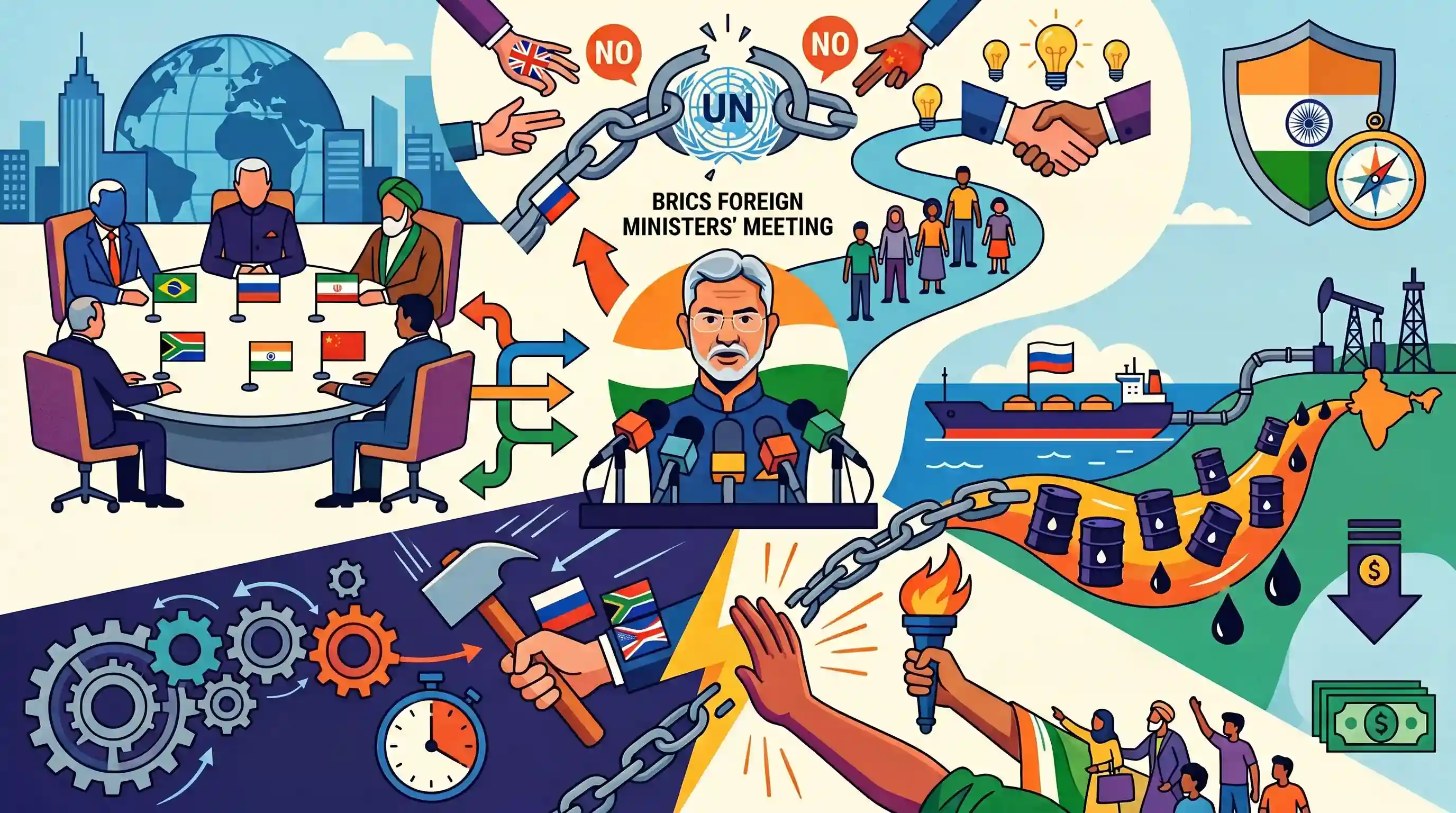
The article provides a textbook example of India asserting its 'strategic autonomy'—balancing its strategic partnerships with the West against its vital energy security needs sourced from Russia. It also illustrates how India utilizes multilateral forums like BRICS to build consensus against Western unilateralism and position itself as the voice of the Global South.
Summary
External Affairs Minister S. Jaishankar recently criticized unilateral, non-UN-backed sanctions, emphasizing that they disproportionately affect developing countries and cannot replace diplomatic dialogue. Speaking at a BRICS Foreign Ministers' meeting attended by his Russian and Iranian counterparts, his remarks highlighted India's push for strategic autonomy. Crucially, the statement came just days before the expiration of a U.S. waiver on sanctions against Russian oil imports, amidst a record surge in India's procurement of discounted Russian crude. The development underscores the tension between Western geopolitical strategies and India's pragmatic pursuit of energy security and advocacy for the Global South.
Key Points
- External Affairs Minister S. Jaishankar strongly condemned unilateral sanctions, arguing they bypass the UN system, violate international law, and disproportionately harm developing nations.
- The remarks were delivered during a BRICS Foreign Ministers' meeting, a platform India uses to champion a multipolar world order and articulate Global South concerns.
- This diplomatic push coincides with the impending expiration of a U.S. waiver on Russian oil sanctions on May 16, 2026.
- India’s crude oil imports from Russia have surged to a record 1.96 million barrels per day, demonstrating India's prioritization of energy security and strategic autonomy over Western geopolitical pressure.
Important Terms
Strategic Autonomy

India's core foreign policy doctrine of maintaining independent decision-making in international affairs, avoiding formal military alliances while partnering with various global powers based on national interest.
UPSC context
GS Paper II (IR); fundamental for explaining India's balancing act between the West and Russia/China.
BRICS (BRICS+)
An intergovernmental organization of major emerging economies—originally Brazil, Russia, India, China, and South Africa—expanded in 2024 to include Iran, Egypt, Ethiopia, and the UAE.
UPSC context
GS Paper II (IR); tests knowledge of South-South cooperation and reform of global economic governance.
Unilateral Sanctions
Economic or political penalties imposed by a single nation or a bloc without a United Nations Security Council mandate, often used as foreign policy tools to coerce behavior.
UPSC context
GS Paper II (Bilateral/Global Groupings); critical for analyzing international law and impacts on India's energy trade.
Global South
A socio-economic and political grouping of developing and less-developed countries, primarily in Africa, Asia, and Latin America, often sharing a history of colonialism and marginalization.
UPSC context
GS Paper II (IR); essential for understanding India's leadership role and advocacy for equitable global development.
Energy Security
The reliable, uninterrupted, and affordable availability of energy sources, critical for macroeconomic stability given India's 85%+ dependence on crude oil imports.
UPSC context
GS Paper III (Economy/Infrastructure); vital for questions on national security and managing global supply chain shocks.
Prelims Trap
India is legally bound to comply with secondary sanctions imposed by major trading partners like the US.
India officially recognizes only multilateral sanctions mandated by the UN Security Council under Chapter VII, explicitly rejecting extraterritorial or unilateral secondary sanctions.
Static Concepts Connected
What is the legal distinction between UN sanctions and unilateral sanctions?
- UNSC Sanctions: Imposed under Chapter VII of the UN Charter; they are universally legally binding on all UN member states to maintain international peace.
- Unilateral Sanctions: Imposed by individual states (e.g., US) or blocs without a UN mandate. India considers these violations of international law.
- Secondary Sanctions: The extraterritorial application of domestic laws penalizing third-party nations (like India) for engaging with sanctioned entities.
How does CAATSA operate as an instrument of secondary sanctions?
- US Federal Law: Countering America's Adversaries Through Sanctions Act is a US law designed to penalize entities trading with Russia, Iran, and North Korea.
- Extraterritorial Reach: It targets non-US entities engaging in significant transactions with sanctioned countries, threatening their access to the US dollar and financial system.
- Waiver Mechanism: Allows the US President to grant exemptions based on national security, a provision historically relevant to India's S-400 and oil procurements.
Cross-Topic Patterns
BRICS & Local Currency Settlement
Unilateral sanctions accelerate de-dollarization. BRICS nations are expanding local currency trade (like the Rupee-Rouble mechanism) to bypass SWIFT and insulate themselves from Western secondary sanctions.
Energy Security + Imported Inflation
Procuring discounted Russian crude helps India manage its current account deficit and curbs imported inflation, linking diplomatic strategic autonomy directly to domestic macroeconomic stability.

Expect a 2026 Prelims question mixing UN Chapter VII sanctions, extraterritorial laws (CAATSA), and Rupee-trade settlement mechanisms.
Linked PYQs · 3
Linked PYQs · 3
- 2025MainsGS2
"Energy security constitutes the dominant kingpin of India's foreign policy, and is linked with India's overarching influence in Middle Eastern countries.” How would you integrate energy security with India's foreign policy trajectories in the coming years?
- 2012MainsGS2
Compare the significance of IBSA and BRICS in the context of India's multilateral diplomacy.
- 2025MainsGS2
"The reform process in the United Nations remains unresolved, because of the delicate imbalance of East and West and entanglement of the USA vs. Russo-Chinese alliance.” Examine and critically evaluate the East-West policy confrontations in this regard.
