Unilateral sanctions and India energy security amid Russia oil waiver
Source:The Hindu ↗
Why It Matters
This issue exemplifies the practical challenges of maintaining strategic autonomy in India's foreign policy. It bridges international relations with core economic imperatives, demonstrating the complex collision between India's energy security needs, Western unilateral sanctions, and participation in non-Western multilateral platforms like BRICS.
Summary
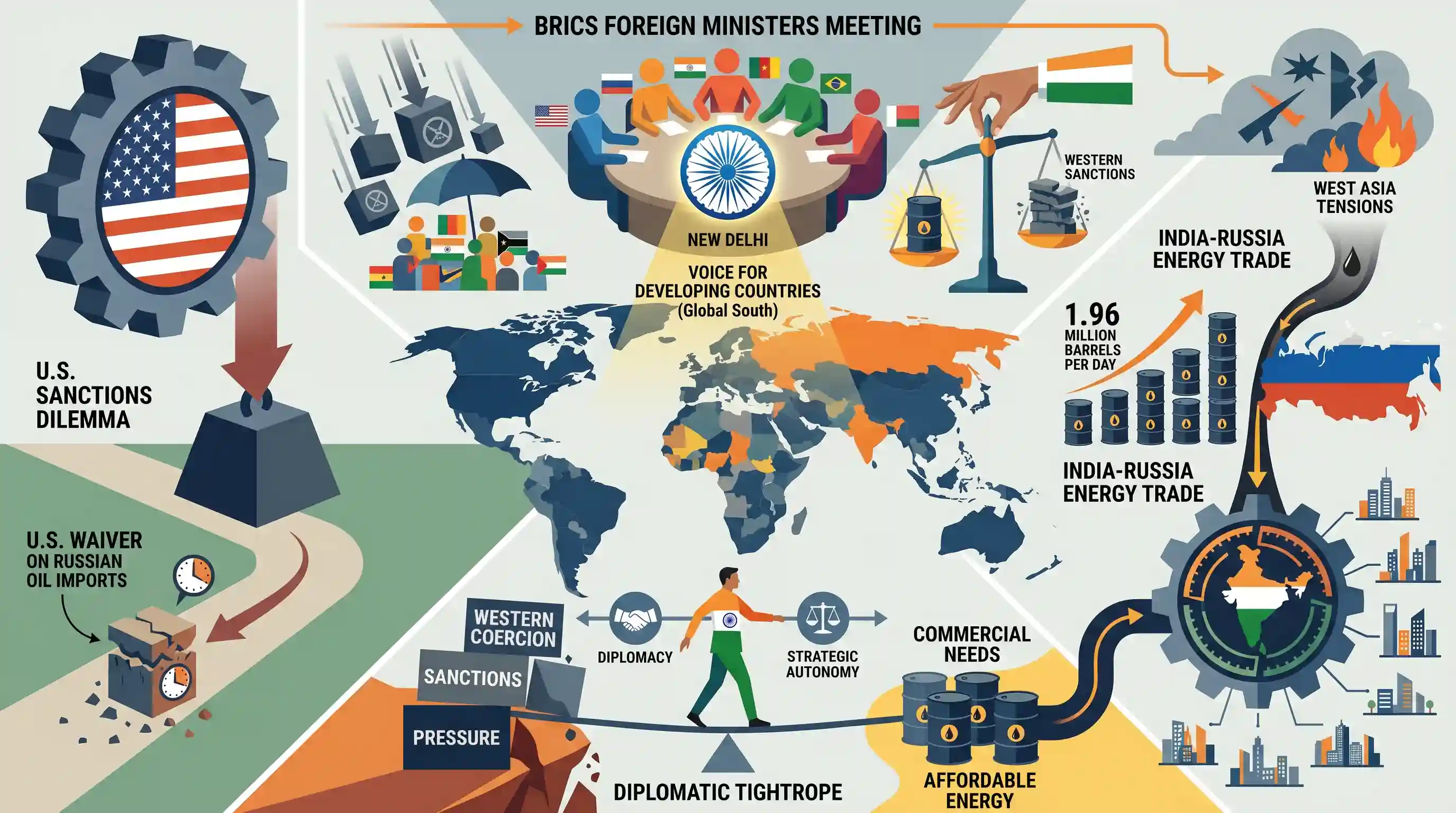
At a recent BRICS Foreign Ministers meeting in New Delhi, India's External Affairs Minister S. Jaishankar strongly criticized unilateral sanctions, stating they are unjustified and disproportionately harm developing countries. His remarks come just days before the expiration of a U.S. waiver that permitted India to import Russian crude oil despite existing sanctions. Driven by securing affordable energy amidst tensions in West Asia, India's Russian oil imports recently surged to 1.96 million barrels per day. The situation highlights India's ongoing diplomatic tightrope walk: officially refusing to recognize non-UN sanctions while practically balancing its commercial energy needs with the geopolitical realities of Western coercion.
Key Points
- External Affairs Minister S. Jaishankar criticized unilateral, non-UN sanctions at a BRICS Foreign Ministers meeting, arguing they disproportionately harm developing nations.
- A temporary U.S. waiver allowing Indian refiners to purchase Russian oil is set to expire on May 16, with the U.S. Treasury indicating no further extensions.
- India's crude oil imports from Russia surged to 1.96 million barrels per day in May as refiners sought stable supplies amid escalating tensions in West Asia.
- While officially rejecting unilateral sanctions, India pragmatically navigates them to safeguard commercial interests, continuously balancing strategic autonomy, energy demands, and diplomatic relations.
Important Terms
Unilateral Sanctions

Economic or political penalties imposed by a single country or group without UN Security Council authorization. India opposes these, asserting they lack legal legitimacy and disproportionately harm developing nations.
UPSC context
GS Paper-2: Effect of policies of developed countries on India's interests; tests understanding of international law and sovereign rights.
Strategic Autonomy
India’s foreign policy principle of making independent decisions based on national interest rather than following any specific power bloc. It allows India to balance relations with competing global powers.
UPSC context
GS Paper-2: Indian Foreign Policy; core concept testing India's shift to multi-alignment in a multipolar world.
BRICS
An intergovernmental organization comprising major emerging economies like Brazil, Russia, India, China, and South Africa. It advocates for a multipolar world and reforms to Western-led global financial institutions.
UPSC context
GS Paper-2: Global groupings involving India; tests knowledge of India's role in South-South cooperation.
UN Charter
The UN's founding treaty establishing international law. India maintains that sanctions are only legitimate when mandated by the UN Security Council under the Charter’s collective security framework.
UPSC context
GS Paper-2: International institutions and mandates; tests understanding of the legal basis for the global order.
Energy Security
Ensuring the uninterrupted availability of energy sources at an affordable price. For India, importing discounted Russian crude is a strategic imperative to stabilize the domestic economy and inflation.
UPSC context
GS Paper-3: Infrastructure and Energy; tests understanding of how resource procurement impacts national development.
Secondary Sanctions
Penalties imposed by a state on third-party entities for engaging in trade with a primary sanctioned target, often forcing non-aligned countries to choose between conflicting commercial and diplomatic interests.
UPSC context
GS Paper-2: Effect of policies of developed countries; tests understanding of extraterritoriality in international relations.
Ministry of External Affairs (MEA)
The Indian government ministry responsible for foreign relations. It implements foreign policy, manages diplomatic missions, and articulates India's official stance on global issues.
UPSC context
GS Paper-2: Structure and functioning of the Executive; tests knowledge of India’s diplomatic machinery.
U.S. Treasury
The U.S. department that administers economic sanctions through the Office of Foreign Assets Control (OFAC), significantly impacting global trade and nations importing sanctioned goods.
UPSC context
GS Paper-2: Important International institutions; tests knowledge of external agencies impacting India’s economic landscape.
Prelims Trap
India officially recognizes and enforces US-imposed unilateral economic sanctions under international trade laws.
India explicitly rejects unilateral sanctions (like those by the US or EU). It only recognizes and is legally bound by multilateral sanctions mandated by the United Nations Security Council (UNSC).
Static Concepts Connected
What are the distinct types of international economic sanctions?
- Unilateral Sanctions: Imposed by a single country or bloc (e.g., US or EU) without a UN mandate. India does not officially recognize these under international law.
- Multilateral Sanctions: Mandated by the UN Security Council under Chapter VII of the UN Charter. These are legally binding on all UN member states.
- Secondary Sanctions: Also known as extraterritorial sanctions. The sanctioning nation penalizes third-party entities (like Indian refiners) for conducting business with the primary sanctioned state.
How do crude oil dynamics impact India's macroeconomic stability?
- Current Account Deficit: Since India imports over 85% of its crude, expensive oil widens the CAD, putting depreciative pressure on the Rupee and drawing down forex reserves.
- Imported Inflation: Elevated crude prices cascade into higher domestic transport, logistics, and manufacturing costs, driving up headline retail inflation (CPI).
- Strategic Buffer: Discounted Russian crude helps cushion these shocks, demonstrating why energy security dictates India's strategic autonomy and overrides Western diplomatic pressure.
Cross-Topic Patterns
Vostro Accounts & Rupee Trade
Sanctions on Russia pushed India to use Special Rupee Vostro Accounts, directly linking geopolitical strategy to the RBI's macroeconomic push for the internationalization of the Rupee.
BRICS Alternative Financial Architecture
Opposition to Western financial dominance drives BRICS initiatives like the New Development Bank and proposed alternative payment architectures designed to bypass SWIFT and unilateral sanctions.

Expect a multi-statement Prelims question mixing UNSC sanction legality, US secondary sanctions, and RBI's Rupee-trade mechanisms in 2026.
Linked PYQs · 4
Linked PYQs · 4
- 2025MainsGS2
"Energy security constitutes the dominant kingpin of India's foreign policy, and is linked with India's overarching influence in Middle Eastern countries.” How would you integrate energy security with India's foreign policy trajectories in the coming years?
- 2018MainsGS2
In what ways would the ongoing US-Iran Nuclear Pact Controversy affect the national interest of India? How should India respond to this situation?
- 2019MainsGS2
‘What introduces friction into the ties between India and the United States is that Washington is still unable to find for India a position in its global strategy, which would satisfy India's national self-esteem and ambitions.’ Explain with suitable examples.
- 2012MainsGS2
Compare the significance of IBSA and BRICS in the context of India's multilateral diplomacy.
