Kerala Political Parties Competing for Solidarity on Chhattisgarh Nuns
Source:Indian Express ↗
Why It Matters
This issue highlights the complex interplay between religion, competitive electoral politics, and minority rights. It provides a contemporary example for UPSC aspirants to understand how incidents affecting minorities in one state can trigger intense political mobilization in another, thereby shaping the discourse on India's secularism and democratic processes.
Summary
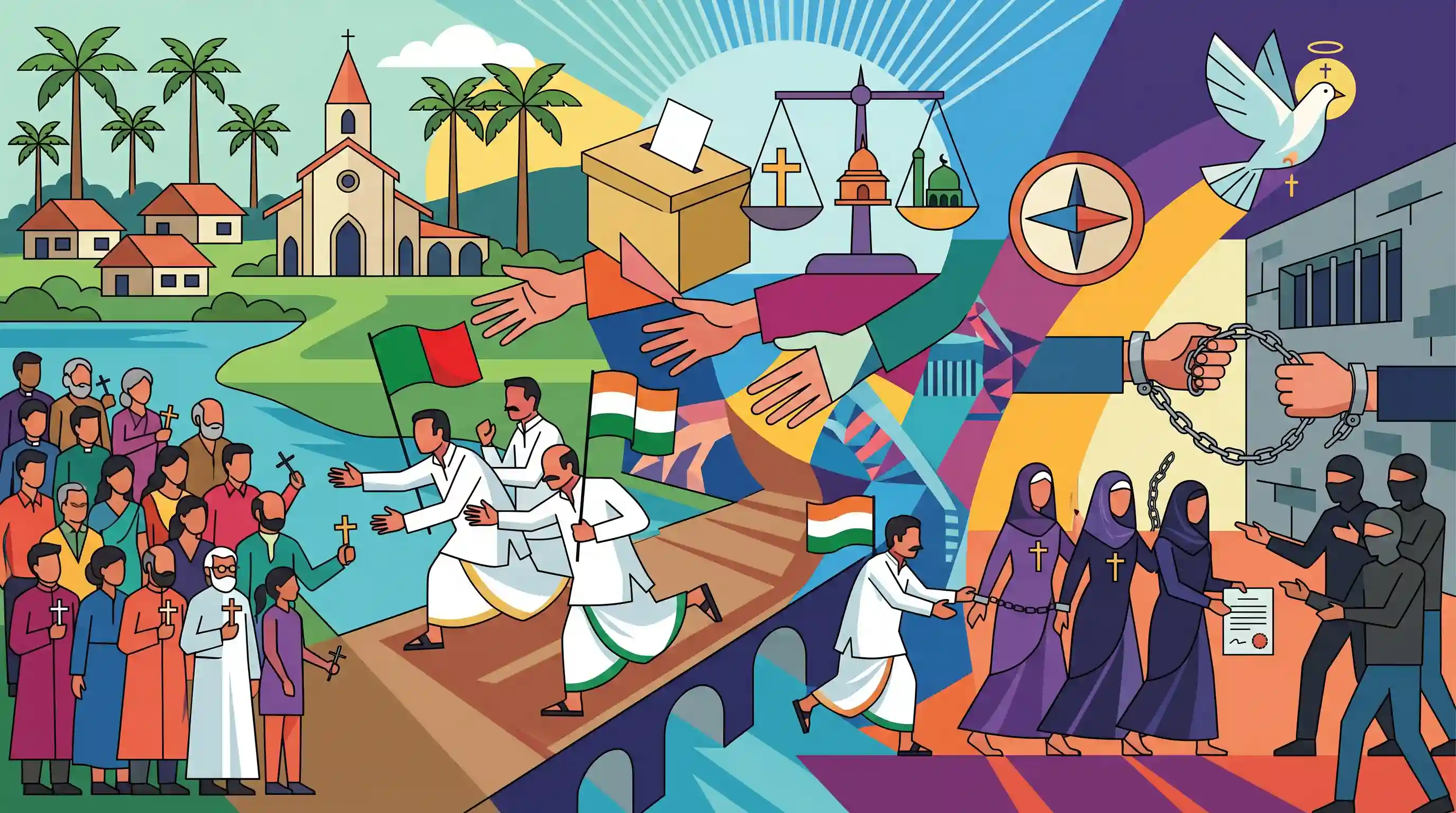
Following the release on bail of nuns arrested in Chhattisgarh, Kerala's main political parties, notably the CPI(M) and the Congress, have engaged in a competitive display of solidarity by sending delegations to the state. This political maneuvering is primarily aimed at wooing the influential Christian voter base in Kerala. The incident underscores the deeply entrenched role of religion in Indian electoral politics and highlights ongoing debates surrounding secularism, minority rights, and freedom of religion (Article 25) across different states.
Key Points
- Nuns recently arrested in Chhattisgarh have been released on bail, sparking a political contest in Kerala over claiming credit and expressing solidarity.
- Major political formations in Kerala, including the CPI(M)-led LDF and the Congress-led UDF, have sent delegations to Chhattisgarh.
- The swift political response underscores competitive electoral strategies aimed at wooing the influential Christian minority demographic in Kerala.
- The incident brings into focus broader national issues such as minority rights, freedom of religion, and the implementation of anti-conversion laws.
- Cross-state political interventions highlight how local demographic interests can drive political narratives around incidents occurring in distant states.
Important Terms
Anti-conversion Laws

State-level legislations (often termed 'Freedom of Religion Acts') designed to prevent religious conversions through force, fraud, allurement, or coercion. They mandate notification to authorities and carry punitive measures.
UPSC context
GS II (Polity); tests the balance between individual Fundamental Rights (Article 25) and the state's power to maintain public order.
Article 25
A Fundamental Right guaranteeing all persons freedom of conscience and the right to freely profess, practice, and propagate religion, subject to public order, morality, and health.
UPSC context
GS II (Fundamental Rights); essential for understanding the limits of 'propagation' and the 'Right to Convert' debate.
Indian Secularism
A 'positive' concept based on 'Sarva Dharma Sambhava' (equal respect for all religions), where the state maintains a principled distance but can intervene for social reform.
UPSC context
GS I (Social Issues) and GS II (Polity); contrasts with the Western model of absolute separation between Church and State.
Minority Rights
Constitutional safeguards under Articles 29 and 30 that protect the cultural, linguistic, and educational interests of minorities, including the right to establish and administer educational institutions.
UPSC context
GS II (Polity); tests the state's commitment to pluralism and the protection of vulnerable sections.
National Party
A political party recognized by the Election Commission of India (ECI) for its significant presence across multiple states, qualifying under specific vote-share or seat-count criteria.
UPSC context
GS II (Polity - Elections); covers the recognition criteria for parties like the Indian National Congress and CPI(M).
Indian National Congress
A centrist National Party that historically led the independence movement and advocates for a secular, pluralistic political framework within a multi-party system.
UPSC context
GS II (Polity); central to the evolution of the 'Congress System' and mainstream secular ideology in India.
CPI(M)
A recognized National Party representing left-wing ideology; it is a major political force in Kerala and follows the principles of Marxism-Leninism.
UPSC context
GS II (Polity); important for studying regional political dynamics and the role of ideological parties in India.
Prelims Trap
"Article 25 of the Indian Constitution grants citizens the fundamental right to convert others to their religion."
The SC explicitly ruled in the Rev. Stanislaus case (1977) that "propagate" under Article 25 does NOT include the right to convert others, as forced conversions threaten public order.
Static Concepts Connected
On what constitutional basis do State governments enact anti-conversion legislation?
- Public Order: States derive legislative competence from Entry 1 of the State List (Seventh Schedule), treating forced religious conversions as a threat to public peace and order.
- Rev. Stanislaus Case: The Supreme Court upheld state anti-conversion laws, clarifying that the fundamental right to propagate religion does not encompass a right to convert.
How does the Representation of the People Act, 1951 restrict religious appeals during elections?
- Section 123(3): This section prohibits candidates from appealing for votes on the grounds of religion, race, caste, community, or language.
- Corrupt Practice: Such appeals are designated as "corrupt practices," and under the Abhiram Singh judgment (2017), can lead to the outright annulment of an election result.
Cross-Topic Patterns
Interstate demographic vote-banking
Political parties intervening in distant state issues to cater to their home state's demographic highlights how regional vote-banks increasingly influence and nationalize localized law-and-order incidents.
Freedom of Religion vs. Public Order
The justification of state anti-conversion laws strictly rests on the "Public Order" restriction under Article 25(1), directly tying individual religious freedoms to state-level police powers.

Expect a multi-statement question linking Article 25 "propagate" clauses with the "Public Order" entry in the State List (List II).
Linked PYQs · 4
Linked PYQs · 4
- 2024MainsGS2
Discuss India as a secular state and compare with the secular principles of the US constitution.
- 2017MainsGS1
Distinguish between religiousness/religiosity and communalism giving one example of how the former has got transformed into the latter in independent India.
- 2018MainsGS1
Communalism arises either due to power struggle or relative deprivation.' Argue by giving suitable illustrations.
- 2019MainsGS1
What are the challenges to our cultural practices in the name of secularism?
