Sensex hitting record high offers temporary economic reprieve
Source:Indian Express ↗
Why It Matters
Understanding the intersection of domestic economic indicators (like monsoon and stock market performance) with global geopolitical events (such as Middle East tensions and US-China trade policies) is crucial for analyzing India's macroeconomic stability. This article provides vital context for GS3 topics relating to the Indian economy, energy security, and global supply chains.
Summary
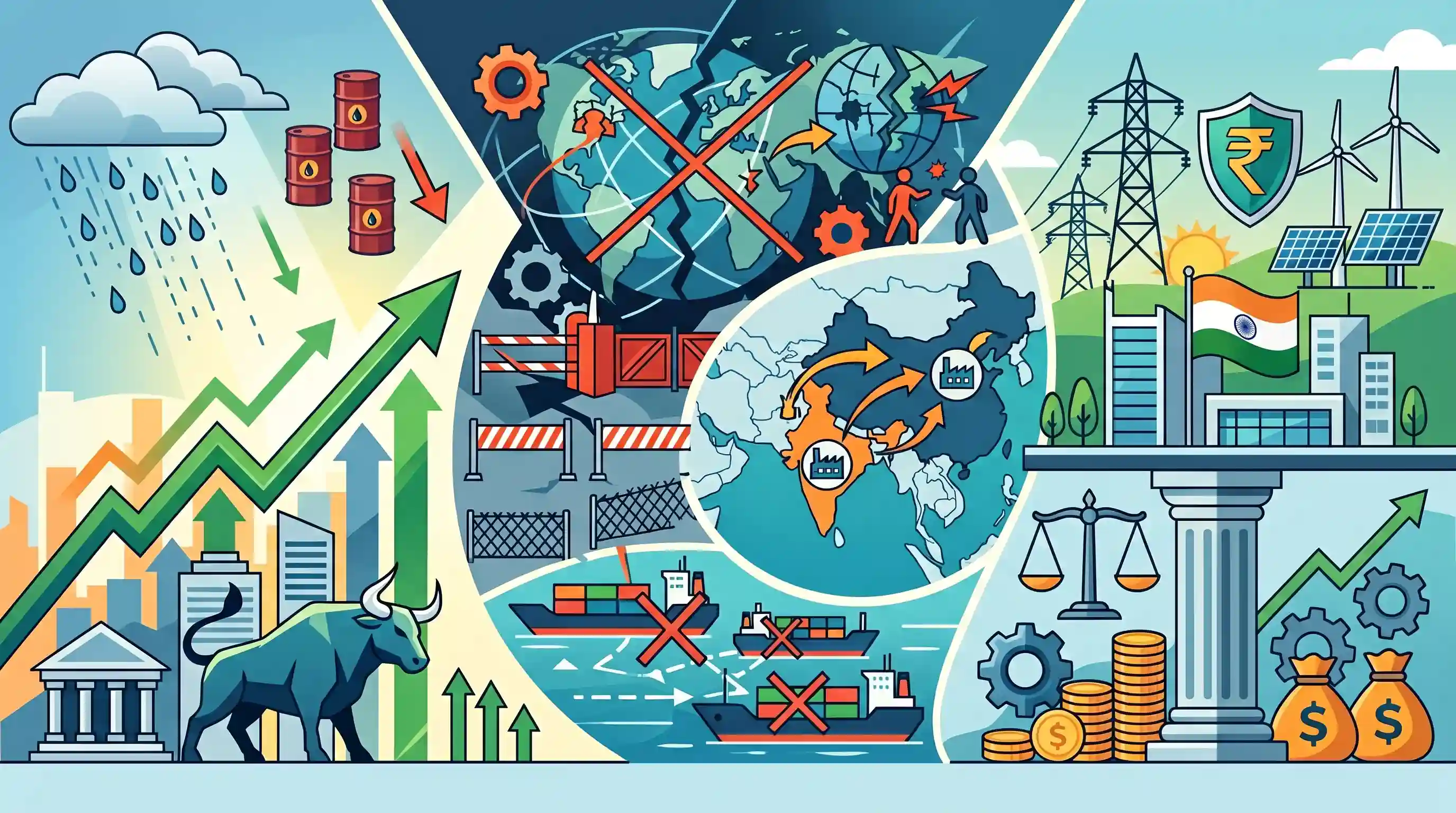
The Indian stock market's recent record highs provide a temporary economic reprieve driven by positive domestic factors like a reviving southwest monsoon and falling crude oil prices. Amidst a global backdrop of shifting geopolitical tensions and trade protectionism, India is advised to utilize this period to solidify macroeconomic stability and leverage the "China-plus-one" supply chain diversification strategy.
Key Points
- The Indian stock market hit record highs (Sensex closing at 84,059), reflecting market optimism and providing a temporary economic reprieve for India.
- Positive domestic indicators contributing to the rally include the revival of the southwest monsoon, filling of water reservoirs, and falling Brent crude oil prices.
- Global geopolitical risks, such as the Iran-Israel conflict and the US-China tariff war, appear to be temporarily ebbing or at a truce.
- The Strait of Hormuz remains a critical chokepoint for global energy security, facilitating the transit of a fifth of global oil and a third of LNG.
- The article stresses the importance of using this reprieve to bolster macroeconomic stability and capitalize on the "China-plus-one" strategy to attract global manufacturing.
Important Terms
China-plus-one strategy

A global business strategy where companies diversify supply chains by expanding into countries like India alongside China to mitigate geopolitical risks and reduce overdependence on a single manufacturing hub.
UPSC context
GS Paper III (Industry/Economy); tests understanding of global supply chain shifts and India’s manufacturing potential.
Sensex
The benchmark index of the Bombay Stock Exchange (BSE), tracking the performance of 30 large, financially sound companies. It serves as a key barometer for investor sentiment and India's economic health.
UPSC context
GS Paper III (Economy/Capital Markets); tests knowledge of financial indicators and market dynamics.
US Federal Reserve (Fed)
The central bank of the United States. Its monetary policy, especially interest rate changes, heavily influences global capital flows, foreign institutional investment (FII) in India, and the Rupee's exchange rate.
UPSC context
GS Paper III (External Sector); tests awareness of global monetary policy impacts on the domestic economy.
Macroeconomic Stability
A state where an economy maintains low inflation, sustainable fiscal and current account deficits, and consistent growth, thereby minimizing vulnerability to external shocks and attracting investment.
UPSC context
GS Paper III (Indian Economy); tests understanding of core economic health and resilience strategies.
Nifty 50
The flagship index of the National Stock Exchange (NSE), representing the weighted average of the top 50 blue-chip companies across various sectors, offering a broader market view than Sensex.
UPSC context
GS Paper III (Economy); tests familiarity with financial indices and their role in tracking national economic performance.
Prelims Trap
"Brent crude is a pricing benchmark for oil extracted exclusively from the Middle East."
Brent crude is primarily extracted from the North Sea (Europe), not the Middle East. The Dubai/Oman benchmarks represent Middle Eastern crude, though Brent influences global pricing.
Static Concepts Connected
What is the geographical significance of the Strait of Hormuz?
- Location: It acts as a critical maritime artery connecting the Persian Gulf to the Gulf of Oman and the wider Arabian Sea.
- Bordering nations: It is flanked by Iran to the north, and the United Arab Emirates and Oman (specifically the Musandam exclave) to the south.
- Energy transit: It is a highly vulnerable chokepoint that facilitates the transit of roughly 20% of global oil and a third of liquefied natural gas (LNG).
How do falling crude oil prices aid India's macroeconomic stability?
- Current Account Deficit: Because India imports over 80% of its crude oil, lower prices directly shrink the import bill, narrowing the Current Account Deficit (CAD) and stabilizing the Rupee.
- Imported inflation: Cheaper crude translates to lower domestic fuel and logistics costs, which significantly dampens imported inflation and eases pressure on both WPI and CPI.
Cross-Topic Patterns
China-Plus-One and PLI Schemes
Global supply chain diversification away from China provides a strategic window for India's Production Linked Incentive (PLI) schemes to capture migrating electronics and manufacturing hubs.
Reservoir levels and RBI stance
Robust southwest monsoons and high reservoir levels suppress food inflation, directly influencing the RBI Monetary Policy Committee's ability to transition towards rate cuts.

Expect a 2026 map-based question linking Middle East chokepoints (Hormuz, Bab-el-Mandeb) to specific global energy transit disruptions.
Linked PYQs · 3
Linked PYQs · 3
- 2018MainsGS3
How would the recent phenomena of protectionism and currency manipulations in world trade affect macroeconomic stability of India?
- 2021MainsGS1
Discuss the multi-dimensional implications of uneven distribution of mineral oil in the world.
- 2022MainsGS3
Is inclusive growth possible under market economy ? State the significance of financial inclusion in achieving economic growth in India.
