Macroeconomic Impact of Sustained Low Inflation
Source:Indian Express ↗
Why It Matters
Understanding the interplay between global commodity prices (like crude oil), domestic inflation indices (WPI and CPI), and the subsequent monetary (RBI rate cuts) and fiscal (excise duty hikes) policy responses is a core component of the UPSC GS3 Economy syllabus.
Summary
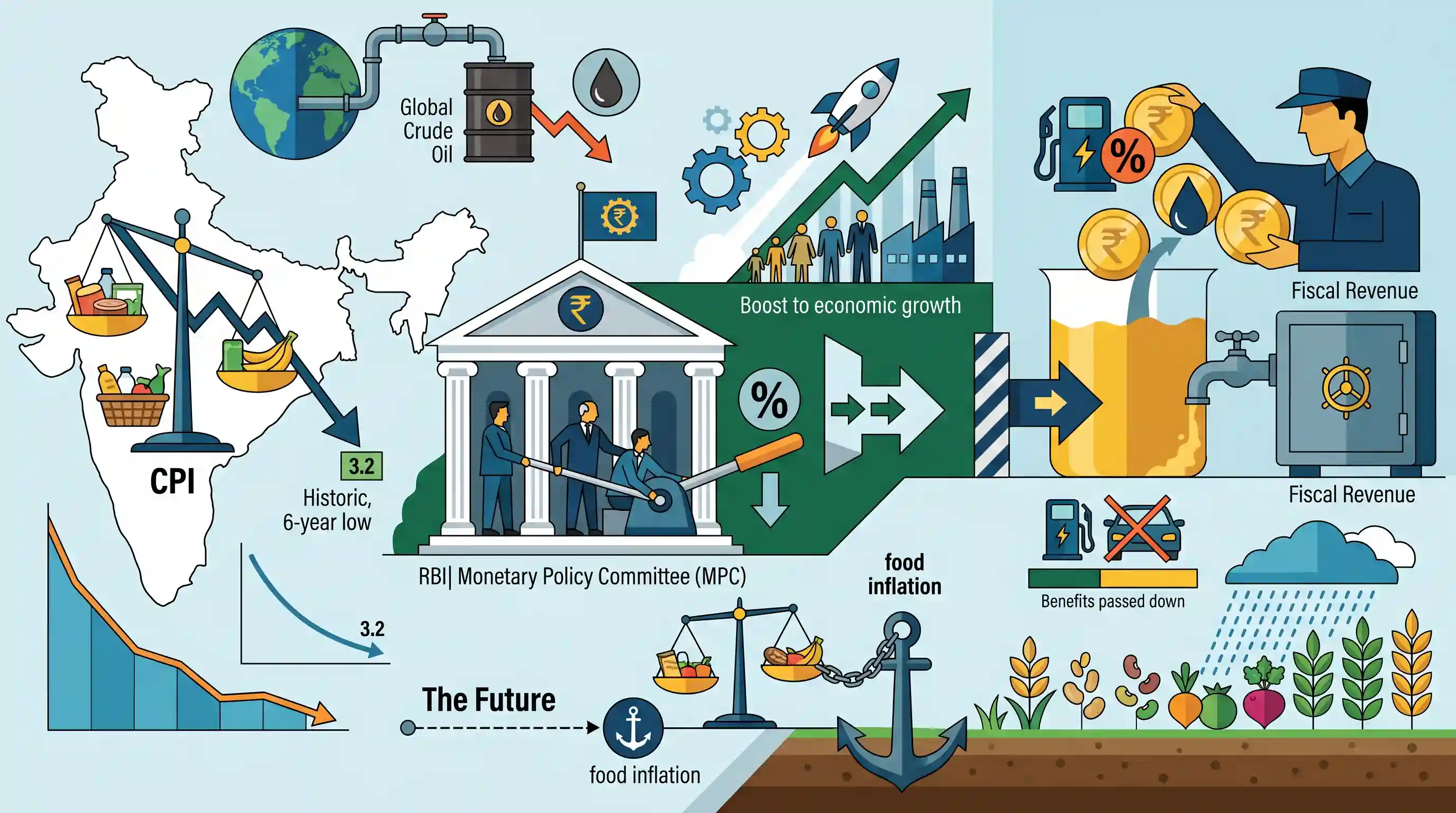
The editorial highlights the sustained moderation of both wholesale and retail inflation in India, with CPI dropping to a six-year low of 3.2% in April. This development offers the Reserve Bank of India's Monetary Policy Committee the much-needed leeway to cut interest rates and boost economic growth. The moderation is largely driven by plunging global crude oil prices. However, rather than passing the benefits to consumers, the government has capitalized on the low prices by hiking excise duties on fuel to bolster its fiscal revenues. Moving forward, a normal monsoon will be crucial in keeping food inflation anchored.
Key Points
- India witnessed a sustained moderation in inflation in April, with Wholesale Price Index (WPI) growth slowing to a 14-month low of 0.9% and retail inflation (CPI) easing to a 6-year low of 3.2%.
- The decline in retail inflation to well within the RBI's target band of 4% (+/- 2%) provides the Monetary Policy Committee (MPC) with significant space to cut interest rates and stimulate economic growth.
- A major contributor to the disinflationary trend has been the sharp fall in global crude oil prices.
- Instead of passing the benefits of lower global oil prices to consumers, the government increased excise duties on petrol and diesel to shore up its tax revenues and maintain fiscal stability.
- A predicted normal monsoon is expected to keep food inflation in check, further supporting macroeconomic stability and monetary easing.
Important Terms
Monetary Policy Committee (MPC)

A six-member statutory body established under the RBI Act (1934) to decide India’s benchmark interest rates. It targets price stability while supporting economic growth, meeting at least four times annually.
UPSC context
GS Paper III / Indian Economy. Tests institutional frameworks for price stability and the 2016 monetary reform.
Flexible Inflation Targeting (FIT)
A framework where the RBI targets a specific inflation rate (currently 4% with a ±2% band) while considering growth. It was legally adopted in 2016 to anchor long-term price expectations.
UPSC context
GS Paper III / Monetary Policy. Tests understanding of the "4±2%" mandate and balancing growth with stability.
Consumer Price Index (CPI)
An index measuring the average change in retail prices of a fixed basket of goods and services. It serves as the primary gauge for the Reserve Bank of India’s inflation-targeting framework.
UPSC context
GS Paper III / Indian Economy. Tests understanding of retail inflation metrics and their role in policy.
Wholesale Price Index (WPI)
A measure tracking price changes of goods traded in bulk at the wholesale level. Compiled by the Ministry of Commerce & Industry, it captures supply-side inflation before reaching retail consumers.
UPSC context
GS Paper III / Indian Economy. Tests ability to distinguish between producer-level and consumer-level price pressures.
Excise Duty
An indirect tax levied by the central government on the manufacture or production of goods within the country. On fuel, it acts as a crucial non-GST revenue stream for fiscal management.
UPSC context
GS Paper III / Fiscal Policy. Tests knowledge of indirect taxes and the government's resource mobilization.
Fiscal Policy
The use of government spending and taxation to influence the economy. It focuses on revenue mobilization and expenditure management to meet fiscal deficit targets and promote growth.
UPSC context
GS Paper III / Government Budgeting. Tests understanding of the executive’s role in economic stabilization.
Prelims Trap
A sharp fall in global crude oil prices automatically leads to a proportional decrease in retail fuel prices.
While fuel is deregulated, governments often hike excise duties during global oil price crashes to absorb the differential for tax revenue, preventing full consumer pass-through.
Static Concepts Connected
How does the RBI's Flexible Inflation Targeting (FIT) framework operate?
- Target Range: The primary objective is to maintain Consumer Price Index (CPI) inflation at 4%, with a tolerance band of +/- 2%.
- Statutory Authority: The target is set by the Government of India, in consultation with the RBI, once every five years under the amended RBI Act, 1934.
- Monetary Policy Committee: A six-member committee (3 from RBI, 3 external) determines the policy repo rate required to achieve the inflation target.
What are the key differences between WPI and CPI in India?
- Coverage: WPI measures prices at the wholesale/producer level (goods only); CPI measures prices at the retail/consumer level (goods and services).
- Food Weightage: CPI has a much higher weight for food (~45.8%) compared to WPI, making retail inflation significantly more sensitive to monsoon and agricultural supply.
- Publishing Agency: WPI is published by the Office of Economic Adviser (MoCI); CPI is published by the National Statistical Office (NSO) under MoSPI.
Cross-Topic Patterns
Monetary easing vs. Fiscal consolidation
As the RBI gains room to cut rates (monetary stimulus), the government's move to hike excise duties on cheap oil acts as a fiscal stabilizer, showcasing coordinated macroeconomic management.
Imported inflation and CAD dynamics
Falling global crude prices not only ease domestic inflation but also significantly reduce India's import bill, directly shrinking the Current Account Deficit and stabilizing the Rupee.

Expect a multi-statement Prelims question testing the interplay between global crude price crashes, excise duty adjustments, and CPI.
Linked PYQs · 4
Linked PYQs · 4
- 2020PrelimsGS1
Consider the following statements: 1. The weightage of food in Consumer Price Index (CPI) is higher than that in Wholesale Price Index (WPI). 2. The WPI does not capture changes in the prices of services, which CPI does. 3. Reserve Bank of India has now adopted WPI as its key measure of inflation and to decide on changing the key policy rates. Which of the statements given above is/are correct?
- 2010PrelimsGS1
With reference to India, consider the following statements : 1. The Wholesale Price Index (WPI) in India is available on a monthly basis only. 2. As compared to Consumer Price Index for Industrial Workers (CPI(IW)), the WPI gives less weight to food articles. Which of the statements given above is/are correct ?
- 2022PrelimsGS1
In India, which one of the following is responsible for maintaining price stability by controlling inflation?
- 2024MainsGS3
What are the causes of persistent high food inflation in India? Comment on the effectiveness of the monetary policy of the RBI to control this type of inflation.
