India-Bangladesh Relations and Extradition Diplomacy
Source:Indian Express ↗
Why It Matters
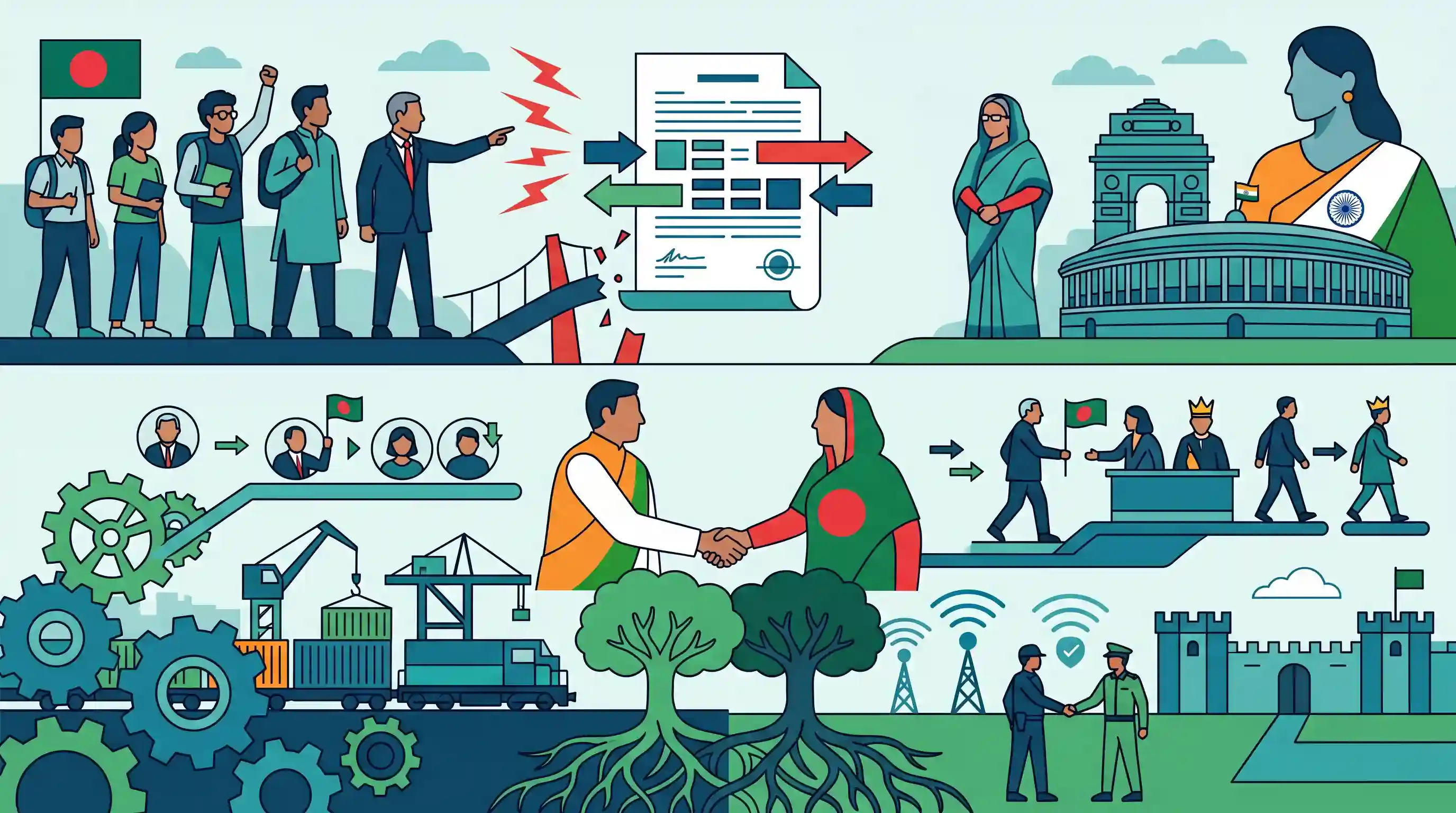
The political transition in Bangladesh and the subsequent diplomatic friction over Sheikh Hasina's extradition present a textbook case of the challenges inherent in India's 'Neighborhood First' policy. It highlights the delicate balance New Delhi must maintain between supporting historical allies and pragmatically engaging with new regimes to protect critical border security, economic, and connectivity interests.
Summary
The article analyzes the diplomatic implications of the interim Bangladesh government's demand for the extradition of former Prime Minister Sheikh Hasina from India. It notes that while India is not legally obligated to comply under the 2013 extradition treaty, Hasina's presence in India has become a major friction point. The editorial stresses the importance of 'politics-proofing' bilateral ties, advising that long-term strategic, economic, and border security cooperation must transcend political transitions and individual leaders, given the vital geopolitical interdependence of the two neighbors.
Key Points
- The interim government of Bangladesh led by Muhammad Yunus is seeking the extradition of ousted Prime Minister Sheikh Hasina from India.
- The 2013 bilateral extradition treaty contains exemptions for offenses of a political character, meaning India is not legally obliged to hand her over.
- Under Hasina's tenure, India-Bangladesh relations reached new heights with key initiatives in connectivity, trade, and border security, which are currently facing pushback in Dhaka.
- A surge in anti-India sentiment and political instability in Bangladesh poses risks to India's border security and regional connectivity goals.
- The editorial argues that both nations must 'politics-proof' their relationship, ensuring that a 4,000-km shared border and mutual economic interests take precedence over individual leaders or party ideologies.
Important Terms
2013 Extradition Treaty (India-Bangladesh)

A bilateral agreement signed in 2013 (amended 2016) to surrender individuals accused of crimes punishable by at least one year. It simplifies extradition by accepting arrest warrants without prima facie evidence.
UPSC context
GS Paper II (IR); critical for understanding legal frameworks governing neighborhood security and the management of cross-border fugitives.
Political Offence Clause
A provision (Article 6 of the 2013 Treaty) permitting refusal of extradition for political crimes. However, it explicitly excludes serious offenses like murder, terrorism, and kidnapping from being classified as 'political'.
UPSC context
GS Paper II (International Relations); tests knowledge of international law, diplomatic immunity, and the legal hurdles in high-profile extradition cases.
Interim Government (Bangladesh)
A non-partisan, temporary administration led by Chief Adviser Muhammad Yunus, established in August 2024 to restore order and oversee new elections following the collapse of the Awami League government.
UPSC context
GS Paper II (Neighborhood Relations); concerns India’s strategy for maintaining stability and protecting interests during neighboring political transitions.
Neighbourhood First Policy
A primary foreign policy pillar emphasizing physical, digital, and economic connectivity with immediate neighbors to ensure a peaceful, prosperous, and stable South Asian region.
UPSC context
GS Paper II (International Relations); the fundamental framework for analyzing India's regional engagement and strategic responses to crises in nearby states.
Politics-proofing
A diplomatic concept aimed at insulating core bilateral interests—such as trade, energy, and security—from the volatility of internal political shifts or changes in leadership in partner nations.
UPSC context
GS Paper II (International Relations); relevant for essays or questions on building sustainable, institutionalized ties that transcend individual political regimes.
Awami League
The political party led by Sheikh Hasina that held power from 2009 to 2024. Its secular, pro-India stance long anchored the bilateral strategic partnership, particularly in counter-terrorism.
UPSC context
GS Paper II (Neighborhood Relations); essential context for understanding the internal political drivers of Bangladesh’s foreign policy towards India.
Prelims Trap
"India is legally bound to extradite a fugitive if an official extradition treaty exists with the requesting nation."
Extradition is rarely absolute. Treaties universally incorporate exceptions (like the political offence exception) and require Dual Criminality, meaning India is not legally forced to blindly comply with demands.
Static Concepts Connected
What are the core legal principles governing India's international extradition requests?
- Dual Criminality: The alleged crime must be recognized as a punishable offense (usually >= 1 year imprisonment) in both the requesting and requested states.
- Political Offence Exception: The requested state can refuse extradition if the crime is deemed political, though severe crimes like murder and terrorism are explicitly excluded.
- Principle of Specialty: The extradited fugitive can only be tried for the specific crime mentioned in the original extradition request, not for other past offenses.
Why is Bangladesh geographically and strategically critical for India's Northeast?
- Siliguri Corridor bypass: Bangladesh provides vital transit access, bypassing the narrow 'Chicken's Neck' (Siliguri Corridor) to physically and economically connect mainland India to the Northeast.
- Insurgency management: A cooperative Dhaka is essential to dismantle camps of Indian insurgent groups (like ULFA, NDFB) that previously used Bangladeshi territory as a safe haven.
- Port connectivity: Transit agreements utilizing Chittagong and Mongla ports are crucial for the economic integration and trade logistics of India's landlocked Northeastern states.
Cross-Topic Patterns
Regime changes & Neighbourhood First Policy
India's reliance on specific leaders (Hasina in Bangladesh, Solih in Maldives) exposes a structural vulnerability in its Neighbourhood First Policy whenever domestic anti-incumbency sweeps the opposition into power.
Border management & political instability
Political turmoil in Dhaka directly tests GS3 border management, elevating the risks of undocumented migration, insurgent safe-havens, and smuggling across the porous 4,096-km shared boundary.

Expect a prelims statement testing the 'Principle of Dual Criminality' and 'political offence exception' within India's Extradition Act.
Linked PYQs · 4
Linked PYQs · 4
- 2013MainsGS1
Critically examine the compulsions which prompted India to play a decisive role in the emergence of Bangladesh.
- 2020MainsGS3
Analyze internal security threats and transborder crimes along Myanmar, Bangladesh and Pakistan borders including Line of Control (LoC). Also discuss the role played by various security forces in this regard.
- 2022MainsGS2
India is an age-old friend of Sri Lanka.’ Discuss India's role in the recent crisis in Sri Lanka in the light of the preceding statement.
- 2022MainsGS2
Do you think that BIMSTEC is a parallel organisation like the SAARC ? What are the similarities and dissimilarities between the two ? How are Indian foreign policy objectives realized by forming this new organisation?
