Enforcement Directorate and Judicial Scrutiny of PMLA Investigations
Source:Indian Express ↗
Why It Matters
This editorial highlights the growing friction between central investigative agencies and state governments, touching upon critical constitutional issues like federalism, separation of powers, and the balance between stringent anti-corruption laws (PMLA) and fundamental rights (Article 21). It is highly relevant for GS Paper 2 (Polity and Governance) and GS Paper 3 (Internal Security - Money Laundering).
Summary
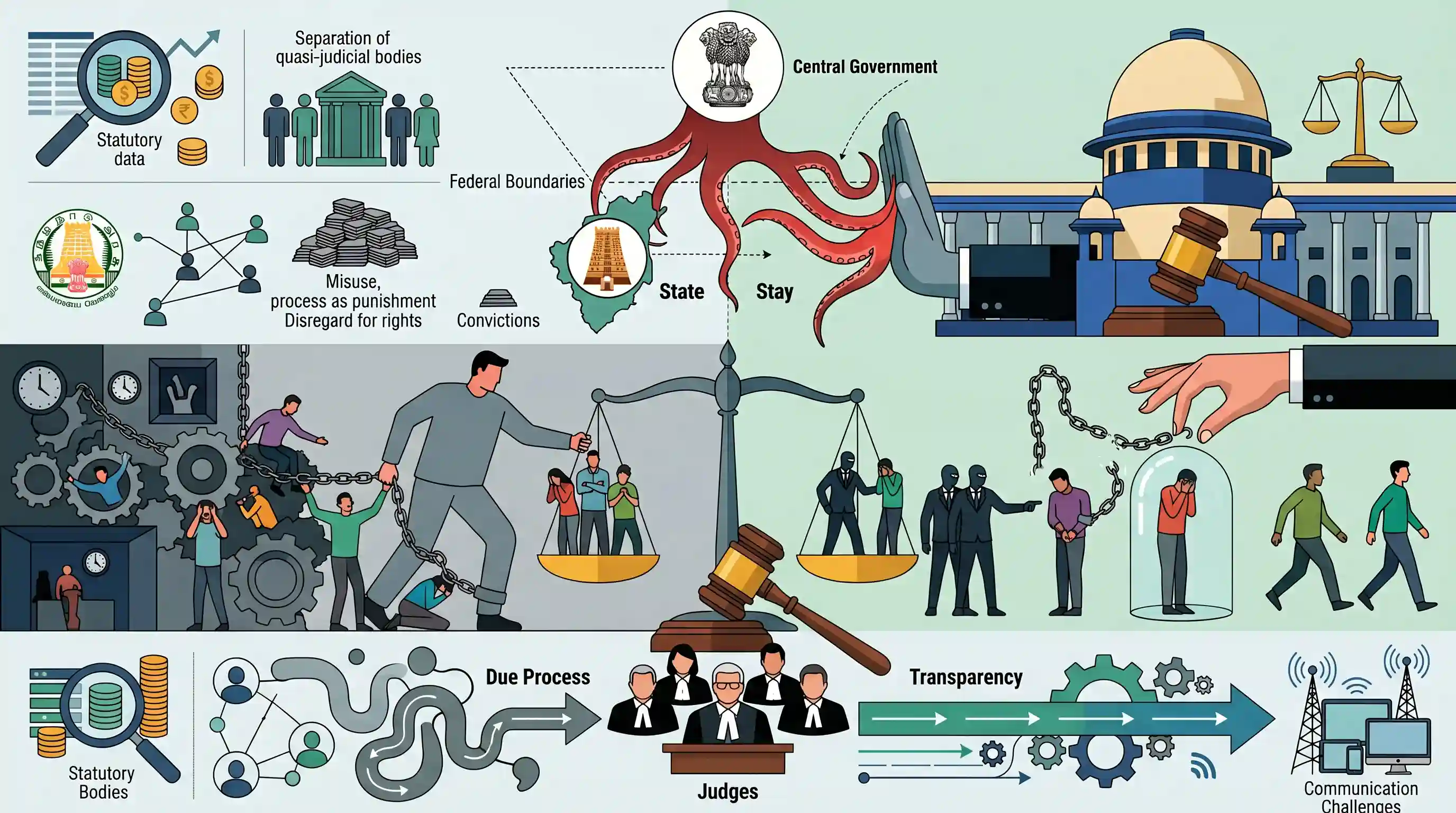
The Supreme Court recently stayed the Enforcement Directorate's (ED) probe into Tamil Nadu's TASMAC, criticizing the central agency for overstepping its jurisdiction and infringing upon federal principles. The editorial highlights the SC's repeated rebukes of the ED for alleged misuse of the Prevention of Money Laundering Act (PMLA), citing instances of arbitrary allegations, prolonged interrogations, and disregard for fundamental rights. Despite the Supreme Court upholding PMLA's stringent provisions in the 2022 Vijay Madanlal Choudhary case, it stressed the need for safeguards to protect personal liberty. With a conviction rate of less than 1% and allegations of selectively targeting Opposition leaders, the editorial argues that the ED is using the 'process as punishment' and calls for urgent course correction, strict adherence to due procedure, and greater transparency in its operations.
Key Points
- The Supreme Court halted the ED's probe into Tamil Nadu's TASMAC, terming the central agency's intervention an infringement on federal principles and beyond its jurisdiction.
- The SC has repeatedly censured the ED for misusing the Prevention of Money Laundering Act (PMLA), making arbitrary allegations, and violating the fundamental rights and dignity of the accused.
- While the 2022 Supreme Court verdict in Vijay Madanlal Choudhary vs Union of India upheld the stringent provisions of the PMLA, it strongly emphasized the need for safeguards protecting personal liberty.
- With a conviction rate of less than 1% over the last decade, the ED has been accused by the Court of utilizing the investigative 'process as punishment.'
- The editorial raises concerns over the ED's political neutrality, citing data that 95% of political leaders probed since 2014 are from the Opposition, and urges the agency to prioritize due process and transparency.
Important Terms
Prevention of Money Laundering Act (PMLA)

A 2002 Indian law designed to prevent money laundering and allow the confiscation of proceeds from crime. It features stringent bail conditions and a reverse burden of proof.
UPSC context
GS Paper 3: Internal Security (money laundering) and GS Paper 2: Statutory bodies and government policies.
Enforcement Directorate (ED)
A specialized financial investigation agency under the Ministry of Finance. It enforces economic laws like PMLA, the Foreign Exchange Management Act (FEMA), and the Fugitive Economic Offenders Act.
UPSC context
GS Paper 2: Statutory, regulatory and quasi-judicial bodies; GS Paper 3: Internal Security and economic offenses.
Vijay Madanlal Choudhary Case (2022)
A landmark 2022 Supreme Court judgment that upheld the constitutionality of the PMLA's stringent provisions, including the ED's powers of arrest and the 'twin conditions' for bail.
UPSC context
GS Paper 2: Judiciary, Fundamental Rights, and separation of powers; tests understanding of legal safeguards versus state power.
TASMAC
A state-owned company in Tamil Nadu with a monopoly over the wholesale and retail vending of alcoholic beverages. It is currently at the center of a federal-jurisdictional dispute.
UPSC context
GS Paper 2: Issues and challenges pertaining to the federal structure and center-state relations.
Federal Structure
The constitutional arrangement dividing power between the Union and States. The Supreme Court recently rebuked the ED for 'violating' this structure by overreaching into state-owned entities.
UPSC context
GS Paper 2: Functions and responsibilities of the Union and the States; tests concepts of cooperative and competitive federalism.
Prelims Trap
The Enforcement Directorate can take suo motu cognizance to register a case of money laundering under the PMLA.
The ED cannot initiate a money-laundering probe independently. It strictly requires a 'predicate' or 'scheduled' offence to be registered first by another law enforcement agency.
Static Concepts Connected
What is a 'Predicate Offence' under the PMLA framework?
- Trigger mechanism: ED cannot act independently; it needs a pre-existing FIR by agencies like State Police or CBI for a 'scheduled offence'.
- Scheduled offences: These include specific crimes listed in the PMLA schedule (e.g., under IPC, NDPS Act, UAPA) from which 'proceeds of crime' are derived.
- Acquittal impact: As per Supreme Court rulings, if an accused is acquitted or discharged in the predicate offence, the linked PMLA case automatically collapses.
How is the Enforcement Directorate (ED) positioned within the Union Government?
- Nodal Ministry: It functions under the Department of Revenue, which is under the Ministry of Finance.
- Acts enforced: It enforces criminal provisions of the PMLA (2002), civil provisions of FEMA (1999), and the Fugitive Economic Offenders Act (2018).
Cross-Topic Patterns
General Consent (CBI) vs Predicate Offence (ED)
While the CBI requires 'general consent' from states under the DSPE Act, the ED uses the PMLA to bypass state consent, making it the new primary battleground for Centre-State investigative friction.
Bail Jurisprudence: PMLA and UAPA parallels
The stringent twin conditions for bail under PMLA reverse the presumption of innocence, echoing the restrictive bail provisions of the UAPA. Both laws prompt judicial debates on 'process as punishment.'

Expect a 2026 Prelims multi-statement question contrasting ED, CBI, and NIA regarding state consent, suo motu powers, and nodal ministries.
Linked PYQs · 4
Linked PYQs · 4
- 2021MainsGS2
The jurisdiction of the Central Bureau of Investigation (CBI) regarding lodging an FIR and conducting probe within a particular State is being questioned by various States. However, the power of the States to withhold consent to the CBI is not absolute. Explain with special reference to the federal character of India.
- 2021MainsGS3
Discuss how emerging technologies and globalisation contribute to money laundering. Elaborate measures to tackle the problem of money laundering both at national and international levels.
- 2019MainsGS3
Indian Government has recently strengthened the anti-terrorism laws by amending the Unlawful Activities (Prevention) Act (UAPA), 1967 and the NIA Act. Analyze the changes in the context of prevailing security environment while discussing the scope and reasons for opposing the UAPA by human rights organizations.
- 2017MainsGS2
Examine the scope of Fundamental Rights in the light of the latest judgement of the Supreme Court on Right to Privacy.
