India Kuwait ties strategic partnership and West Asia security goals
Source:Indian Express ↗
Why It Matters
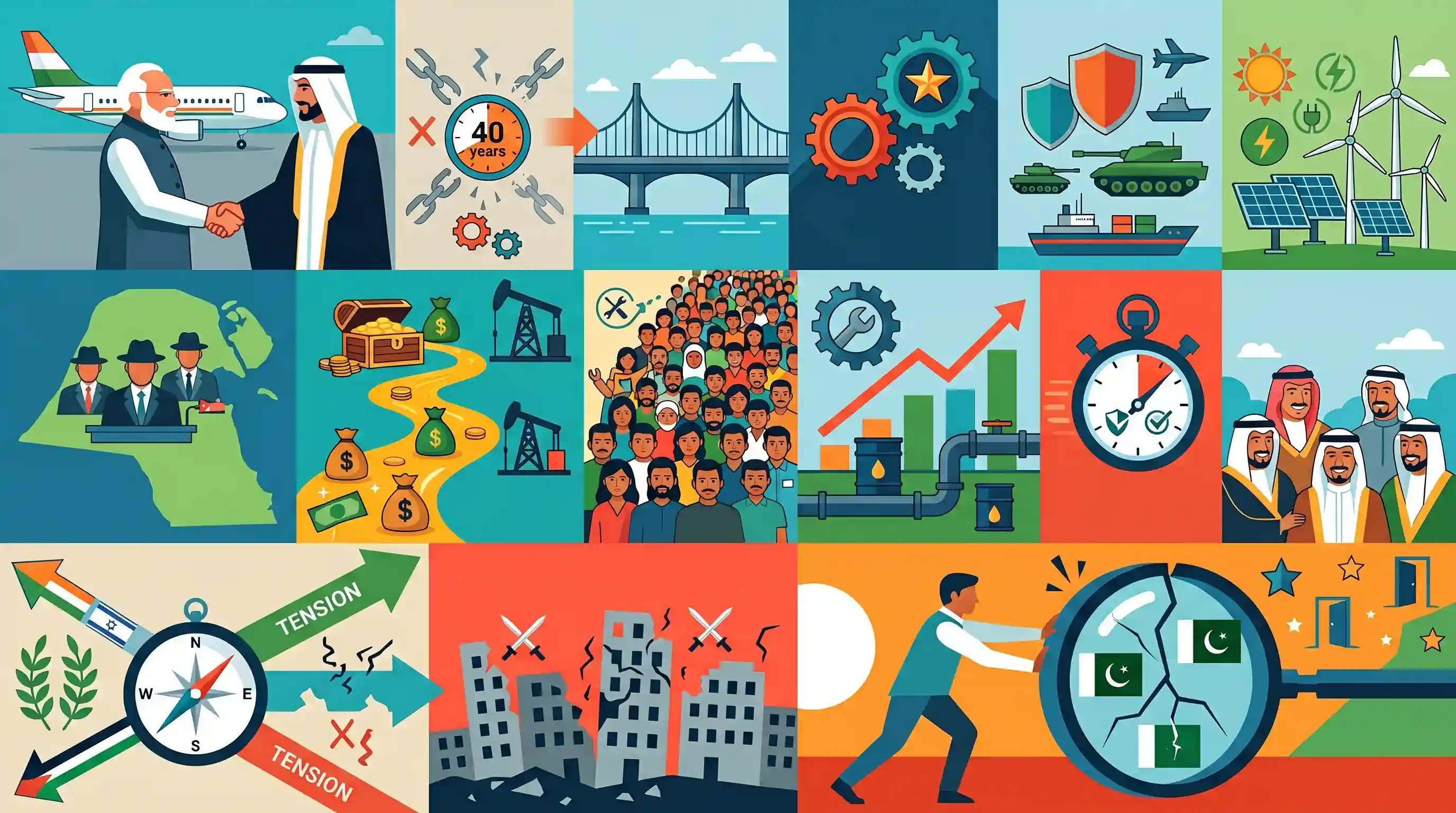
The article illustrates a major milestone in India's foreign policy by concluding a long period of estrangement with Kuwait. It highlights the practical requirements—operationalising defence pacts and securing FDI—to sustain India's strategic footprint in a rapidly reorganising West Asia amid post-Abraham Accords realignments and conflicts.
Summary
The editorial analyzes Prime Minister Narendra Modi's historic visit to Kuwait, the first by an Indian PM in 40 years, marking a decisive shift from past diplomatic neglect following the 1990 Gulf War. It highlights the elevation of bilateral ties to a strategic partnership with new agreements in defence and renewables. Kuwait's role as GCC president, a major source of FDI via Sovereign Wealth Funds, and host to a large Indian diaspora makes it vital to India's economic and energy security. The article urges New Delhi to swiftly operationalize security pacts and leverage its successful engagement with moderate Arab states to navigate ongoing geopolitical shifts, including the Israel-Palestine conflict and instability in post-Assad Syria, independent of the Pakistan prism.
Key Points
- PM Modi's visit to Kuwait is the first by an Indian Prime Minister in four decades, correcting a historic diplomatic distance that originated during India's ambivalence over Saddam Hussein's 1990 invasion of Kuwait.
- Bilateral relations have been elevated to a strategic partnership with newly signed agreements to institutionalise defence cooperation and develop renewable energy projects.
- Kuwait is a critical economic partner for India, acting as the current president of the GCC, hosting a large Indian diaspora, and serving as a major potential source for FDI via its Sovereign Wealth Funds.
- India has successfully decoupled its Gulf relations from the Pakistan prism, deepening engagement with moderate Arab states.
- The editorial emphasizes that India must rapidly operationalise security agreements and foster a business-friendly environment to navigate regional instability driven by the Israel-Palestine conflict and post-Assad Syria.
Important Terms
India-Kuwait Strategic Partnership

A 2024 diplomatic milestone elevating India-Kuwait ties beyond oil trade into comprehensive cooperation across defense, renewables, and technology, formalizing a shift from past buyer-seller relations.
UPSC context
GS Paper II (International Relations). Tests bilateral milestones and strategic reorientation in India's 'extended neighborhood.'
Gulf Cooperation Council (GCC)
A regional political and economic union of six Arab states (Bahrain, Kuwait, Oman, Qatar, Saudi Arabia, UAE). It is India’s largest trading partner and vital for energy security.
UPSC context
GS Paper II (Regional Groupings). Crucial for topics on energy security, diaspora, and regional stability.
Sovereign Wealth Funds (SWFs)
State-owned investment funds, such as the Kuwait Investment Authority (KIA), funded by forex reserves or commodity revenues. They are key sources of long-term FDI for India's infrastructure.
UPSC context
GS Paper III (Indian Economy). Relevant for FDI trends, infrastructure financing, and National Investment and Infrastructure Fund (NIIF).
Abraham Accords
2020 U.S.-brokered agreements normalizing relations between Israel and several Arab nations (UAE, Bahrain). They facilitate India's plurilateral engagement in West Asia through groupings like I2U2.
UPSC context
GS Paper II (Geopolitics). Tests India’s 'de-hyphenation' policy and its ability to navigate regional shifts.
Link West Policy
India’s strategic framework for proactive engagement with West Asian nations, expanding beyond energy imports to include maritime security, counter-terrorism, and food security corridors.
UPSC context
GS Paper II (India's Foreign Policy). Tests strategic autonomy and regional outreach mechanisms.
Prelims Trap
India and Kuwait recently operationalized a Comprehensive Economic Partnership Agreement (CEPA).
Aspirants confuse this with the UAE CEPA. With Kuwait, India only recently elevated relations to a 'Strategic Partnership'—no FTA or CEPA exists yet.
Static Concepts Connected
What comprises the Gulf Cooperation Council (GCC)?
- Core Members: Saudi Arabia, UAE, Qatar, Kuwait, Oman, and Bahrain (Iran, Iraq, and Yemen are not members).
- Strategic Value: Supplies over 50% of India's crude oil and hosts approximately 8.5 million Indian diaspora members.
- Structure: Established in 1981 in Riyadh, aiming to achieve a customs union and common market among Gulf monarchies.
How do Sovereign Wealth Funds (SWFs) operate in India?
- Definition: State-owned investment funds holding surplus reserves (like oil revenues) to invest globally for long-term returns.
- India's Incentive: India grants 100% tax exemption on interest, dividend, and capital gains for notified SWFs investing in domestic infrastructure.
Cross-Topic Patterns
Think West + De-hyphenation
India's engagement with Gulf states is now completely decoupled from the Pakistan prism, allowing independent strategic and defense pacts with moderate Arab nations.
Diaspora + Macroeconomic Stability
The 1-million strong Indian diaspora in Kuwait acts as a vital remittance engine, helping stabilize India's Current Account Deficit against fluctuating global crude oil prices.

A mixed IR-Economy question mapping GCC members against India's strategic partnerships or SWF tax incentives is highly likely in 2026.
Linked PYQs · 3
Linked PYQs · 3
- 2025MainsGS2
"Energy security constitutes the dominant kingpin of India's foreign policy, and is linked with India's overarching influence in Middle Eastern countries.” How would you integrate energy security with India's foreign policy trajectories in the coming years?
- 2018MainsGS2
“India’s relations with Israel have, of late, acquired a depth and diversity, which cannot be rolled back.” Discuss.
- 2016MainsGS3
Justify the need for FDI for the development of the Indian economy. Why there is gap between MOUs signed and actual FDIs? Suggest remedial steps to be taken for increasing actual FDIs in India.
