Accountability Demanded for MP Minister Remarks
Source:Indian Express ↗
Why It Matters
Highlights the critical intersection of domestic political rhetoric, social media toxicity, and foreign policy, emphasizing the need for accountability among public officials and cautioning against allowing sensationalist media to constrain diplomatic manoeuvrability.
Summary
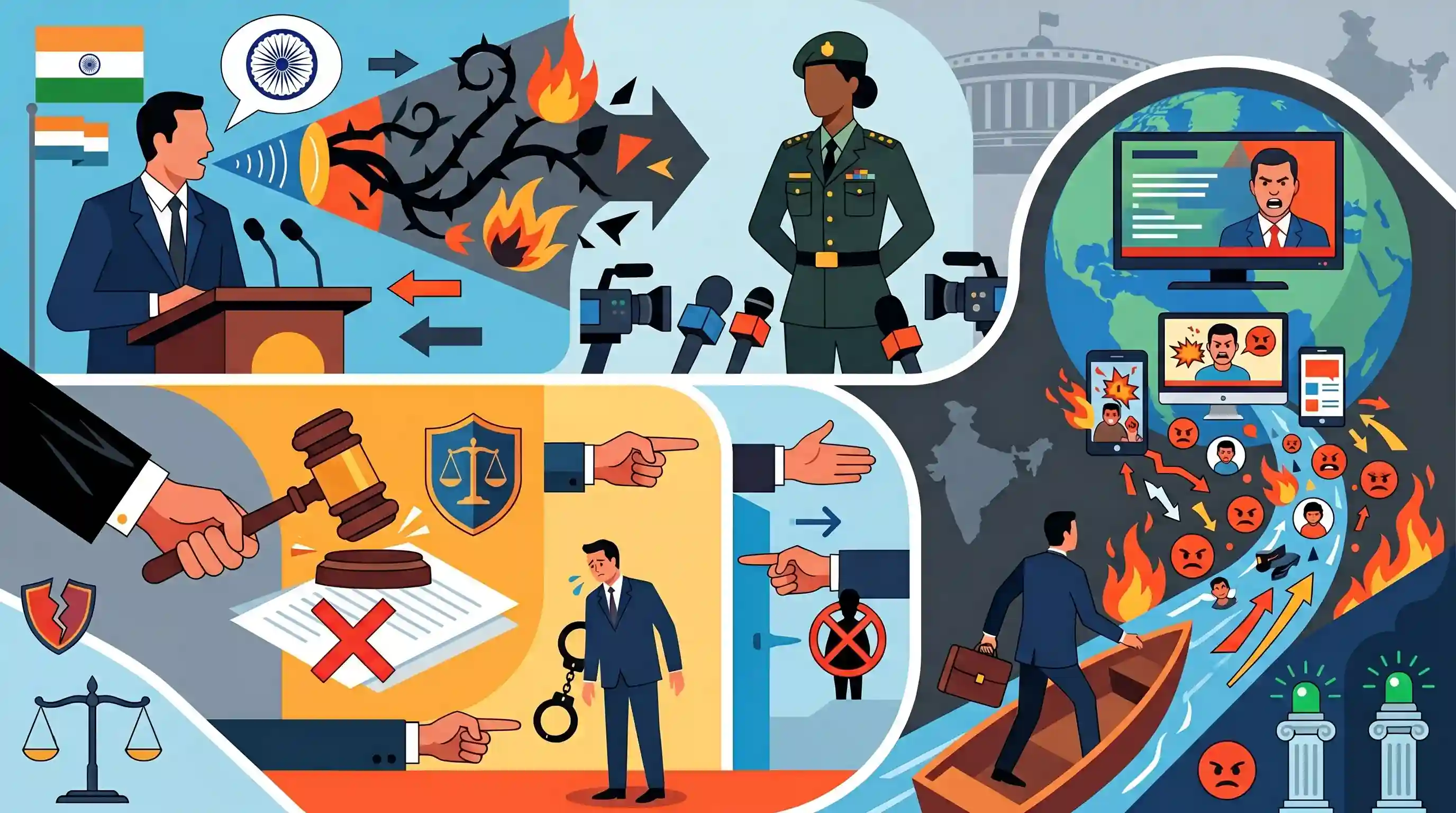
The editorial criticizes Madhya Pradesh Tribal Affairs Minister Vijay Shah for his derogatory remarks against Colonel Sofiya Qureshi, who was prominently involved in the media briefings during Operation Sindoor. Following the MP High Court's decision to order an FIR against the minister, the piece argues that he should be fired to set a firm example against hate speech masquerading as patriotism. Additionally, it highlights the online abuse faced by Foreign Secretary Vikram Misri, warning that sensationalist TV coverage and social media trolls are dangerously narrowing the crucial space required for India's diplomacy and strategic maneuvering in the aftermath of the military operation.
Key Points
- Following Operation Sindoor, MP Tribal Affairs Minister Vijay Shah made derogatory remarks about Colonel Sofiya Qureshi, prompting the MP High Court to order an FIR.
- The editorial strongly advocates for the minister's dismissal to establish accountability and clarify that hate speech must not be conflated with patriotism.
- Foreign Secretary Vikram Misri and his family faced severe online abuse after articulating India's position on pausing hostilities, reflecting the growing toxicity of social media.
- Sensationalist TV anchors and social media trolls constrain India's diplomatic flexibility by whipping up public sentiment with extreme demands and falsehoods.
- Post-Operation Sindoor, it is crucial to keep the space for diplomacy and strategic maneuvering secure and expansive, free from the interference of a "fact-free" abuse machine.
Important Terms
Operation Sindoor

A 2025 Indian military operation involving precision missile and drone strikes against terror camps in Pakistan and PoK, launched after the Pahalgam terrorist attack.
UPSC context
GS II (International Relations) & GS III (Internal Security). Tests India's counter-terrorism response doctrine and non-contact warfare capabilities.
Accountability of Ministers
The principle that executive members are answerable for their public conduct and statements to the legislature, judiciary, and the rule of law.
UPSC context
GS II (Governance/Polity). Concerns the Code of Conduct for ministers and constitutional checks on executive power.
Hate Speech
Utterances that promote enmity, hatred, or insult individuals based on identity; subject to legal restrictions under Indian law (e.g., Section 153A IPC).
UPSC context
GS II (Fundamental Rights) & GS IV (Ethics). Relevant to balancing Freedom of Speech (Art 19) with communal harmony.
Madhya Pradesh High Court
The highest judicial authority in Madhya Pradesh; in this case, it intervened to order an FIR against a minister for derogatory remarks.
UPSC context
GS II (Judiciary). Tests the role of High Courts in exercising judicial oversight and protecting the dignity of citizens.
Foreign Secretary
The administrative head of the Ministry of External Affairs and India’s most senior diplomat responsible for policy advice and international negotiations.
UPSC context
GS II (International Relations). Relates to the institutional framework for Indian diplomacy and the protection of strategic diplomatic space.
Prelims Trap
"Hate speech" is explicitly defined under Article 19(2) of the Constitution as a ground for restricting freedom of speech.
The term 'hate speech' is nowhere mentioned or defined in the Constitution. Article 19(2) only lists 'public order', 'decency or morality', and 'incitement to an offence' as reasonable restrictions.
Static Concepts Connected
How is "Hate Speech" legally regulated in India?
- No constitutional definition: 'Hate speech' is not explicitly defined in the Constitution but is restricted via Article 19(2) under 'public order' and 'incitement to an offence'.
- Criminal Laws (BNS): Punished under Bharatiya Nyaya Sanhita (formerly IPC Sections 153A, 295A) for promoting enmity between groups on grounds of religion, race, place of birth, or language.
- Electoral Disqualification: Section 8 of RPA 1951 disqualifies a person convicted of promoting enmity or committing acts prejudicial to national integration from contesting elections.
Can the Judiciary dismiss a State Minister for misconduct?
- Pleasure Doctrine: Under Article 164, State Ministers hold office during the pleasure of the Governor, which is exercised exclusively on the advice of the Chief Minister.
- Judicial Limitations: The Supreme Court has ruled that courts cannot dismiss a Minister or compel the CM to remove them, even if an FIR or chargesheet exists.
- Constitutional Morality: The apex court leaves it to the wisdom and ethical judgment of the PM/CM to exclude individuals facing serious criminal charges from the Council of Ministers.
Cross-Topic Patterns
Domestic opinion dictating foreign policy
The interference of social media trolls in peace-building efforts mirrors Putnam's 'Two-Level Game Theory,' where domestic pressures actively constrain international diplomatic maneuverability (GS2).
Media ethics merging with internal security
Sensationalist TV broadcasting merges GS4 (Media Ethics) with GS3 (Internal Security), as fake narratives create law and order challenges and polarize societies during sensitive military operations.

Expect a GS4 case study or GS2 question on balancing diplomatic autonomy with hyper-nationalist domestic pressures driven by social media.
Linked PYQs · 4
Linked PYQs · 4
- 2014MainsGS2
What do you understand by the concept "freedom of speech and expression"? Does it cover hate speech also ? Why do the films in India stand on a slightly different plane from other forms of expression ? Discuss.
- 2024MainsGS3
Social media and encrypting messaging services pose a serious security challenge. What measures have been adopted at various levels to address the security implications of social media? Also suggest any other remedies to address the problem.
- 2025MainsGS4
In the present digital age, social media has revolutionised our way of communication and interaction. However, it has raised several ethical issues and challenges. Describe the key ethical dilemmas in this regard.
- 2014MainsGS4
There is a heavy ethical responsibility on the public servants because they occupy positions of power, handle huge amounts of public funds, and their decisions have wide-ranging impact on society and environment. What steps have you taken to improve your ethical competence to handle such responsibility?
