Rising Atrocities Against Scheduled Tribes Highlighted by NCRB
Source:Indian Express ↗
Why It Matters
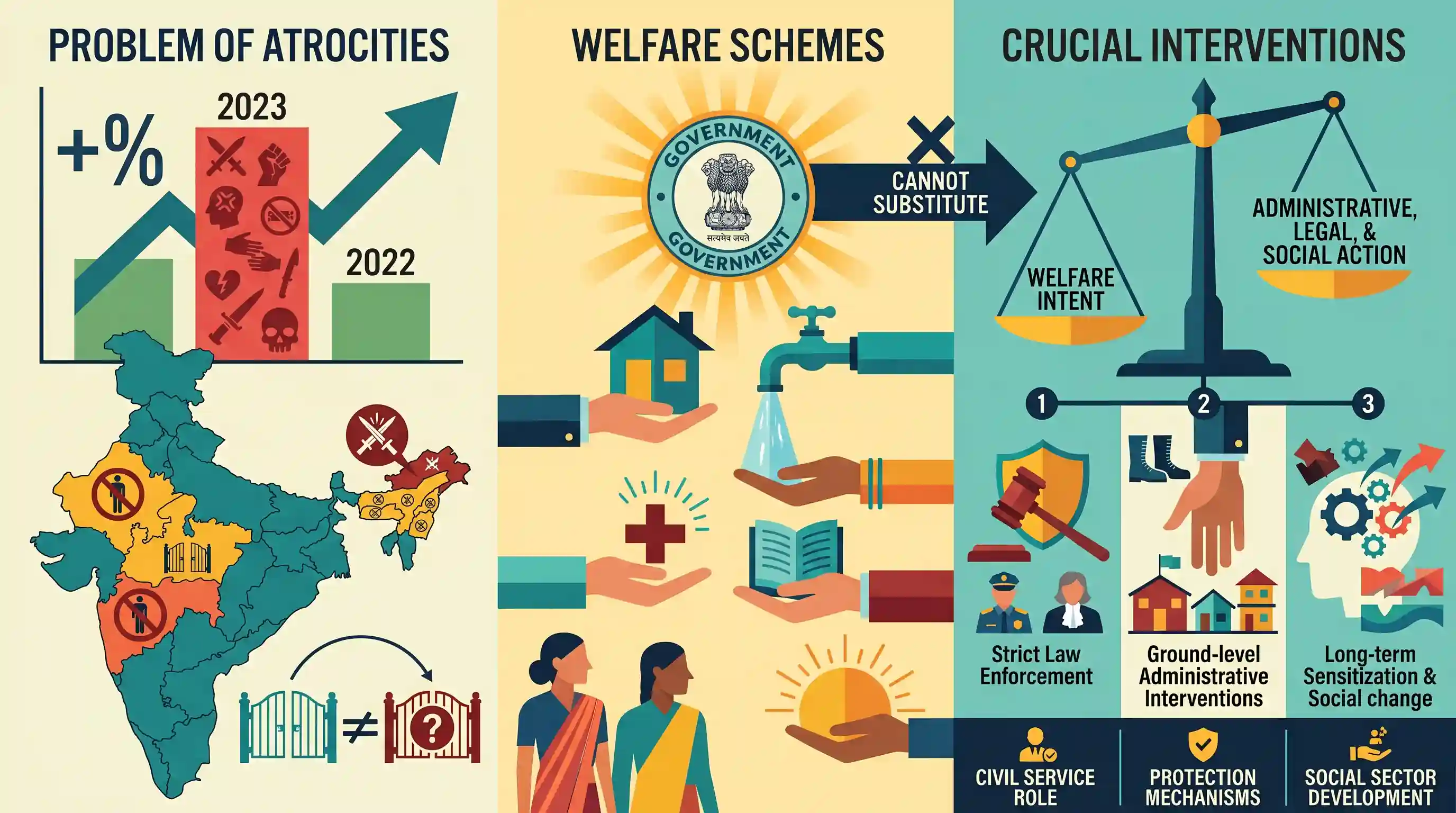
The article provides crucial data and analysis on the gap between tribal welfare policies and actual ground-level protection of marginalized communities. It is highly relevant for GS-2 (Social Justice and Governance), demonstrating that while schemes address economic and infrastructure needs, systemic social biases require rigorous law enforcement and institutional accountability to ensure the safety and dignity of Scheduled Tribes.
Summary
The latest National Crime Records Bureau (NCRB) data reveals a concerning 28.8% increase in crimes against Scheduled Tribes (STs) in 2023. This surge is partly attributed to the ethnic violence in Manipur, alongside consistently high numbers in states like Madhya Pradesh and Rajasthan. The editorial underscores a significant disparity in administrative responsiveness, highlighting Rajasthan's dismal charge-sheeting rate compared to Madhya Pradesh. It argues that while recent Central welfare schemes like PM JANMAN demonstrate an intent to uplift tribal communities, they cannot substitute for strict law enforcement, ground-level administrative interventions, and long-term sensitization efforts required to eradicate entrenched social biases and prevent atrocities.
Key Points
- According to the 2023 NCRB data, registered cases of atrocities against Scheduled Tribes (STs) spiked by 28.8% compared to the previous year.
- The surge was heavily impacted by the conflict in Manipur, where reported crimes against STs jumped from 1 case in 2022 to 3,399 in 2023.
- Madhya Pradesh and Rajasthan recorded the second and third highest numbers of atrocities against STs, reflecting deeply ingrained social prejudices in these states.
- There is a stark contrast in administrative accountability: Madhya Pradesh reported a charge-sheeting rate of 98.4%, while Rajasthan lagged severely at 42.3%.
- While the Union Government has launched ambitious tribal outreach schemes like PM JANMAN and DAJGUA, these welfare initiatives are insufficient without active law enforcement and sustained social sensitization to combat systemic bias.
Important Terms
National Crime Records Bureau (NCRB)

The nodal central agency under the Ministry of Home Affairs (est. 1986) responsible for collecting and analyzing crime data, publishing the annual 'Crime in India' report.
UPSC context
GS II (Governance) & GS III (Security); critical for evidence-based analysis of social issues and law-and-order trends.
SC/ST (Prevention of Atrocities) Act, 1989
Legislation enacted to prevent caste-based discrimination, violence, and humiliation against SC/ST communities, providing for special courts and stringent punishments to ensure social justice and dignity.
UPSC context
GS II (Social Justice); tests understanding of constitutional safeguards (Articles 15, 17) and legal protections for vulnerable sections.
Pradhan Mantri Janjati Adivasi Nyaya Maha Abhiyan (PM JANMAN)
A 2023 mission targeting 75 Particularly Vulnerable Tribal Groups (PVTGs) through 11 inter-ministerial interventions including housing, clean water, healthcare, and digital connectivity to ensure last-mile welfare delivery.
UPSC context
GS II (Welfare Schemes); focuses on administrative convergence and targeted upliftment of the most marginalized tribal communities.
Dharti Aaba Janjatiya Gram Utkarsh Abhiyan (DAJGUA)
A holistic development scheme aimed at saturating social infrastructure and service gaps across 63,843 tribal-majority villages, leveraging 25 interventions from 17 ministries.
UPSC context
GS II (Governance); represents a strategic shift toward 'saturation' of welfare benefits in tribal-inhabited aspirational blocks.
Particularly Vulnerable Tribal Groups (PVTGs)
A subset of Scheduled Tribes (75 identified groups) identified by a declining/stagnant population, pre-agricultural technology, low literacy, and extreme socio-economic backwardness.
UPSC context
GS II (Vulnerable Sections); a frequent focus for Prelims and Mains regarding specific constitutional and developmental criteria.
Prelims Trap
"PM JANMAN aims to uplift all Scheduled Tribes across India through 11 critical interventions."
PM JANMAN specifically targets 75 Particularly Vulnerable Tribal Groups (PVTGs). DAJGUA is the broader scheme targeting 63,000 tribal-majority villages.
Static Concepts Connected
What are the criteria for classifying a community as a PVTG?
- Tech & Economy: Pre-agricultural level of technology and a purely subsistence-level economy.
- Demographics: A stagnant or declining population growth rate.
- Literacy: Extremely low levels of literacy compared to the broader Scheduled Tribe population.
What are the key legal and constitutional safeguards against atrocities on STs?
- Article 46: Directs the State to protect SCs and STs from social injustice and all forms of exploitation.
- Article 338A: Constitutes the National Commission for Scheduled Tribes (NCST) to monitor and evaluate legal safeguards.
- PoA Act 1989: Provides for Special Courts, stringent punishments, and defines specific offenses of untouchability and atrocities.
Cross-Topic Patterns
Internal Security skewing crime stats
Manipur's ethnic conflict distorted national NCRB data (from 1 to 3,399 ST crimes), illustrating how localized internal security breakdowns directly warp national social justice indicators.
Welfare saturation vs. Rule of Law
Financial outlays for schemes like PM JANMAN mean little if state administrative responsiveness (e.g., Rajasthan's 42% charge-sheeting rate) remains dismal. Economic welfare cannot substitute criminal justice.

PM JANMAN vs DAJGUA target-group distinctions + NCST powers likely to form a tricky paired-statement Prelims question in 2026.
Linked PYQs · 3
Linked PYQs · 3
- 2025MainsGS1
Does tribal development in India centre around two axes, those of displacement and of rehabilitation? Give your opinion.
- 2018MainsGS2
Whether National Commission for Scheduled Castes (NCSC) can enforce the implementation of constitutional reservation for the Scheduled Castes in the religious minority institutions? Examine.
- 2022MainsGS2
Besides the welfare schemes, India needs deft management of inflation and unemployment to serve the poor and the underprivileged sections of the society. Discuss.
