US Immigration Protectionism and Impact on Skilled Indian Talent
Source:Indian Express ↗
Why It Matters
It highlights the intersection of US immigration policies, global trade protectionism, and India's economic reliance on IT services and remittances, directly linking to UPSC themes of diaspora, bilateral relations, and economic transition.
Summary
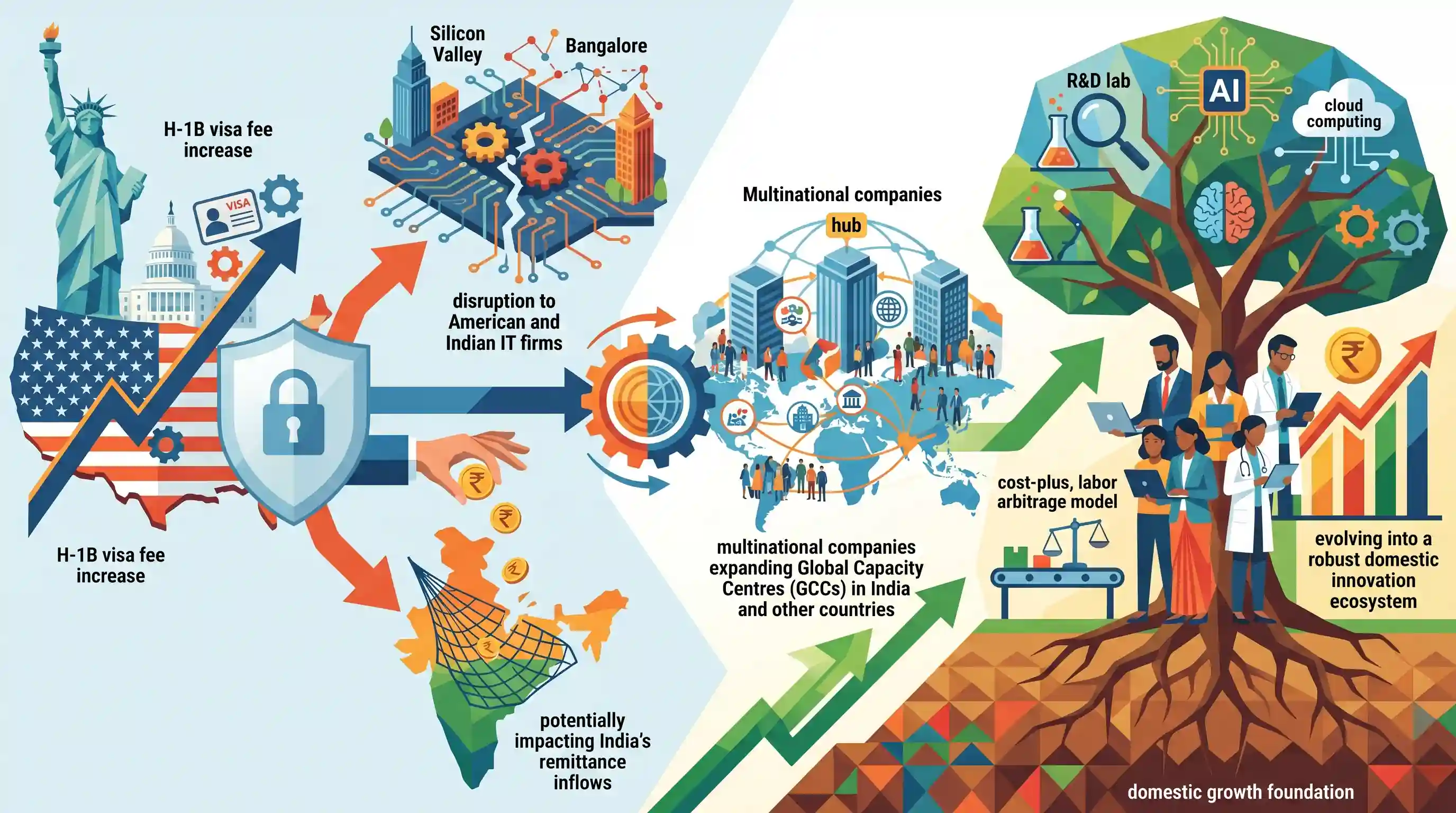
The US administration's proposal to increase H-1B visa fees indicates a protectionist shift targeting labor mobility and high-skilled professionals. This policy threatens to disrupt the operations of both American tech giants and Indian IT firms, while also potentially impacting India's remittance inflows. However, the visa restrictions could offer a silver lining by driving multinational companies to expand their Global Capacity Centres (GCCs) in India and other countries. The editorial emphasizes that to truly capitalize on this shift, India's IT sector must evolve from a cost-plus, labor arbitrage model into a robust domestic innovation ecosystem.
Key Points
- The proposed hike in US H-1B visa fees expands American protectionism from goods tariffs to labor mobility and high-skilled services.
- The policy will disrupt operations for Indian IT majors and US tech giants reliant on migrant talent, and could adversely affect remittances to India, which heavily depend on the US.
- Restrictive US immigration policies may inadvertently boost India's Global Capacity Centres (GCCs), as multinational firms expand foreign offices to access talent.
- The Indian IT sector needs to move beyond its traditional cost-plus, labor arbitrage model and focus on nurturing a domestic innovation ecosystem.
Important Terms
H-1B visa program

A US non-immigrant visa allowing employers to hire foreign workers in 'specialty occupations' requiring technical expertise (STEM/IT). It is the primary channel for high-skilled Indian professional mobility.
UPSC context
GS Paper II: Effect of policies of developed countries on India’s interests; GS Paper III: Indian Economy and employment.
Global Capacity Centres (GCCs)
Strategic offshore units established by multinational corporations to handle internal business functions like R&D, innovation, and analytics. They represent India's shift from low-cost outsourcing to high-value global innovation.
UPSC context
GS Paper III: Economic growth, industrial policy, and technology-driven development.
Protectionism
Economic policies—such as tariffs, quotas, or visa fee hikes—designed to shield domestic industries and labor from foreign competition. It marks a shift away from globalization.
UPSC context
GS Paper II: International Relations and trade policy; GS Paper III: Effects of liberalization on the economy.
Remittances
Money sent by migrants to their home country. India is the world's top recipient; H-1B restrictions threaten these critical foreign exchange inflows and household incomes.
UPSC context
GS Paper III: Indian Economy, external sector, and balance of payments.
Labor Arbitrage
Exploiting wage differentials between different countries to reduce costs. The Indian IT sector is evolving from this model toward high-end innovation and value-added services.
UPSC context
GS Paper III: Changes in industrial policy and their effects on growth.
Indian Diaspora
The global community of people of Indian origin. Protecting their interests and leveraging their success is a pillar of India's foreign policy and 'Soft Power' strategy.
UPSC context
GS Paper II: Important aspects of governance, transparency and accountability, and Indian Diaspora.
Prelims Trap
The majority of India's inward remittances originate from the Gulf Cooperation Council (GCC) countries.
The US recently surpassed the UAE as the top source of inward remittances to India, driven by high-earning white-collar professionals, despite the Gulf having a larger overall Indian migrant population.
Static Concepts Connected
What are the 4 Modes of Services Supply under WTO GATS?
- Mode 1 (Cross-border): Delivery of a service across borders (e.g., remote IT support, BPO services).
- Mode 2 (Consumption): Consumer travels to the supplying country (e.g., tourism, foreign education).
- Mode 3 (Commercial): Establishing a physical foreign presence (e.g., setting up a Global Capacity Centre or bank branch).
- Mode 4 (Natural persons): Temporary movement of professionals to provide services (e.g., Indian software engineers on H-1B visas).
Where do remittances figure in India's Balance of Payments?
- Current Account: Remittances are recorded under the Current Account, not the Capital Account, as they do not create a future liability.
- Invisibles: They fall under the 'Invisibles' category, specifically classified as 'Private Transfers'.
- BoP Stabilizer: Strong remittance inflows are crucial for India as they help offset the structural merchandise trade deficit.
Cross-Topic Patterns
From Labor Arbitrage to GCC Boom
As H-1B visas become restrictive, MNCs bypass immigration barriers by setting up Global Capacity Centres (GCCs) in India, transforming FDI dynamics and shifting from labor-export to direct foreign investment.
The New Face of Service Protectionism
While earlier US trade wars focused on goods (tariffs on steel/aluminum), protectionism has expanded into services via Mode 4 restrictions (movement of natural persons), altering the WTO-trade debate.

Expect a GS-3 Mains question assessing the dual threat of AI automation and Western visa protectionism on India’s IT-led export model.
Linked PYQs · 2
Linked PYQs · 2
- 2012MainsGS2
Discuss the likely negative impact of the protectionist measures proposed by the US on India's software industry.
- 2020MainsGS2
Indian diaspora has a decisive role to play in the politics and economy of America and European Countries'. Comment with examples.
