Wheat Stock Management and Food Security Buffer Norms in India
Source:Indian Express ↗
Why It Matters
Provides a contemporary case study for GS3 on how government interventions (stockpiling, open market sales, MSP announcements) directly impact agricultural prices and food security. It also underscores the ecological and economic imperative for crop diversification away from water-guzzling crops like rice.
Summary
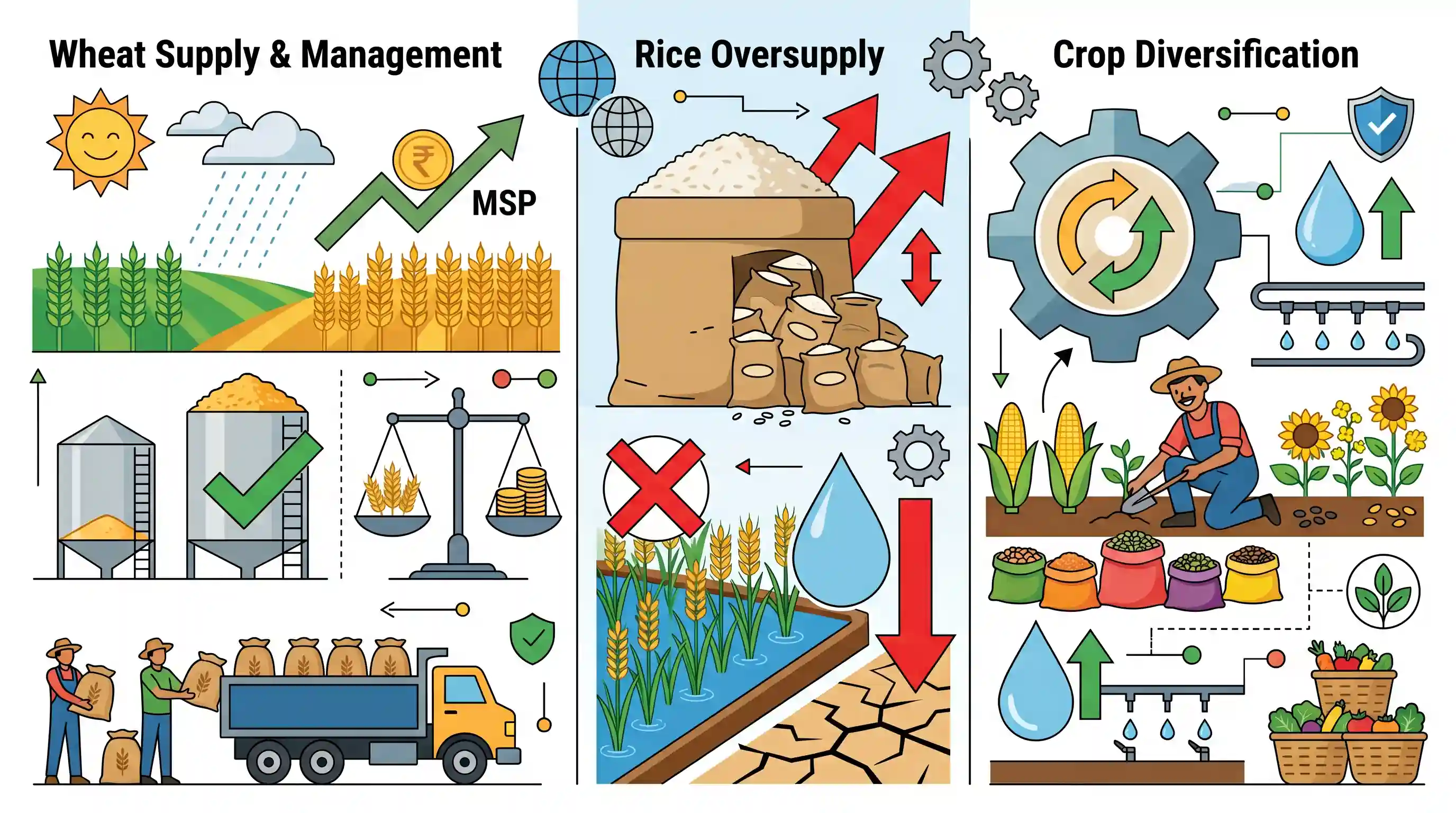
The editorial analyzes India's current comfortable wheat supply position, attributing it to prudent government stock management and a bumper harvest driven by favorable weather and increased Minimum Support Price (MSP). Unlike the depleted public stocks of 2023, current reserves and expected procurement ensure food security and stable open market prices. However, the piece contrasts this balanced wheat scenario with the structural oversupply of rice, whose public stocks far exceed buffer norms. The article advocates using this 'Goldilocks moment' to shift agricultural policy focus away from water-intensive rice cultivation towards sustainable, less water-consuming alternatives like maize, pulses, and oilseeds, thereby promoting necessary crop diversification.
Key Points
- The government's strategy to conserve wheat stocks rather than aggressively liquidating them has successfully stabilized market prices and ensured food security.
- A bumper wheat crop is expected due to increased acreage (driven by higher MSP and state bonuses) and favorable weather conditions, contrasting with the depleted stocks of 2023.
- Wheat procurement is projected to exceed 30 million tonnes this marketing season, the highest in four years, bringing public stocks to a comfortable level.
- In contrast to wheat, public rice stocks are more than 4.5 times the required buffer norm, indicating a structural and unsustainable surplus.
- The editorial strongly advocates for crop diversification, urging a shift away from water-intensive rice cultivation towards maize, pulses, and oilseeds to conserve resources.
Important Terms
Minimum Support Price (MSP)

A government-mandated price floor for crops, ensuring farmers a guaranteed minimum return regardless of market fluctuations to prevent distress sales.
UPSC context
GS Paper III (Agriculture/Food Security); tests knowledge of price support mechanisms and their impact on cropping patterns.
Food Corporation of India (FCI)
A statutory body under the Ministry of Consumer Affairs responsible for procuring, storing, and distributing foodgrains to maintain national food security.
UPSC context
GS Paper II & III; crucial for understanding institutional frameworks in food management and PDS efficiency.
Buffer Stocks
Minimum quantities of foodgrains (wheat and rice) that must be maintained in the central pool to meet PDS needs and handle emergencies.
UPSC context
GS Paper III (Food Security); focuses on stock management, storage challenges, and price stabilization.
Crop Diversification
Shifting from a rice-wheat monoculture to a variety of crops like pulses and oilseeds to improve soil health and conserve water.
UPSC context
GS Paper III (Major Crops/Environment); tests strategies for sustainable agriculture and climate resilience.
Public Distribution System (PDS)
A tool for providing subsidized foodgrains to vulnerable populations through a network of Fair Price Shops (FPS) across the country.
UPSC context
GS Paper III (Public Distribution System); covers objectives, functioning, and reforms like technology integration.
Open Market Sale Scheme (OMSS)
A scheme where the FCI sells surplus foodgrains in the open market to bulk consumers and traders to moderate retail prices.
UPSC context
GS Paper III (Food Management); tests understanding of market interventions to control food inflation.
Prelims Trap
"Open-ended procurement guarantees the government will buy all 23 MSP-mandated crops."
While the Centre announces MSP for 23 crops, open-ended procurement (buying whatever is offered) is effectively limited to wheat and paddy in major producing states.
Static Concepts Connected
How does the FCI manage procurement and buffer stocks for food security?
- Open-ended Procurement: FCI and state agencies buy all offered paddy and wheat at MSP from farmers, with no quantitative ceiling.
- Buffer Norms: The minimum stock required at the start of each quarter (Jan, Apr, Jul, Oct) to meet PDS and operational requirements.
- Central Pool: The pool consists of operational stocks (for regular PDS distribution) and strategic reserves (to buffer against bad harvests).
What is 'Virtual Water' in the context of Indian agriculture?
- Definition: The hidden flow of water embedded in food or commodities when they are grown, traded, or stockpiled.
- Rice and Sugar: India's massive export and public stocking of highly water-intensive crops like rice and sugarcane essentially amounts to locking away or exporting critical groundwater.
- Diversification need: Shifting away from rice to maize, pulses, and oilseeds significantly reduces this virtual water drain in water-stressed states.
Cross-Topic Patterns
MSP distortions and PM-AASHA scheme
Heavy MSP procurement for wheat/rice heavily distorts cropping patterns. PM-AASHA aims to ensure remunerative prices for pulses and oilseeds to encourage necessary ecological diversification.
Virtual water drain and groundwater depletion
The structural surplus of rice acts as a massive 'virtual water' drain, linking GS3 agricultural procurement policies directly to GS1 groundwater crises in Northwestern India.

Expect a multi-statement question linking MSP procurement anomalies, virtual water export via rice, and the need for crop diversification.
Linked PYQs · 4
Linked PYQs · 4
- 2024MainsGS3
Elucidate the importance of buffer stocks for stabilizing agricultural prices in India. What are the challenges associated with the storage of buffer stock? Discuss.
- 2021MainsGS3
What are the present challenges before crop diversification? How do emerging technologies provide an opportunity for crop diversification?
- 2018MainsGS3
What do you mean by Minimum Support Price (MSP)? How will MSP rescue the farmers from the low income trap?
- 2020PrelimsGS1
Which of the following factors/policies were affecting the price of rice in India in the recent past? 1. Minimum Support Price 2. Government's trading 3. Government's stockpiling 4. Consumer subsidies Select the correct answer using the code given below:
