India US trade pact signals shift towards freer trade reforms
Source:Indian Express ↗
Why It Matters
This topic sits at the critical intersection of GS2 (International Relations) and GS3 (Economy). It highlights how India balances strategic autonomy (e.g., Russian oil imports) with deepening economic integration (US trade deal) while underscoring that global trade success is contingent upon structural domestic reforms.
Summary
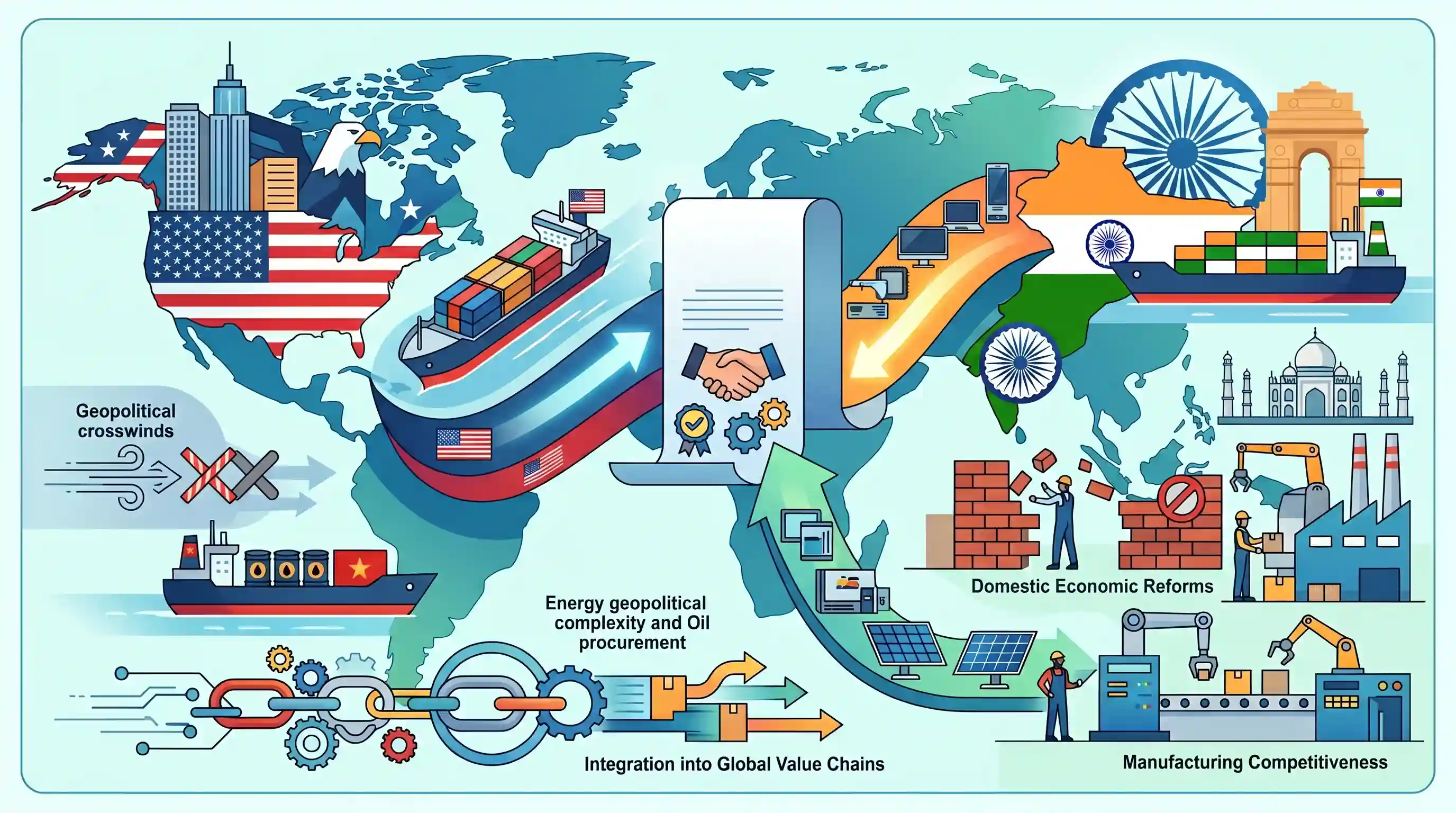
The editorial highlights the significance of a major trade agreement between India and the US, framing it as a pivotal shift towards freer trade and bilateral economic integration. Despite complex geopolitical crosswinds—such as India's continued procurement of Russian oil—the deal underscores a pragmatic deepening of the India-US strategic partnership. However, the article emphasizes that the external trade pact must be accompanied by internal action; to truly capitalize on this opportunity, India must pursue a robust domestic economic reform agenda, dismantle remaining protectionist barriers, and boost its manufacturing competitiveness to integrate effectively into global value chains.
Key Points
- India and the US have agreed on a significant trade deal, marking a notable shift towards freer trade and moving away from recent protectionist trends.
- The agreement demonstrates diplomatic pragmatism, balancing deeper US economic ties with India's ongoing strategic energy interests, such as importing Russian oil.
- The pact is expected to help integrate India more deeply into global supply chains and counter global headwinds of protectionism.
- To fully leverage the benefits of the trade deal, India needs a robust domestic reform agenda focusing on reducing tariff barriers, improving manufacturing competitiveness, and enhancing the ease of doing business.
Important Terms
India-US Interim Trade Framework (2026)

A 2026 agreement reducing US tariffs on Indian exports (50% to 18%) in exchange for India's energy pivot from Russia and a $500 billion purchase commitment.
UPSC context
GS Paper II: Bilateral Relations. Tests understanding of major shifts in India-US economic ties and trade diplomacy.
Bilateral Trade Agreement (BTA)
A preferential trade pact between two nations to reduce or eliminate tariffs and barriers, fostering deeper economic integration than standard international trade rules.
UPSC context
GS Paper III: Indian Economy. Tests knowledge of trade policy instruments and their impact on domestic manufacturing.
Global Value Chains (GVCs)
The international production network where different manufacturing stages are located across various countries to maximize efficiency and minimize costs.
UPSC context
GS Paper III: Economy/Manufacturing. Relevant for questions on "Make in India" and export-led growth strategies.
Strategic Autonomy
A foreign policy principle where a country makes independent decisions based on national interest without being permanently aligned with any major power bloc.
UPSC context
GS Paper II: International Relations. Crucial for analyzing India's balance between US trade and Russian energy ties.
Reciprocal Tariffs
A trade policy where one country matches the tariff rates of another; specifically used by the US to pressure India into lowering high import duties.
UPSC context
GS Paper III: Trade Policy. Important for understanding "transactional diplomacy" and international trade disputes.
SHANTI Act, 2025
A 2025 Indian legislative reform (Small Modular Reactors for Atomic Energy) allowing private and foreign entities to operate nuclear reactors and data centers.
UPSC context
GS Paper III: Science & Tech/Infrastructure. Tests knowledge of energy sector reforms and civil nuclear cooperation.
Non-Tariff Barriers (NTBs)
Trade restrictions such as quotas, technical standards, or licensing requirements that countries use to protect domestic industries without applying direct taxes.
UPSC context
GS Paper III: Economy. Key to discussing ease of doing business and global market access challenges.
Prelims Trap
"India and the US have signed a Comprehensive Economic Partnership Agreement (CEPA)."
Despite signing major bilateral trade deals, India and the US do not currently have a full CEPA or comprehensive FTA. These are targeted pacts.
Static Concepts Connected
How do high import tariffs impact integration into Global Value Chains (GVCs)?
- Cost of Inputs: High tariffs increase the cost of imported intermediate goods, making domestic assembly expensive.
- Export Competitiveness: Expensive raw materials make final assembled exports uncompetitive in the global market.
- Inverted Duty Structure: It often leads to an inverted duty structure, discouraging domestic value addition and hurting export-oriented industries.
What distinguishes a basic FTA from a Comprehensive Economic Partnership Agreement (CEPA)?
- FTA Focus: Focuses primarily on reducing or eliminating customs duties on a specified list of traded goods.
- CEPA Scope: Covers a much broader spectrum including trade in services, investments, intellectual property, and competition.
- Depth of Integration: CEPAs usually involve deeper regulatory harmonization and broader economic integration than standard FTAs.
Cross-Topic Patterns
Strategic Autonomy in Energy vs Trade
Balancing US trade integration with Russian oil imports exemplifies India's "multi-alignment" doctrine, separating core economic partnerships from strategic energy imperatives.
Protectionism vs PLI Export Goals
The push for free trade exposes how high domestic import tariffs on intermediate goods contradict the export-oriented goals of India's Production Linked Incentive (PLI) schemes.

Expect a 2026 Mains question linking India's protectionist tariffs with its struggles to fully exploit the 'China Plus One' GVC shift.
Linked PYQs · 3
Linked PYQs · 3
- 2025MainsGS3
What are the challenges before the Indian economy when the world is moving away from free trade and multilateralism to protectionism and bilateralism? How can these challenges be met?
- 2019MainsGS2
‘What introduces friction into the ties between India and the United States is that Washington is still unable to find for India a position in its global strategy, which would satisfy India's national self-esteem and ambitions.’ Explain with suitable examples.
- 2025MainsGS2
"Energy security constitutes the dominant kingpin of India's foreign policy, and is linked with India's overarching influence in Middle Eastern countries.” How would you integrate energy security with India's foreign policy trajectories in the coming years?
