Gaza ceasefire deal offers fragile first step toward regional peace
Source:Indian Express ↗
Why It Matters
The Israel-Palestine conflict is a core issue in West Asian geopolitics, directly impacting regional stability, energy security, and global supply chains. For UPSC aspirants, understanding the evolving dynamics, the role of external mediators like the US, and India's diplomatic balancing act (de-hyphenation policy and support for a two-state solution) is critical for analyzing International Relations in GS Paper 2.
Summary
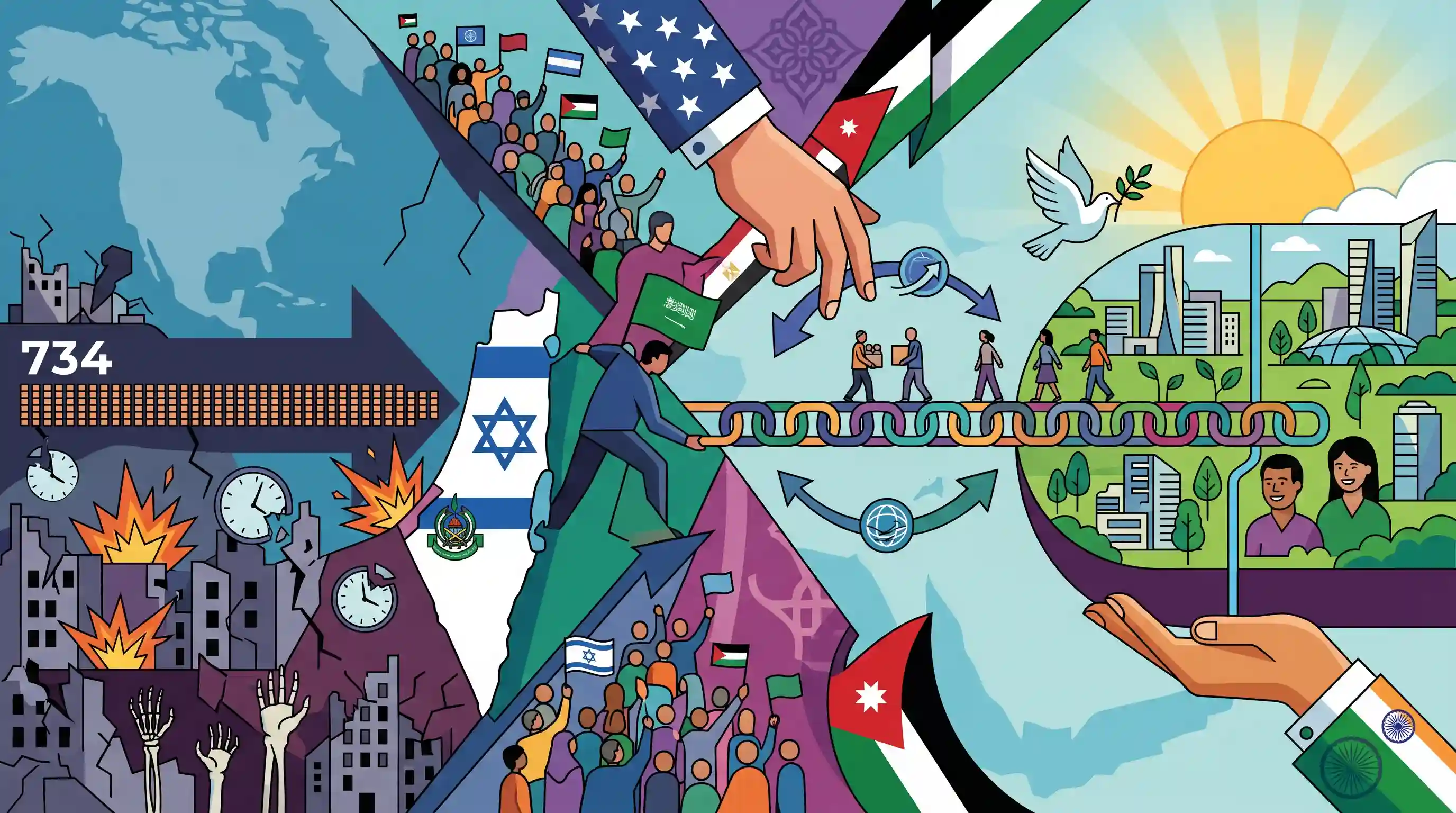
The editorial examines the recent tentative ceasefire in Gaza, facilitated by a US-brokered 20-point peace plan involving hostage and prisoner exchanges. After 734 days of devastating conflict resulting in massive casualties and famine, domestic and international pressures have forced both Israel and Hamas to the negotiating table. The success of this truce heavily relies on sustained diplomatic pressure, particularly from the US on Israel, and regional players on Hamas. The article emphasizes that a durable peace requires addressing long-term governance in Gaza and urges India to actively champion the two-state solution to ensure lasting security in West Asia.
Key Points
- A new ceasefire deal, supported by a 20-point plan proposed by US President Donald Trump and backed by Arab nations, is set to initiate the exchange of Israeli hostages and Palestinian prisoners.
- The protracted 734-day conflict has resulted in over 66,000 Palestinian deaths and catalyzed a severe humanitarian crisis, including widespread famine in Gaza.
- Significant pressure is being applied on both sides, with the US pushing allies like Qatar, Egypt, and Turkey to negotiate with Hamas, while Israeli PM Netanyahu faces both international isolation and domestic discontent.
- Sustaining the truce requires the US to restrain Israeli aggression and carefully navigate complex post-war issues like Gaza's governance and territorial boundaries.
- India must leverage its diplomatic ties to promote Palestinian self-determination and the two-state solution, which is essential for the long-term stability and security of West Asia.
Important Terms
Hamas

A Palestinian Sunni-Islamist political and militant organization that has governed the Gaza Strip since 2007; it is a central party in the conflict with Israel.
UPSC context
GS-2 (International Relations); key non-state actor influencing West Asian stability and India’s regional security interests.
Trump's 20-point peace plan
A 2025/26 US-led roadmap for a Gaza ceasefire, featuring hostage-prisoner exchanges, reconstruction via an international board, and eventual pathways to Palestinian self-determination.
UPSC context
GS-2 (International Relations); represents contemporary diplomatic efforts and the role of major powers in resolving long-standing West Asian conflicts.
Two-State Solution
The diplomatic framework proposing the establishment of an independent State of Palestine alongside the State of Israel, typically based on pre-1967 borders.
UPSC context
GS-2 (International Relations); a long-standing pillar of India's Middle East policy and a core concept in global conflict resolution.
De-hyphenation
India's policy of engaging with Israel and Palestine as separate bilateral relationships, ensuring that ties with one do not come at the expense of the other.
UPSC context
GS-2 (International Relations); essential for understanding India’s shift toward pragmatic, interest-based diplomacy in the Middle East.
International Stabilization Force (ISF)
A proposed multilateral security mission intended to maintain order, oversee demilitarization, and train local police in post-conflict Gaza.
UPSC context
GS-2 (International Relations); tests knowledge of international peacekeeping, regional security architectures, and post-war reconstruction strategies.
Board of Peace
An international transitional body designed to manage the governance, funding, and redevelopment of Gaza following a ceasefire agreement.
UPSC context
GS-2 (International Relations); highlights the evolution of international oversight in conflict-torn territories and modern administrative diplomacy.
Prelims Trap
"India supported the 1947 UN Resolution 181 as the historical basis for the Two-State Solution."
India actually voted AGAINST UN Resolution 181 in 1947, favoring a single federal state with autonomy for Arabs and Jews instead.
Static Concepts Connected
What are the foundational agreements of the Israel-Palestine peace process?
- UN Resolution 181: The 1947 UN General Assembly resolution proposing the division of Mandatory Palestine into independent Arab and Jewish states, with Jerusalem under an international regime.
- Oslo Accords: The 1993 agreement marking the first mutual recognition between Israel and the PLO, establishing the Palestinian Authority (PA) for interim self-governance.
How is India's "De-hyphenation" policy applied to Israel and Palestine?
- Independent Relations: India engages with Israel and Palestine independently on their own merits, abandoning the previous zero-sum approach where ties with one dictated ties with the other.
- Standalone Diplomacy: Demonstrated by PM Modi's separate, standalone bilateral visits to Israel in 2017 and Palestine in 2018, decoupling the diplomatic engagements.
Cross-Topic Patterns
IMEC & I2U2 vs. Regional Instability
The Gaza conflict stalls Arab-Israeli normalization, directly threatening the operationalization of the India-Middle East-Europe Economic Corridor (IMEC) and I2U2 investments.
Shift in India's UN Voting Patterns
India's recent abstentions on certain UNGA ceasefire resolutions highlight a nuanced pivot in its traditionally staunch pro-Palestine UN voting record.

Expect a 2026 Mains question linking the Gaza conflict's geopolitical fallout to the viability of India's IMEC and I2U2 initiatives.
Linked PYQs · 3
Linked PYQs · 3
- 2018MainsGS2
“India’s relations with Israel have, of late, acquired a depth and diversity, which cannot be rolled back.” Discuss.
- 2025MainsGS2
"Energy security constitutes the dominant kingpin of India's foreign policy, and is linked with India's overarching influence in Middle Eastern countries.” How would you integrate energy security with India's foreign policy trajectories in the coming years?
- 2022MainsGS2
How will I2U2 (India, Israel, UAE and USA) grouping transform India's position in global politics?
