Russia-Ukraine Conflict Resolution and Diplomatic Stakeholder Talks
Source:Indian Express ↗
Why It Matters
Provides critical insights into how global conflicts like the Russia-Ukraine war have direct policy and economic repercussions for India (such as US tariff retaliation), which is essential for understanding India's strategic autonomy and energy security imperatives in GS2.
Summary
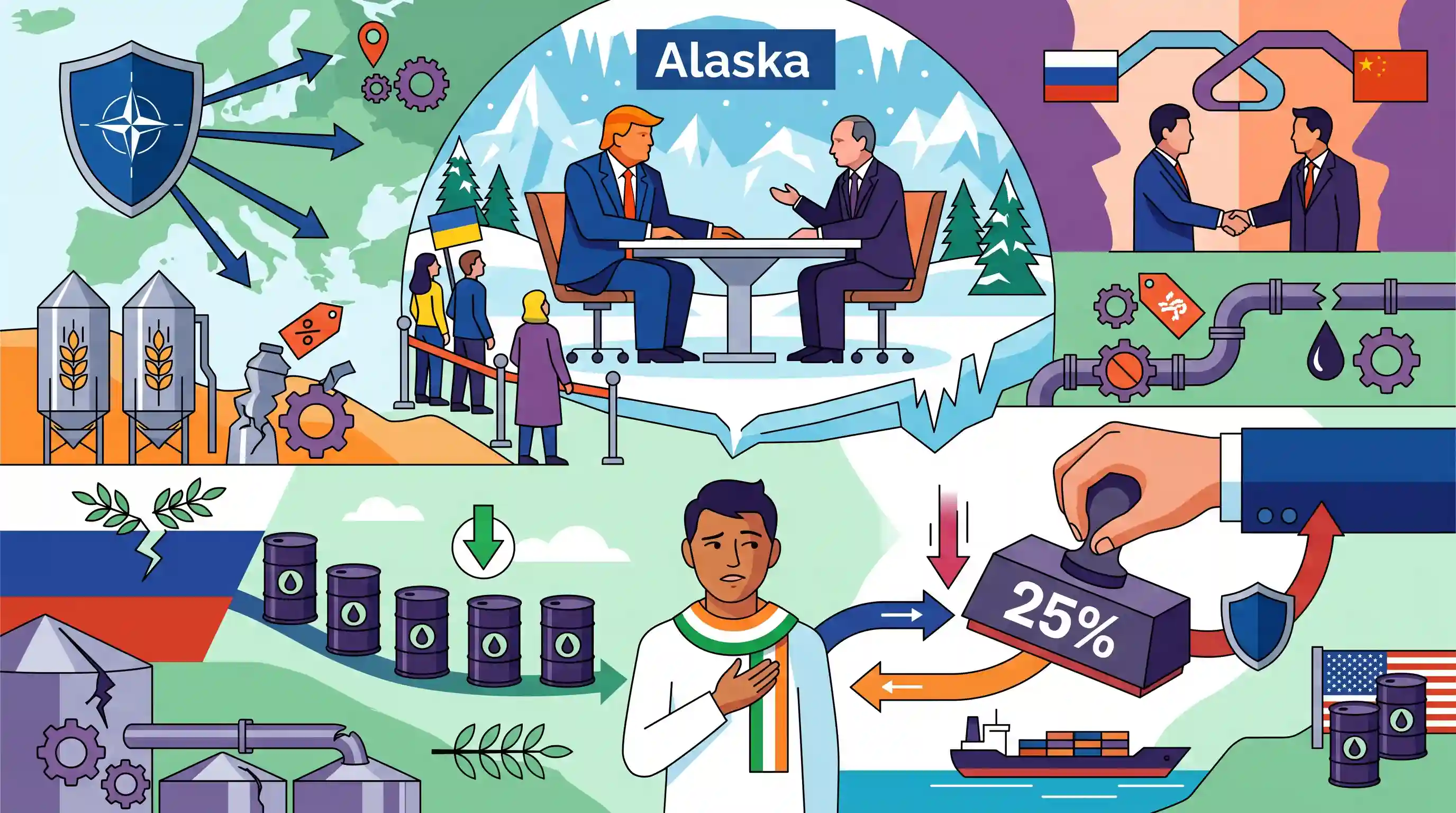
An editorial analyzing the implications of the Alaska summit between US President Donald Trump and Russian President Vladimir Putin to address the protracted Russia-Ukraine war. The exclusion of Ukraine and European allies from the dialogue limits the meeting's potential for a lasting resolution. The article traces the war's global ramifications, including NATO's expansion, closer Russia-China strategic ties, and widespread disruptions to food and energy supply chains. For India, the conflict creates significant diplomatic and economic dilemmas. While India advocates for peace, its continued purchase of discounted Russian oil has led to retaliatory 25% tariffs imposed by the US, illustrating the complex trade-offs between maintaining energy security and managing vital strategic partnerships.
Key Points
- The US-Russia summit in Alaska aimed at resolving the Russia-Ukraine war notably excludes Ukraine and European allies, raising doubts about its ultimate effectiveness.
- The protracted conflict has fundamentally altered global geopolitics by expanding NATO, pushing Russia closer to China, and disrupting global food and fuel supply chains.
- While India maintains a principled stance advocating for diplomacy and peace, its practical economic need to purchase discounted Russian oil creates geopolitical friction.
- The US administration under Donald Trump has imposed 25% tariffs on Indian goods as retaliation for India's continued procurement of Russian oil.
- These dynamics highlight the challenge India faces in balancing strategic autonomy, energy security, and its crucial bilateral relationship with the United States.
Important Terms
NATO (North Atlantic Treaty Organization)

Intergovernmental military alliance of 32 North American and European countries, based on collective defense. Expanded recently to include Finland (2023) and Sweden (2024) in response to regional instability.
UPSC context
GS Paper II: International Relations. Essential for understanding collective security, the "security dilemma," and evolving European security architecture.
Energy Security
The uninterrupted availability of energy sources at an affordable price. For India, this involves balancing discounted Russian crude with Western diplomatic pressure and supply chain resilience.
UPSC context
GS Paper III: Economic Development (Energy). Tests the trade-off between economic necessity (inflation control) and geopolitical alignment.
Strategic Autonomy
India's foreign policy doctrine of making independent decisions based on national interest, avoiding formal military alliances while maintaining partnerships with rival powers like the US and Russia.
UPSC context
GS Paper II: International Relations. Core concept for Indian diplomacy; tests the ability to navigate a multipolar world order.
Alaska Summit (2025)
A high-level meeting between Donald Trump and Vladimir Putin in Anchorage (August 2025) aimed at resolving the Ukraine war. It highlighted the exclusion of regional allies from great-power diplomacy.
UPSC context
GS Paper II: Global Events. Illustrates bilateral diplomacy's limitations and the shift toward "America First" transactional foreign policy.
Reciprocal Tariffs
Trade duties imposed by one country on another at similar rates. In 2025-26, US-India trade was marked by a 25% penalty tariff on oil, later reverted to an 18% reciprocal rate.
UPSC context
GS Paper III: Indian Economy/Trade. Tests understanding of trade barriers, "coercive diplomacy," and bilateral trade agreements (BTAs).
Russia-China Strategic Coordination
The deeply integrated Russia-China partnership (marking its 30th year in 2026) focused on energy, defense, and challenging Western hegemony through multilateral platforms like BRICS and SCO.
UPSC context
GS Paper II: International Relations. Critical for India's regional security, particularly concerning the "two-front" challenge and Eurasian stability.
Prelims Trap
India's oil purchases are legally restricted by US-mandated global price caps and sanctions.
India explicitly does not recognize unilateral US/EU sanctions or price caps. New Delhi's foreign policy officially abides only by UN Security Council-mandated sanctions.
Static Concepts Connected
How does India justify bypassing unilateral sanctions?
- UN recognition: India officially abides only by UN Security Council sanctions, rejecting unilateral mechanisms like CAATSA or Western price caps.
- Macroeconomic necessity: Importing over 80% of its crude, securing discounted oil is critical to curbing imported inflation and maintaining a manageable current account deficit.
- Strategic Autonomy: Pursuing an independent foreign policy driven by national interest, balancing legacy Russian ties with growing US strategic partnerships.
Under what WTO provision are unilateral tariffs usually justified?
- Article XXI (GATT): The 'Security Exception' allows WTO members to breach trade obligations to protect essential security interests, increasingly used to bypass Most-Favored-Nation (MFN) principles.
- Dispute Settlement: Affected nations must ideally use the WTO Dispute Settlement Body, though its Appellate Body paralysis currently complicates enforcement against unilateral tariffs.
Cross-Topic Patterns
Imported Inflation vs Export Tariffs
Discounted Russian oil shields India's economy from imported inflation, but resulting US retaliatory tariffs directly threaten Indian export competitiveness in its largest foreign market.
Eurasian Axis vs Indo-Pacific Security
Russia's growing dependency on China during the conflict complicates New Delhi's calculations, potentially limiting Russian defense supplies to India during any future Sino-Indian border crisis.
UNSC Paralysis & Great Power Politics
Bilateral US-Russia summits deciding Ukraine's fate without its participation highlight the complete marginalization of the UN and multilateral institutions in resolving modern geopolitical conflicts.

Expect a 2026 question analyzing how India's 'Strategic Autonomy' is tested by transactional US trade policies and unilateral tariffs.
Linked PYQs · 5
Linked PYQs · 5
- 2023MainsGS2
‘The expansion and strengthening of NATO and a stronger US-Europe strategic partnership works well for India.’ What is your opinion about this statement ? Give reasons and examples to support your answer.
- 2019MainsGS2
‘What introduces friction into the ties between India and the United States is that Washington is still unable to find for India a position in its global strategy, which would satisfy India's national self-esteem and ambitions.’ Explain with suitable examples.
- 2025MainsGS2
"Energy security constitutes the dominant kingpin of India's foreign policy, and is linked with India's overarching influence in Middle Eastern countries.” How would you integrate energy security with India's foreign policy trajectories in the coming years?
- 2023PrelimsGS1
Consider the following pairs: Regions often mentioned in news Reason for being in news 1. North Kivu and Ituri : War between Armenia and Azerbaijan 2. Nagorno-Karabakh : Insurgency in Mozambique 3. Kherson and Zaporizhzhia : Dispute between Israel and Lebanon How many of the above pairs are correctly matched?
- 2023PrelimsGS1
Consider the following pairs: Area of conflict mentioned in news Country where it is located 1. Donbas : Syria 2. Kachin : Ethiopia 3. Tigray : North Yemen How many of the above pairs are correctly matched?
