Bombay High Court Ruling on Deleted Voters and Electoral Rolls
Source:Indian Express ↗
हे का महत्त्वाचे आहे
Voter roll integrity is central to free and fair elections. Judicial scrutiny of voter deletions highlights systemic challenges in electoral administration and underscores the necessity of transparency and strict adherence to rule of law by election authorities.
सारांश
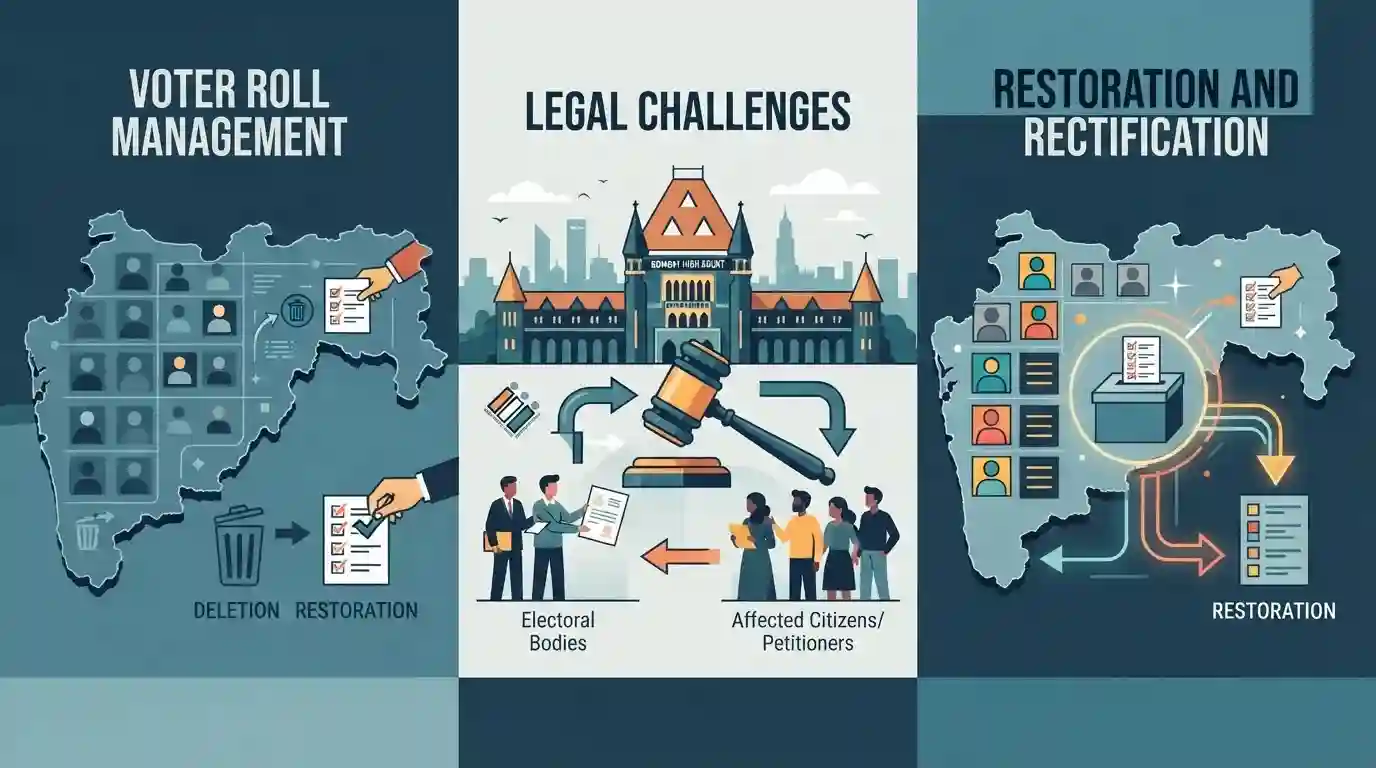
The article discusses legal proceedings and challenges in the Bombay High Court concerning the deletion and restoration of voters from electoral rolls in Maharashtra, shedding light on systemic procedures of voter roll management and institutional accountability of electoral bodies.
मुख्य मुद्दे
- Legal challenges involving voter roll deletions and restoration procedures in Maharashtra have reached judicial scrutiny.
- The Bombay High Court examined issues related to the integrity of electoral rolls, deletion of voters, and procedural adherence by electoral authorities.
- Such cases underscore the critical need for administrative transparency, accountability, and robust safeguards by the Election Commission of India to prevent arbitrary voter disenfranchisement.
- Electoral integrity is foundational to democratic governance, requiring strict compliance with statutory frameworks governing electoral roll updates.
महत्त्वाच्या संज्ञा
Representation of the People Act, 1950

A landmark legislation enacted by Parliament that provides for the allocation of seats, delimitation of constituencies, qualifications of voters, and the preparation of electoral rolls for parliamentary and assembly elections in India.
UPSC context
GS Paper II (Polity) - Statutory framework governing elections, voter roll management, and representation of states in legislatures.
Representation of the People Act, 1951
A comprehensive statute that governs the actual conduct of elections, qualifications and disqualifications for membership of Parliament and State Legislatures, registration of political parties, and resolution of election disputes.
UPSC context
GS Paper II (Polity) - Statutory bodies and mechanisms for conducting free and fair elections, corrupt practices, and electoral petitions.
Election Commission of India
An independent constitutional body established under Article 324 of the Constitution to superintend, direct, and control the entire process of conducting elections to Parliament, State Legislatures, and the offices of President and Vice-President.
UPSC context
GS Paper II (Polity) - Powers, functions, and responsibilities of various constitutional bodies.
Supreme Court of India
The apex judicial institution of India, possessing extensive writ, appellate, and constitutional review powers under Articles 32 and 136, ensuring the enforcement of fundamental rights and maintenance of rule of law.
UPSC context
GS Paper II (Polity) - Structure, organization, and jurisdiction of the judiciary and judicial review of administrative and electoral actions.
Bombay High Court
The highest court of law for the state of Maharashtra, exercising original and appellate civil/criminal jurisdiction as well as writ jurisdiction under Article 226 to review administrative and electoral actions.
UPSC context
GS Paper II (Polity) - Structure and functioning of High Courts, judicial review of state-level electoral roll disputes and petitions.
संबंधित स्थिर संकल्पना
What is the constitutional and statutory framework governing electoral rolls in India?
- Constitutional Mandate: Article 324 vests superintendence, direction, and control of elections in the Election Commission of India.
- RPA, 1950: The Representation of the People Act, 1950 governs the allocation of seats and preparation of electoral rolls.
- RPA, 1951: The Representation of the People Act, 1951 deals with the actual conduct of elections and election disputes.
आंतर-विषय नमुने
Judicial Review of Election Commission Decisions
Electoral roll integrity links administrative law with fundamental rights, testing judicial review of statutory bodies under Article 32 and Article 226.

Expect statements on ECI powers under RPA 1950 vs 1951, particularly regarding delimitation, electoral roll revision, and judicial review.
संबंधित PYQ · 2
संबंधित PYQ · 2
- 2022MainsGS2
Discuss the role of the Election Commission of India in the light of the evolution of the Model Code of Conduct.
- 2017MainsGS2
To enhance the quality of democracy in India the Election Commission of India has proposed electoral reforms in 2016. What are the suggested reforms and how far are they significant to make democracy successful?
