Exposomics framework for environmental health and disease prevention
Source:The Hindu ↗
Why It Matters
UPSC frequently tests emerging scientific concepts (like aerial metagenomics or gene editing) and the intersection of environment and human health. Exposomics offers a vital conceptual framework for tackling India's severe pollution crisis and its corresponding burden of non-communicable diseases.
Summary
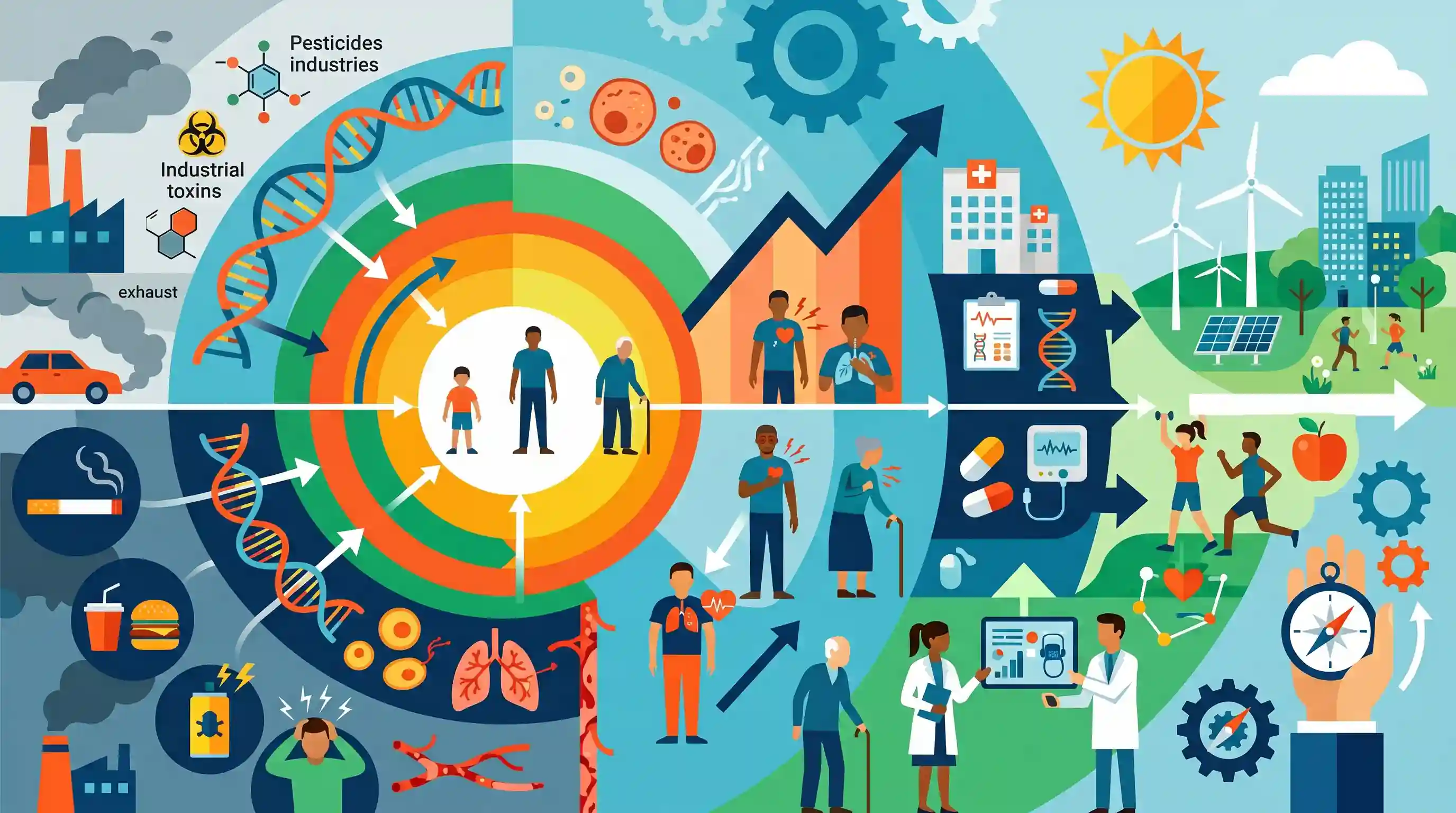
The article discusses 'exposomics', an emerging scientific discipline that studies the cumulative measure of environmental influences and biological responses throughout a person's lifespan. By analyzing the interactions between environmental exposures (such as air pollution, chemical toxins, and lifestyle choices) and human biology, exposomics aims to explain the environmental triggers behind the rising incidence of non-communicable diseases (NCDs). The framework argues for integrating these insights into public health policy, prioritizing proactive environmental mitigation and personalized prevention strategies over purely genetic or reactive healthcare approaches.
Key Points
- Exposomics is the study of the 'exposome'—the totality of human environmental exposures from conception onward, complementing the genome.
- While genomics maps inherited disease risks, exposomics maps how environmental factors (pollutants, diet, stress, climate) trigger diseases like cancer, cardiovascular issues, and respiratory ailments.
- Environmental degradation and pollution are leading drivers of the rising burden of Non-Communicable Diseases (NCDs) globally and in India.
- Integrating exposomic research into policymaking enables precision public health, shifting focus from reactive medical treatments to proactive environmental health interventions and stricter pollution controls.
Important Terms
Exposomics

An emerging scientific discipline studying the totality of environmental exposures (chemical, physical, biological, and social) and internal biological responses throughout an individual's lifespan. It complements genomics to explain disease triggers.
UPSC context
GS Paper 3 (Science & Tech); tests understanding of emerging technologies and their role in addressing India’s environmental disease burden.
Non-communicable diseases (NCDs)
Chronic, non-contagious medical conditions such as cancer, diabetes, and heart disease caused by a combination of genetic, environmental, and behavioral factors. They account for over 60% of deaths in India.
UPSC context
GS Paper 2 (Health); relevant for analyzing socio-economic impacts of chronic diseases and progress toward Sustainable Development Goal 3.4.
National Programme for Prevention and Control of Non-Communicable Diseases (NP-NCD)
A flagship Indian government initiative (formerly NPCDCS) aimed at health promotion, early diagnosis, and management of chronic illnesses like cancer and diabetes through NCD clinics at district levels.
UPSC context
GS Paper 2 (Government Policies); tests knowledge of specific public health interventions targeting India’s rising lifestyle disease burden.
National Health Mission (NHM)
A comprehensive health scheme launched in 2013 by subsuming the National Rural and Urban Health Missions. it aims to provide equitable, affordable, and quality healthcare across India.
UPSC context
GS Paper 2 (Welfare Schemes); fundamental for discussing primary healthcare delivery, rural-urban health gaps, and universal health coverage.
World Health Organization (WHO)
The specialized United Nations agency founded in 1948 responsible for international public health. It sets global health standards, coordinates emergency responses, and monitors global health trends and risks.
UPSC context
GS Paper 2 (International Institutions); evaluates global health governance and India’s engagement in international health policy frameworks.
Prelims Trap
"Environmental exposures cause epigenetic modifications that alter the human DNA sequence."
Epigenetic modifications change how cells read genes (gene expression) but never alter the fundamental DNA sequence itself.
Static Concepts Connected
What is Epigenetics and how does it differ from genetic mutation?
- Definition: The study of heritable and reversible changes in gene expression that do not involve alterations to the underlying DNA sequence.
- Mechanisms: Primarily occurs through DNA methylation or histone modification, which are heavily influenced by environmental factors, diet, and lifestyle (the exposome).
- Versus Mutation: Mutations permanently change the DNA base pair sequence. Epigenetics only changes whether a specific gene is turned "on" or "off".
What is the National Programme for Prevention and Control of NCDs (NP-NCD)?
- Core Focus: A core NHM initiative targeting major non-communicable diseases: Cancer, Diabetes, Cardiovascular Diseases, and Stroke.
- Infrastructure: Establishes specialized NCD clinics at District and Community Health Centre (CHC) levels for opportunistic screening and early diagnosis.
- Preventive Strategy: Prioritizes health promotion, lifestyle modification awareness, and integrating environmental/public health strategies to reduce the NCD burden.
Cross-Topic Patterns
Exposomics + One Health framework
While 'One Health' links human, animal, and ecosystem health primarily for infectious and zoonotic diseases, exposomics extends this ecological framework to Non-Communicable Diseases (NCDs) triggered by environmental degradation.
Spatial AI + Precision Public Health
Exposomics integrates with AI and spatial epidemiology to shift public health governance from reactive medical treatments to predictive, targeted environmental mitigation in vulnerable geographic disease clusters.

Expect a 2026 Prelims question asking to match emerging '-omics' terms (Genomics, Transcriptomics, Exposomics) with their correct domains.
Linked PYQs · 4
Linked PYQs · 4
- 2022MainsGS3
The increase in life expectancy in the country has led to newer health challenges in the community. What are those challenges and what steps need to be taken to meet them?
- 2023PrelimsGS1
'Aerial metagenomics' best refers to which one of the following situations?
- 2018MainsGS2
“Policy contradictions among various competing sectors and stakeholders have resulted in inadequate 'protection and prevention of degradation' to environment.” Comment with relevant illustrations.
- 2024MainsGS2
In a crucial domain like the public healthcare system the Indian State should play a vital role to contain the adverse impact of marketisation of the system. Suggest some measures through which the State can enhance the reach of public healthcare at the grassroots level.
