India Merchandise Trade Deficit and Export Performance in March
Source:The Hindu ↗
Why It Matters
Export-import data and the resulting trade deficit are critical indicators of India's macroeconomic stability and external sector health. Understanding these trends is essential for GS3 topics related to the Balance of Payments, Current Account Deficit (CAD), currency valuation, and the impact of global trade slowdowns on the Indian economy.
Summary
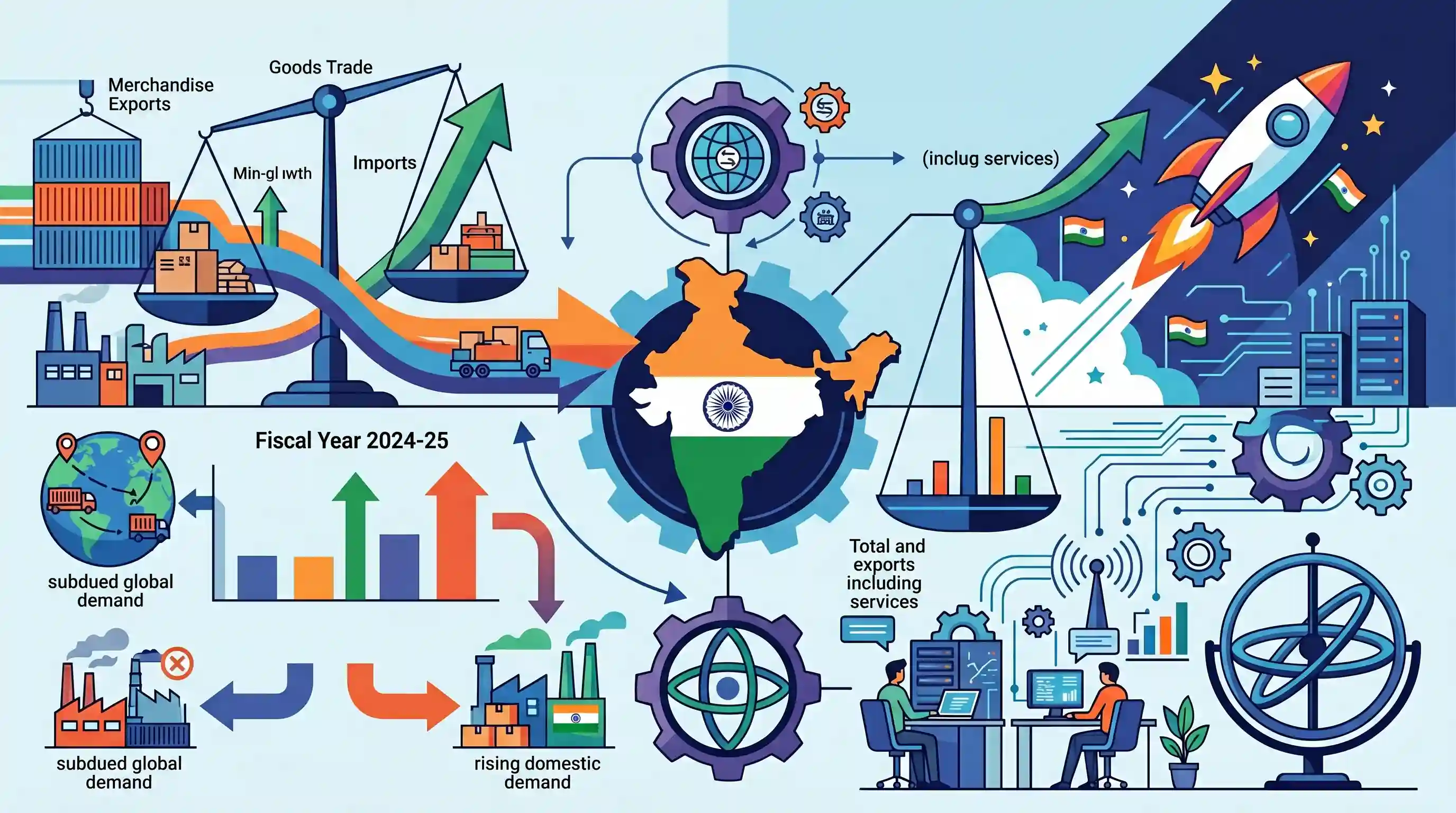
India's goods exports saw a marginal growth of 0.7% to reach $41.97 billion in March 2025, while imports surged by 11.3% to $63.51 billion, leading to a merchandise trade deficit of $21.54 billion. For the entire 2024-25 fiscal year, merchandise exports remained largely flat at $437.42 billion, but total exports (including services) hit a record $820.93 billion, marking a 5.5% overall increase. The widening merchandise trade deficit underscores challenges in the global trade environment, subdued global demand for goods, and rising domestic import demand.
Key Points
- India's merchandise exports saw a marginal increase of 0.7% to $41.97 billion in March 2025.
- The trade deficit for March widened to $21.54 billion, driven by an 11.3% surge in imports to $63.51 billion.
- For the full fiscal year 2024-25, merchandise exports remained nearly flat at $437.42 billion (0.08% growth), while imports grew by 6.62% to $720.24 billion.
- Overall exports (goods and services combined) reached a record high of $820.93 billion for FY 2024-25, reflecting a 5.5% growth primarily supported by the services sector.
Important Terms
Merchandise Trade Deficit

The amount by which the cost of a country's physical goods imports exceeds its exports. It is a key component of the current account and reflects domestic demand and manufacturing competitiveness.
UPSC context
GS Paper III (Economy). Tests understanding of trade imbalances, currency pressure, and impacts on macroeconomic stability.
Balance of Payments (BoP)
A systematic record of all economic transactions between a country's residents and the rest of the world. It comprises the current account (trade, income) and the capital account (investments, loans).
UPSC context
GS Paper III. Vital for analyzing economic health, forex management, and crises like the 1991 reforms.
Current Account Deficit (CAD)
A measurement of a country's trade where the value of imported goods, services, and transfers exceeds exports and receipts. It signifies that the nation is a net borrower from abroad.
UPSC context
GS Paper III. Crucial for assessing external vulnerability, rupee depreciation, and the sustainability of economic growth.
External Sector
The segment of an economy that deals with international trade, foreign exchange, and cross-border financial flows. It bridges the domestic economy with global markets and institutions.
UPSC context
GS Paper III. Evaluates India’s global integration, competitiveness, and resilience against international economic shocks.
Foreign Trade Policy (FTP)
Government guidelines and strategies formulated by the Ministry of Commerce to regulate imports and promote exports. It focuses on trade facilitation, incentives, and enhancing global competitiveness.
UPSC context
GS Paper III. Focuses on export promotion schemes, SEZs, and achieving long-term trade targets.
Services Exports
The export of intangible products like IT, telecommunications, and professional consulting. India typically maintains a surplus here, which helps mitigate the impact of a high merchandise trade deficit.
UPSC context
GS Paper III. Tests knowledge of India's competitive advantages and their role in stabilizing the current account.
Prelims Trap
India recorded a decline in overall exports for FY 2024-25 due to a widening merchandise trade deficit.
Aspirants often assume "stagnant merchandise exports" or a "widening trade deficit" means total exports fell. In reality, total exports hit a record high due to robust services growth.
Static Concepts Connected
What are the primary components of India's Current Account in the Balance of Payments?
- Trade in Goods: Represents visible merchandise imports and exports. India structurally maintains a significant deficit in this component.
- Trade in Services: Represents invisibles like IT, tourism, and financial services. India consistently runs a massive surplus here, cushioning the overall current account.
- Transfer Payments: Unilateral transfers such as inward remittances from the Indian diaspora, where India routinely leads globally.
How does the Trade Deficit differ from the Current Account Deficit (CAD)?
- Trade Deficit: Measures only the gap between physical merchandise (goods) imported and exported over a specific period.
- Current Account Deficit: A broader macroeconomic metric combining the merchandise trade deficit with net services, net factor income, and net unilateral transfers.
Cross-Topic Patterns
Services surplus + PLI constraints
Reliance on IT/ITeS exports to counterbalance the physical goods deficit underlines the critical role of PLI schemes in fixing India's manufacturing competitiveness and integrating into global value chains.
Global protectionism + FTAs
Stagnant goods exports mirror rising geopolitical fragmentation and tariff barriers, increasing the strategic necessity for India to successfully negotiate pending FTAs with Western markets like the UK and EU.

Expect a Prelims question contrasting India's widening merchandise trade deficit with its record overall exports driven by the services sector.
Linked PYQs · 4
Linked PYQs · 4
- 2025MainsGS3
What are the challenges before the Indian economy when the world is moving away from free trade and multilateralism to protectionism and bilateralism? How can these challenges be met?
- 2018MainsGS3
How would the recent phenomena of protectionism and currency manipulations in world trade affect macroeconomic stability of India?
- 2014PrelimsGS1
With reference to Balance of Payments, which of the following constitutes/constitute the Current Account? 1. Balance of trade 2. Foreign assets 3. Balance of invisibles 4. Special Drawing Rights Select the correct answer using the code given below.
- 2013PrelimsGS1
The balance of payments of a country is a systematic record of
