India Merchandise Exports Contraction and Current Account Trends
Source:The Hindu ↗
Why It Matters
Understanding the composition and trends of India's merchandise and services exports is vital for the UPSC Economics syllabus, specifically focusing on Balance of Payments, trade deficits, and macroeconomic stability.
Summary
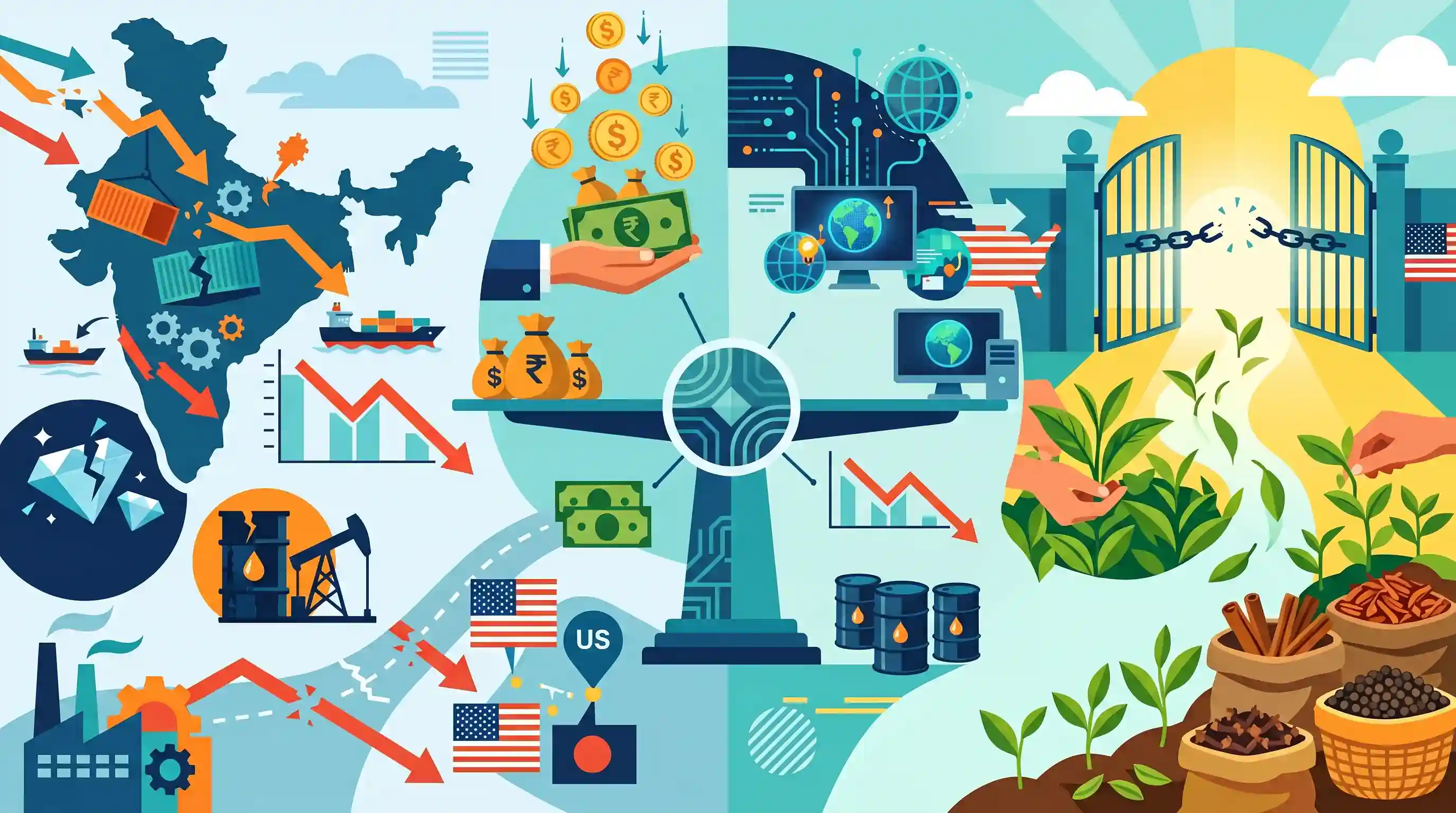
India's merchandise exports witnessed an 11.8% year-on-year decline in October, falling to $34.38 billion, which is the first contraction in 14 months according to CRISIL. The slowdown was broad-based, severely affecting petroleum products, gems and jewellery, and core sectors. Both US and non-US markets recorded significant export drops. However, the Current Account Deficit is expected to remain stable, cushioned by robust services trade, strong remittances, and lower crude oil import costs. A silver lining comes from the US announcing tariff cuts on 254 food items, which bodes well for India's agricultural exports like tea and spices.
Key Points
- India's merchandise exports fell by 11.8% to $34.38 billion in October, marking the first decline in 14 months.
- The drop was broad-based across sectors, with petroleum products falling 10.4% and core sector exports decreasing by 10.2%.
- Exports to the US contracted by 8.6%, and exports to non-US markets declined by 12.5%.
- The Current Account Deficit (CAD) is expected to remain manageable due to a robust services trade surplus, steady remittances, and softer crude oil prices.
- A recent US announcement to cut tariffs on 254 food items is expected to benefit India's agricultural exports, such as tea and spices.
Important Terms
Merchandise Exports

The trade of physical, tangible goods (e.g., textiles, petroleum) produced domestically and sold to foreign markets. It excludes intangible services and is the primary component of the trade balance.
UPSC context
GS Paper 3 (External Sector). Tests knowledge of visible trade and its impact on trade deficits and overall economic growth.
CRISIL
Credit Rating Information Services of India Limited is the nation's first and largest credit rating agency, offering independent ratings, research, and risk advisory services for financial markets.
UPSC context
GS Paper 3 (Financial Markets). Important for understanding the role of analytical agencies in assessing domestic economic health and creditworthiness.
Current Account Deficit (CAD)
A measurement of trade where a country's total imports of goods, services, and transfers exceed its total exports, representing a net outflow of foreign exchange.
UPSC context
GS Paper 3 (Balance of Payments). A vital indicator for currency stability, external debt, and macroeconomic sustainability.
Remittances
Funds sent home by migrants working abroad. India is the world's leading recipient, using these inflows to bridge the trade gap and strengthen foreign exchange reserves.
UPSC context
GS Paper 3 (External Sector). Tests understanding of "Invisible" trade components and their stabilizing role in India's BoP.
Balance of Payments (BoP)
A systematic accounting of all economic transactions—including trade, investments, and transfers—between a country's residents and the rest of the world over a specific period.
UPSC context
GS Paper 3 (Indian Economy). Fundamental for analyzing trade health, capital flows, and foreign exchange management.
Tariff
A tax or duty imposed by a government on imported goods, intended to protect domestic industries from foreign competition or raise fiscal revenue.
UPSC context
GS Paper 3 (Trade Policy). Relevant for studying international trade relations, protectionism, and WTO-related disputes.
Prelims Trap
A contraction in merchandise exports invariably leads to a widening of the Current Account Deficit (CAD).
CAD is the sum of both the trade deficit AND invisibles. A merchandise trade deficit can be entirely offset by robust services exports and strong inward remittances.
Static Concepts Connected
What are the primary components of the Current Account in India's Balance of Payments?
- Visible Trade: The balance of export and import of physical, tangible goods (often heavily in deficit for India).
- Services Trade: Includes trade in services (like IT/BPO, where India has a massive surplus).
- Current Transfers: Unilateral transfers such as remittances from Indians working abroad and foreign grants.
- Income Balance: Net income payments, including interest, profits, and dividends repatriated abroad or received from abroad.
How are commercial agricultural exports like Tea and Spices regulated in India?
- Statutory Boards: They are regulated by dedicated statutory bodies created by Acts of Parliament (e.g., Tea Act 1953, Spices Board Act 1986).
- Nodal Ministry: These commodity boards function under the Ministry of Commerce and Industry, not the Ministry of Agriculture.
- Geographical Focus: Headquarters are regionally distributed based on production hubs: Tea Board in Kolkata, Spices Board in Kochi.
Cross-Topic Patterns
Agri-exports & WTO SPS measures
While tariff cuts aid exports, Indian agricultural goods frequently face rigid Sanitary and Phytosanitary (SPS) measures in developed markets, linking WTO's non-tariff barrier debates to domestic farm incomes.
Exchange rate vs Import-intensive exports
A weaker Rupee theoretically aids export competitiveness, but high import intensity in core sectors like petroleum refining and gems often negates this advantage when global demand slows.

Expect a 2026 Prelims multi-statement question testing the exact invisible components that keep India's CAD manageable amidst trade deficits.
Linked PYQs · 2
Linked PYQs · 2
- 2020PrelimsGS1
With reference to the international trade of India at present, which of the following statements is/are correct? 1. India's merchandise exports are less than its merchandise imports. 2. India's imports of iron and steel, chemicals, fertilisers and machinery have decreased in recent years. 3. India's exports of services are more than its imports of services. 4. India suffers from an overall trade/current account deficit. Select the correct answer using the code given below:
- 2025MainsGS3
What are the challenges before the Indian economy when the world is moving away from free trade and multilateralism to protectionism and bilateralism? How can these challenges be met?
