US tariff cuts revive leather export industry in Uttar Pradesh
Source:Indian Express ↗
Why It Matters
Provides a real-world case study of how international trade policies (US tariffs) impact domestic economic stability, employment in labour-intensive manufacturing (leather), and the MSME sector, which are core themes in GS3 (Economy) and GS2 (IR).
Summary
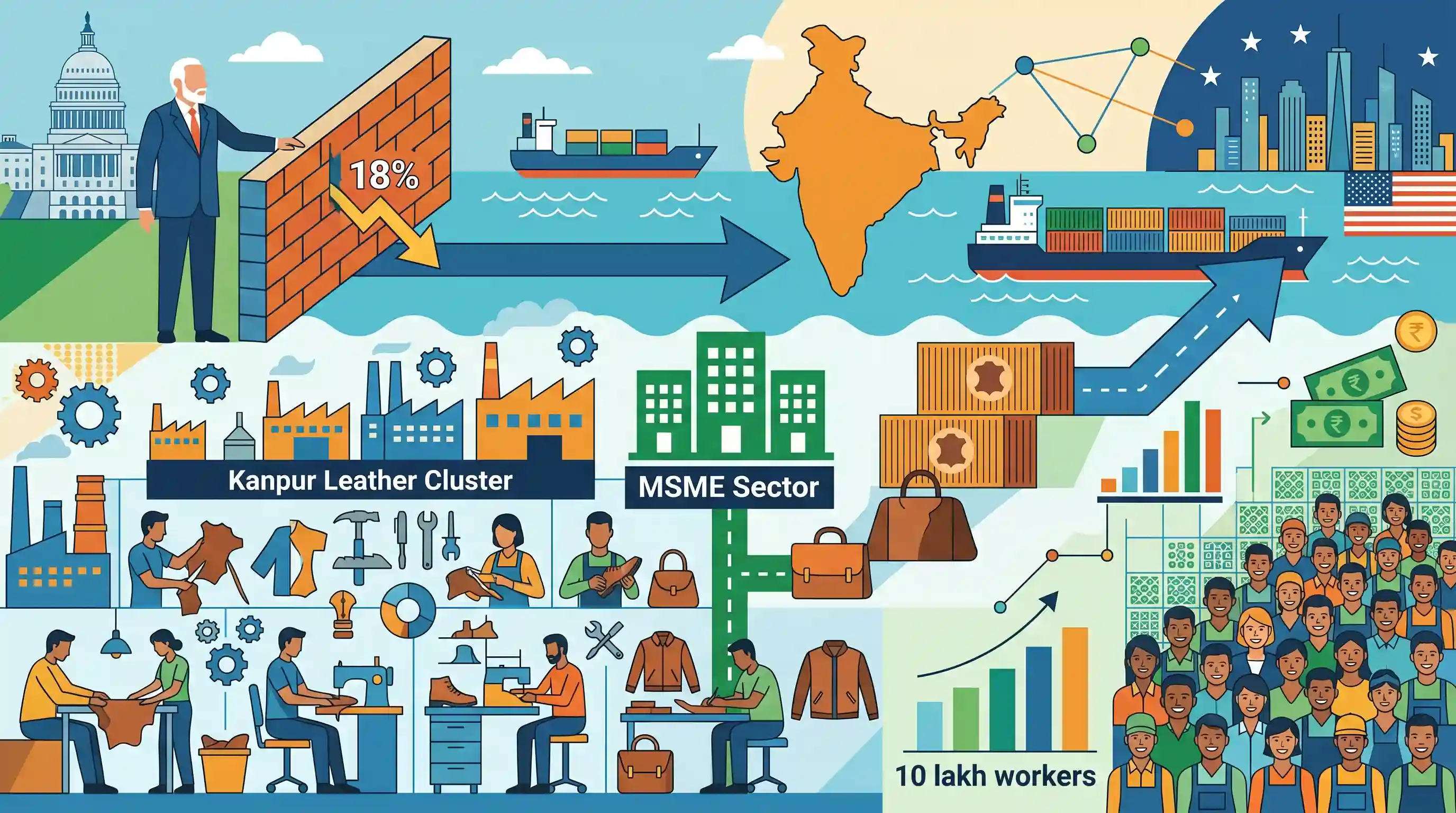
The article discusses the positive implications of US President Donald Trump's proposed 18% tariff cut on the leather industry in Kanpur, Uttar Pradesh. As a major MSME and labour-intensive cluster employing around 10 lakh workers, Kanpur's leather exporters heavily depend on the US market. The anticipated tariff reduction is seen as a lifeline that will enable exporters to recover lost business and regain international competitiveness. This development underscores the direct correlation between the trade policies of major global partners and domestic employment, particularly within India's traditional manufacturing and export-oriented MSME sectors.
Key Points
- The United States is a significant export destination for India's leather industry.
- US President Donald Trump's proposed 18% tariff cut provides a much-needed boost to the leather manufacturing hub in Kanpur, Uttar Pradesh.
- The Kanpur leather cluster is highly labour-intensive, employing approximately 10 lakh workers whose livelihoods are tied to export performance.
- A reduction in tariffs is expected to help Indian leather exporters regain global competitiveness and recover previously lost business volumes.
- The situation exemplifies how the trade policies and tariff structures of advanced economies directly impact India's MSME sector and employment generation.
Important Terms
MSMEs (Micro, Small and Medium Enterprises)

Enterprises classified by investment and turnover (e.g., Micro: ≤₹1cr investment/≤₹5cr turnover). They contribute ~30% to India's GDP and nearly 45% of total exports.
UPSC context
GS-3: Indian Economy. Key for employment, manufacturing, and inclusive growth. Frequently tested in Prelims (definitions) and Mains (challenges/reforms).
Tariff
A tax or duty imposed by a government on imported goods. It is a primary tool of trade policy used to protect domestic industries or raise revenue.
UPSC context
GS-2 & GS-3: International Relations and Economy. Relates to trade wars, WTO rules, and India's competitiveness in global markets.
Labour-Intensive Sector
Industries where the production process requires a high proportion of manual labor relative to capital investment (e.g., leather, textiles, apparel).
UPSC context
GS-3: Employment generation and demographic dividend. Vital for discussing the 'missing middle' and jobless growth in the manufacturing sector.
Bilateral Trade
The exchange of goods, services, and capital between two sovereign nations. India-US trade is a cornerstone of their Comprehensive Global Strategic Partnership.
UPSC context
GS-2: International Relations. Focuses on India's interests, trade deficits, and diplomatic negotiations with major partners like the United States.
Industrial Cluster
A geographic concentration of interconnected businesses, suppliers, and institutions in a specific field (e.g., Kanpur leather cluster). It enhances efficiency through shared resources.
UPSC context
GS-1 & GS-3: Geography/Economy. Relevant for regional development, local employment, and the One District One Product (ODOP) initiative.
MSMED Act, 2006
The principal legal framework governing MSMEs in India. It provides the statutory definition, classification criteria, and measures for promoting and developing small-scale industries.
UPSC context
GS-3: Policy and Governance. Essential for understanding the regulatory environment, ease of doing business, and government support mechanisms for MSMEs.
Export-Oriented MSMEs
Small and medium-sized firms that primarily produce goods for international markets. They often rely on government export incentives to maintain global price competitiveness.
UPSC context
GS-3: External Sector. Critical for analyzing India's trade balance and the impact of global supply chain shifts (e.g., China Plus One).
Prelims Trap
"India's leather export sector is predominantly driven by large-scale organized manufacturing units."
Over 98% of India's leather and footwear businesses are classified as MSMEs. The sector is highly fragmented, labour-intensive, and unorganized, rather than being dominated by large corporations.
Static Concepts Connected
What are the key locational factors for Kanpur's leather tanning industry?
- Raw Material: Proximity to a massive livestock population in Uttar Pradesh and neighbouring states provides a steady supply of hides and skins.
- Water Availability: Location along the banks of the Ganga river historically provided the massive quantities of water required for the chemical-heavy tanning process.
- Labour Supply: Abundant availability of cheap, semi-skilled workforce in the densely populated region supports this highly labour-intensive industry.
How are MSMEs classified under the revised 2020 criteria in India?
- Micro Enterprises: Investment in Plant and Machinery or Equipment up to ₹1 crore and Annual Turnover up to ₹5 crore.
- Small Enterprises: Investment in Plant and Machinery or Equipment up to ₹10 crore and Annual Turnover up to ₹50 crore.
- Medium Enterprises: Investment in Plant and Machinery or Equipment up to ₹50 crore and Annual Turnover up to ₹250 crore.
Cross-Topic Patterns
Kanpur Leather and UP's ODOP Scheme
Kanpur's leather products are heavily promoted under UP's ODOP scheme, illustrating how state-level regional cluster initiatives must navigate global trade dynamics and foreign tariff barriers to succeed.
Employment vs. Export Competitiveness
Tariff barriers severely impact India's demographic dividend by squeezing labour-intensive export sectors (leather, textiles), where competitors like Vietnam and Bangladesh often enjoy preferential Free Trade Agreements.

Expect a Mains 2026 question linking global protectionism to domestic job losses in labour-intensive MSME clusters like leather & textiles.
Linked PYQs · 5
Linked PYQs · 5
- 2023MainsGS3
Faster economic growth requires increased share of the manufacturing sector in GDP, particularly of MSMEs. Comment on the present policies of the Government in this regard.
- 2017MainsGS3
Account for the failure of manufacturing sector in achieving the goal of labour-intensive exports. Suggest measures for more labour-intensive rather than capital-intensive exports.
- 2012MainsGS2
Discuss the likely negative impact of the protectionist measures proposed by the US on India's software industry.
- 2020PrelimsGS1
With reference to the international trade of India at present, which of the following statements is/are correct? 1. India's merchandise exports are less than its merchandise imports. 2. India's imports of iron and steel, chemicals, fertilisers and machinery have decreased in recent years. 3. India's exports of services are more than its imports of services. 4. India suffers from an overall trade/current account deficit. Select the correct answer using the code given below:
- 2023PrelimsGS1
Consider the following statements with reference to India: 1. According to the 'Micro, Small and Medium Enterprises Development (MSMED) Act, 2006', the 'medium enterprises' are those with investments in plant and machinery between ₹ 15 crore and ₹ 25 crore. 2. All bank loans to the Micro, Small and Medium Enterprises qualify under the priority sector. Which of the statements given above is/are correct?
