Andhra Pradesh Firecracker Unit Explosion triggers Relief Funds
Source:The Hindu ↗
Why It Matters
The tragedy underscores the continuous need for stringent enforcement of industrial safety regulations in hazardous units like firecracker factories. It also illustrates the real-world application of institutional relief mechanisms such as the PMNRF in the immediate aftermath of disasters, a relevant topic under GS3 Disaster Management and GS2 Governance.
Summary
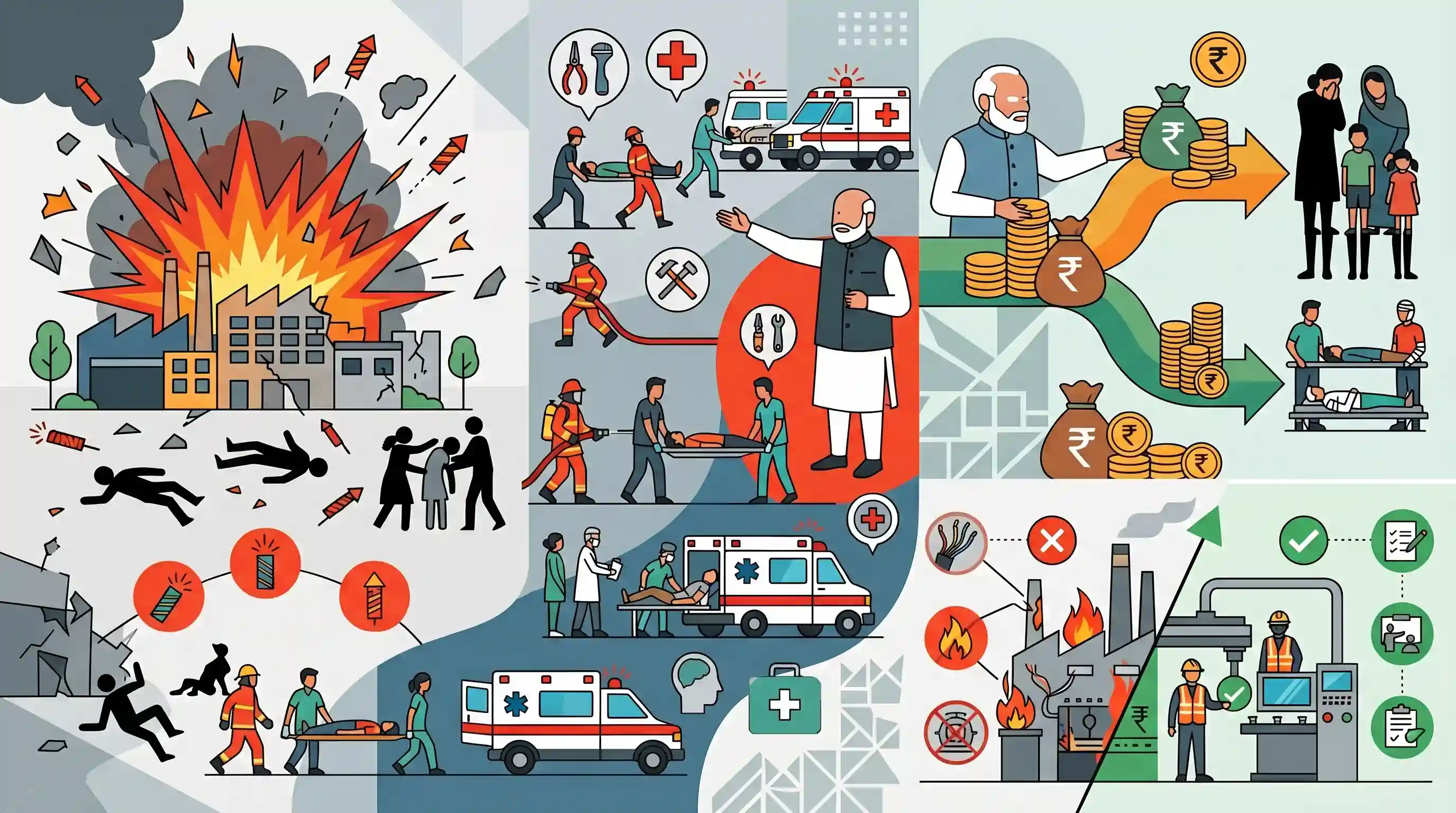
A devastating explosion at a firecracker manufacturing unit in Andhra Pradesh's Kakinada district resulted in multiple fatalities and injuries. In response, Prime Minister Narendra Modi announced an ex gratia of ₹2 lakh from the Prime Minister's National Relief Fund (PMNRF) for the families of the deceased and ₹50,000 for the injured. Union Home Minister Amit Shah also offered condolences, assuring that rescue, relief, and medical operations were actively underway. The incident highlights recurring industrial safety concerns and the critical role of disaster management mechanisms in hazardous manufacturing sectors.
Key Points
- A massive explosion occurred at a firecracker manufacturing unit in the Kakinada district of Andhra Pradesh, leading to loss of life and injuries.
- Prime Minister Narendra Modi expressed grief over the incident and announced financial assistance for the victims.
- An ex gratia of ₹2 lakh from the Prime Minister's National Relief Fund (PMNRF) will be given to the next of kin of the deceased, and ₹50,000 to the injured.
- Union Home Minister Amit Shah stated that rescue and relief operations, along with necessary medical care for the injured, were underway.
Important Terms
Prime Minister’s National Relief Fund (PMNRF)

Established in 1948, this fund relies entirely on public contributions without budgetary support to provide immediate relief to victims of natural calamities, major accidents, and riots.
UPSC context
GS Paper II (Governance) & GS Paper III (Disaster Management). Tests understanding of executive relief mechanisms and non-budgetary funding.
Petroleum and Explosives Safety Organization (PESO)
A nodal statutory agency under the Ministry of Commerce and Industry that regulates the safety of explosives, petroleum, compressed gases, and other hazardous substances in India.
UPSC context
GS Paper III (Industrial Safety). Crucial for questions on regulatory oversight in hazardous manufacturing sectors like firecrackers.
Ex-gratia Payment
A voluntary payment made by the government or an organization out of goodwill or moral obligation, rather than a legal liability or mandated compensation.
UPSC context
GS Paper II (Social Justice/Governance). Relates to the state's discretionary role in providing immediate financial support during tragedies.
Explosives Act, 1884
The primary 19th-century legislation regulating the manufacture, possession, and transport of explosives; currently undergoing reform via the proposed Explosives Bill 2024 to enhance safety penalties.
UPSC context
GS Paper III (Disaster Management/Internal Security). Important for understanding the legal framework governing hazardous industrial units.
National Disaster Management Authority (NDMA)
The apex statutory body for disaster management in India, chaired by the Prime Minister, responsible for laying down national policies, plans, and guidelines.
UPSC context
GS Paper III (Disaster Management). Fundamental for institutional framework questions regarding disaster response and mitigation.
Prelims Trap
"The PMNRF is constituted under an Act of Parliament and its financial expenditures are audited by the CAG."
PMNRF was established as a Trust in 1948, not by an Act of Parliament. It receives no budgetary support and is audited by an independent external auditor, not the CAG.
Static Concepts Connected
How does PMNRF differ from the National Disaster Response Fund (NDRF)?
- Statutory backing: NDRF is a statutory fund under the Disaster Management Act, 2005. PMNRF is structured as a Trust established in 1948.
- Funding source: NDRF receives budgetary allocations and National Calamity Contingent Duty (NCCD). PMNRF relies entirely on voluntary public contributions.
- Audit mechanism: NDRF is audited by the Comptroller and Auditor General (CAG). PMNRF is audited by an independent external auditor.
What is the mandate of the Petroleum and Explosives Safety Organisation (PESO)?
- Nodal Ministry: It operates under the Department for Promotion of Industry and Internal Trade (DPIIT) within the Ministry of Commerce and Industry.
- Core mandate: It is the nodal agency for framing safety guidelines and issuing licenses for manufacturing, storing, and transporting explosives and petroleum.
- Legislative backing: It administers key regulations under the Petroleum Act, 1934 and the colonial-era Explosives Act, 1884.
Cross-Topic Patterns
Industrial Safety & OSH Code 2020
Frequent factory blasts highlight the delayed implementation of the Occupational Safety, Health and Working Conditions Code, 2020, which aims to unify and enforce stricter safety audits in hazardous industries.
Overhauling colonial-era hazard laws
Replacing the Explosives Act of 1884 with the Draft Explosives Bill 2024 matches the government's broader push to update archaic laws and modernize regulatory compliance.

Expect a multi-statement Prelims question comparing the statutory backing, funding models, and audit mechanisms of PMNRF, PM-CARES, and NDRF.
Linked PYQs · 2
Linked PYQs · 2
- 2019MainsGS3
Disaster preparedness is the first step in any disaster management process. Explain how hazard zonation mapping will help disaster mitigation in the case of landslides.
- 2013MainsGS3
How important are vulnerability and risk assessment for pre-disaster management ? As an administrator, what are key areas that you would focus on in a Disaster Management System.
