Bengaluru water resource mismanagement and urban wetland encroachment
Source:The Hindu ↗
Why It Matters
Bengaluru represents a classic case study for UPSC aspirants on the perils of unplanned urban expansion. The city's crisis perfectly illustrates the environmental implications of reclaiming water bodies for urban land use (a direct GS1 PYQ theme) and the emerging climate-induced disaster of urban flooding (GS3 theme). Understanding this dynamic is crucial for answering questions on sustainable urbanization, water security, and urban governance.
Summary
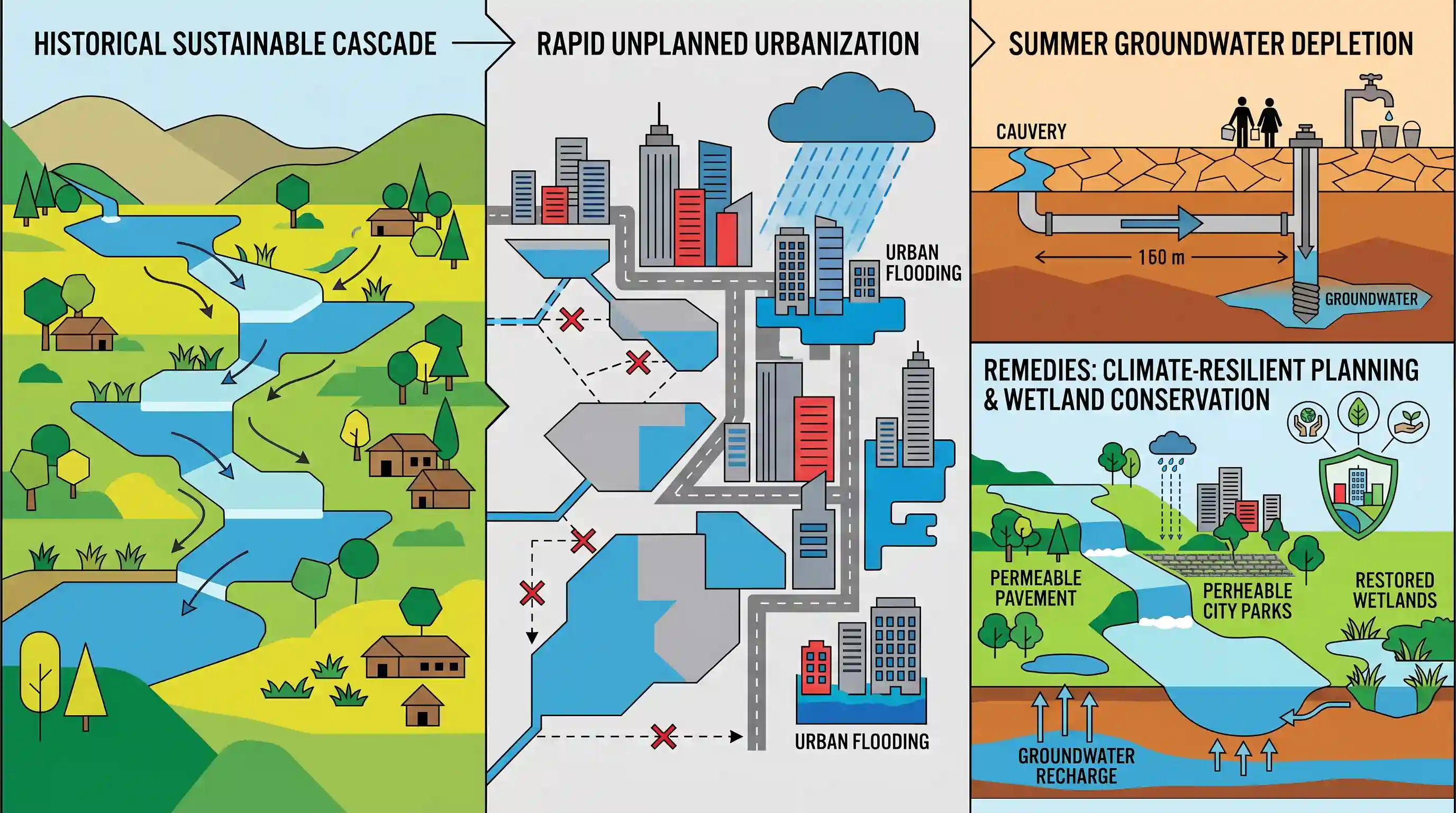
The article delves into Bengaluru's paradoxical relationship with water, marked by a cycle of severe summer droughts and monsoon urban flooding. It traces the city's journey from a historically sustainable settlement built around a cascading network of man-made lakes to a modern metropolis grappling with acute water mismanagement. Rapid, unplanned urbanization has led to the rampant encroachment of wetlands, destruction of lakes, and extensive concretization, which in turn has disrupted natural drainage and groundwater recharge. Consequently, the city is forced to over-extract groundwater and rely heavily on the distant Cauvery River, underscoring the urgent need for climate-resilient urban planning and the restoration of its traditional water infrastructure.
Key Points
- Bengaluru historically relied on a sophisticated, interconnected system of man-made lakes and tanks to harvest rainwater, compensating for the lack of a perennial river.
- Rapid and unplanned urbanization has led to the widespread encroachment and reclamation of these vital water bodies and wetlands, severely disrupting natural drainage and ecological balance.
- Heavy concretization has drastically reduced natural groundwater recharge, leading to an over-reliance on deep borewells and the rapid depletion of aquifers.
- The destruction of the lake network has created a dual crisis: acute water scarcity during dry seasons and severe urban flooding during monsoons due to increased surface runoff.
- The city's current water security heavily depends on pumping water from the distant Cauvery River, an energy-intensive process that faces geopolitical and ecological limits.
- Addressing the crisis requires an integrated approach including the restoration of the traditional lake cascading system, strict enforcement of rainwater harvesting, and large-scale wastewater recycling.
Important Terms
Urban Flooding

A climate-induced disaster where intense rainfall overwhelms a city's drainage capacity, exacerbated by unplanned urbanization, loss of wetlands, and high proportions of impervious concrete surfaces.
UPSC context
GS Paper III (Disaster Management) and GS Paper I (Geography); tests causes, mitigation strategies, and climate resilience in urban planning.
Smart Cities Mission
A centrally sponsored scheme launched in 2015 to improve quality of life through 'smart solutions' like sustainable water management, efficient drainage, and robust IT-enabled governance.
UPSC context
GS Paper II (Government Policies) and GS Paper III (Urbanization); relevant for sustainable urban development and infrastructure.
Wetlands
Seasonal or permanent water-saturated ecosystems (e.g., lakes, marshes) that act as 'ecological kidneys' for water purification and 'sponges' for flood control and groundwater recharge.
UPSC context
GS Paper III (Environment); relates to the Ramsar Convention, biodiversity conservation, and natural disaster mitigation.
Bruhat Bengaluru Mahanagara Palike (BBMP)
The municipal corporation responsible for Bengaluru's civic infrastructure, zoning, and lake maintenance; it plays a critical role in managing urban sprawl and preventing encroachment.
UPSC context
GS Paper II (Polity); tests understanding of Urban Local Bodies (74th Amendment) and decentralized governance.
Bangalore Water Supply and Sewerage Board (BWSSB)
A statutory body established in 1964 to manage bulk water supply (primarily from the Cauvery River) and sewage disposal in the Bengaluru metropolitan area.
UPSC context
GS Paper II/III; represents functional parastatals in urban utility management and inter-departmental coordination challenges.
Groundwater Depletion
The reduction of underground water levels due to over-extraction for domestic and industrial needs, often worsened by concretization which prevents natural rainwater infiltration into aquifers.
UPSC context
GS Paper III (Resources and Environment); highlights water security challenges and the need for sustainable extraction and recharge.
Prelims Trap
The traditional 'Kere' system of Bengaluru consists of naturally formed tectonic lakes.
The 'Kere' system is actually a sophisticated, human-engineered cascading network of man-made tanks built on the Deccan plateau to harvest rainwater, not a natural phenomenon.
Static Concepts Connected
What is a cascading tank system (like Bengaluru's 'Kere')?
- Gravity-fed design: Interconnected man-made reservoirs built along a natural topographical gradient to harvest regional rainfall.
- Overflow management: Surplus water from a filled upstream tank automatically flows to the next downstream tank, preventing local flooding.
- Groundwater recharge: Retains surface water across a wide watershed for extended durations, facilitating deep aquifer replenishment.
What are the key ecological functions of urban wetlands?
- Flood attenuation: Act as massive natural sponges that absorb excess rainfall and surface runoff, drastically reducing peak floods.
- Water purification: Naturally filter out pollutants, heavy metals, and excess nutrients, functioning as biological 'kidneys of the landscape'.
- Microclimate regulation: Moderate localized extreme temperatures and significantly mitigate the Urban Heat Island (UHI) effect through evaporative cooling.
Cross-Topic Patterns
Cauvery Dispute & Urban Demand
Bengaluru's massive draw of over 1,450 MLD from the Cauvery River directly exacerbates the interstate water-sharing dispute between Karnataka and Tamil Nadu, especially during deficit monsoon years.
Kere vs. Tankas & Johads
UPSC frequently tests regional traditional water harvesting. The Deccan's gravity-fed cascading 'Kere' system can be comparatively analyzed alongside Rajasthan's Johads or Tankas designed for arid environments.

Expect a GS1/GS3 Mains question in 2026 linking traditional water systems (like the Kere cascade) to modern urban flood mitigation.
Linked PYQs · 3
Linked PYQs · 3
- 2021MainsGS1
What are the environmental implications of the reclamation of water bodies into urban land use ? Explain with examples.
- 2023MainsGS1
Why is the world today confronted with a crisis of availability of and access to freshwater resources?
- 2024MainsGS3
Flooding in urban areas is an emerging climate-induced disaster. Discuss the causes of this disaster. Mention the features of two such major floods in the last two decades in India. Describe the policies and frameworks in India that aim at tackling such floods.
