Analyzing critical economic importance of Census 2027
Source:Indian Express ↗
Why It Matters
A decennial census is the bedrock of empirical governance, economic planning, and welfare distribution in India. Understanding why the upcoming Census 2027 is critical highlights the challenges of policymaking in the absence of updated demographic data.
Summary
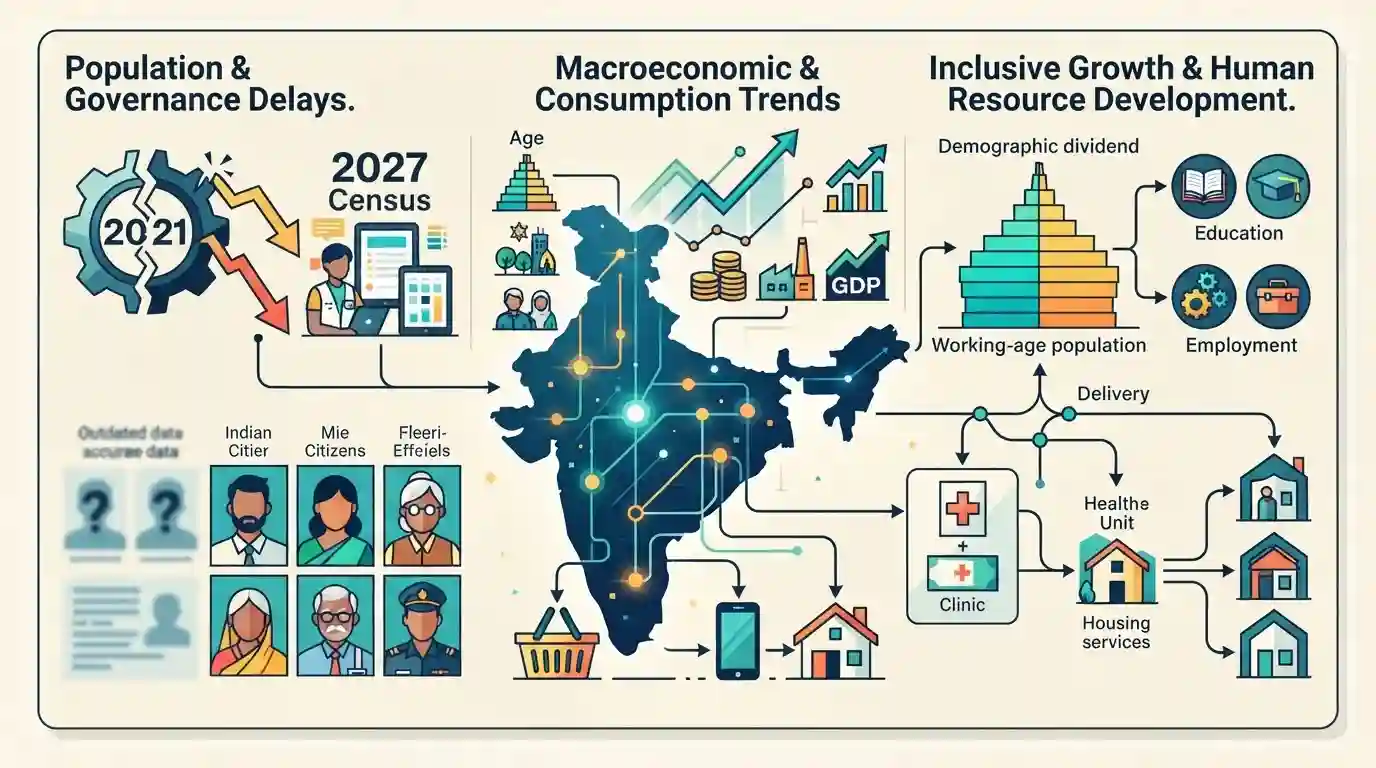
The article discusses the critical importance of Census 2027 to India's economy, governance, and policy planning. Highlighting the delays following the postponement of the 2021 decennial census, the piece emphasizes how granular demographic and socio-economic data are indispensable for accurate macroeconomic modeling, tracking consumption trends, optimizing welfare distribution, and measuring the demographic dividend.
Key Points
- The Census 2027 is crucial for updating India's demographic and socio-economic data, which has been severely delayed past its scheduled 2021 decennial cycle.
- Accurate census data underpins economic modeling, inflation targeting, GDP calculations, public resource allocation, and welfare delivery.
- Without a fresh census, policymakers rely on outdated 2011 census data, leading to distorted estimates of consumption patterns, poverty lines, and the demographic dividend.
- The census results will also have profound implications for future political representation and delimitation exercises.
Important Terms
Census 2027

India's upcoming decennial population enumeration and housing census, postponed from 2021, serving as the first fully digital census with mobile data collection and online self-enumeration options.
UPSC context
UPSC Prelims/Mains (GS Paper I & II - Population & Governance): Crucial for demographic data, policy planning, welfare targeting, and delimitation.
Government of India
The executive branch of the Indian union responsible for formulating administrative policies, implementing laws, conducting national censuses, and managing socio-economic welfare schemes.
UPSC context
UPSC Prelims/Mains (GS Paper II - Polity & Governance): Tests understanding of administrative structures, executive responsibility, and public service delivery.
Prelims Trap
The decennial census is conducted by MoSPI under the authority of the Census Act 1948.
Aspirants often assume the decennial census is conducted under the Census Act of 1948 by the Ministry of Statistics and Programme Implementation (MoSPI). In reality, it is conducted by the Office of the Registrar General and Census Commissioner under the Ministry of Home Affairs.
Static Concepts Connected
What are the legal and administrative provisions governing the decennial Census in India?
- Statutory Basis: Enacted in 1948, it provides the legal framework for conducting the decennial population census in India.
- Executing Authority: The office of the Registrar General and Census Commissioner, India, under the Ministry of Home Affairs, is mandated to carry it out.
- Data Privacy: Strict confidentiality provisions ensure individual respondent data cannot be accessed for taxation or judicial proceedings.
What is the constitutional and statutory mechanism governing parliamentary delimitation in India?
- Constitutional Mandate: Article 82 mandates readjustment of Lok Sabha and Assembly seats after every census through a parliamentary law (Delimitation Commission Act).
- The Freeze: The 84th Constitutional Amendment Act (2001) froze seat allocations based on the 1971 census until the first census post-2026.
- Federal Balance: It balances democratic representation with federal equity for states that successfully implemented population control policies.
Cross-Topic Patterns
Census Data + Finance Commission Devolution
Decennial demographic data directly dictates the allocation formulas of the Finance Commission, linking population baselines to vertical and horizontal tax devolution.
Delimitation + Federal Representation Imbalances
Parliamentary delimitation based on post-2026 census results intersects with federalism debates, balancing population-based representation with incentives for family planning.

Census delays + NFSA leakages + Delimitation after 2026 will feature as a multi-statement governance/polity question.
Linked PYQs · 3
Linked PYQs · 3
- 2011PrelimsGS1
India is regarded as a country with “Demographic Dividend”. This is due to
- 2013PrelimsGS1
To obtain full benefits of demographic dividend, what should India do?
- 2023MainsGS2
The crucial aspect of development process has been the inadequate attention paid to Human Resource Development in India. Suggest measures that can address this inadequacy.
