Union Budget Priorities Face Scrutiny Against India Economic Realities
Source:Indian Express ↗
Why It Matters
Understanding the structural trade-offs in the Union Budget is crucial for GS3. Aspirants must be able to critically evaluate the impacts of capital versus revenue expenditure on macroeconomic stability, employment generation, and private consumption, especially in the context of jobless growth.
Summary
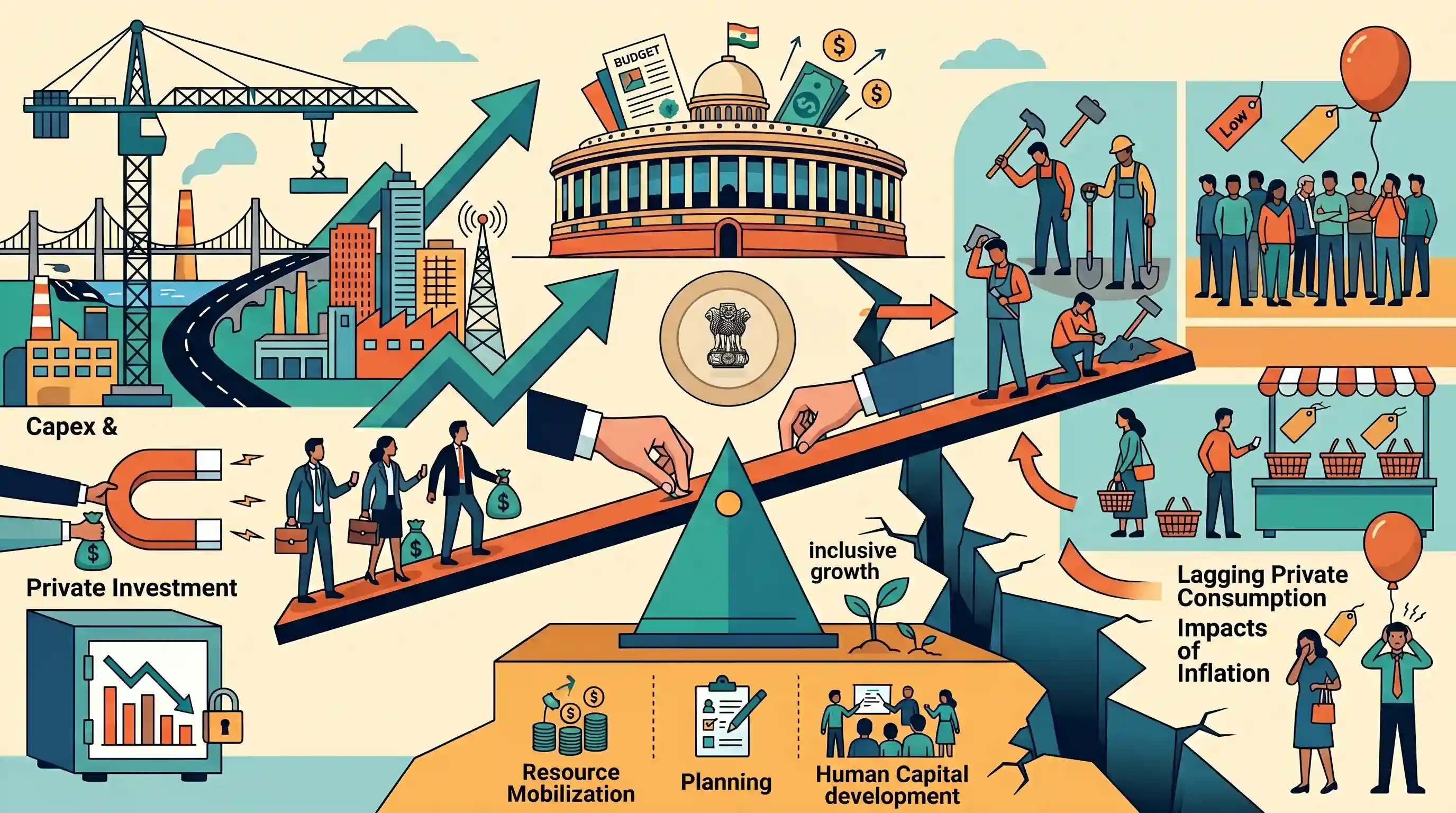
This analytical piece examines whether the government's Union Budget priorities—heavily focused on capital expenditure and fiscal consolidation—align with the structural realities of the Indian economy. While infrastructure spending is designed to spur long-term growth and attract private investment, there are pressing concerns that this strategy overlooks immediate challenges such as 'jobless growth', lagging private consumption, and the impacts of inflation on ordinary citizens. The article explores the policy trade-offs between sustaining macroeconomic stability through fiscal prudence and the urgent need to boost employment and human capital through targeted revenue expenditure.
Key Points
- The government's continued focus on capital expenditure (capex) aims to build infrastructure and crowd in private investment for long-term growth.
- Fiscal consolidation remains a strict priority to maintain macroeconomic stability and adhere to fiscal deficit targets.
- Despite strong headline GDP growth, the economy suffers from structural challenges like jobless growth and insufficient high-quality employment.
- Weak private consumption demand suggests persistent economic distress among lower- and middle-income segments, compounded by inflation.
- There is a critical debate on whether the Budget needs to rebalance its allocations from capex toward revenue expenditure to address immediate welfare, health, education, and job creation needs.
Important Terms
Union Budget

An 'Annual Financial Statement' under Article 112, estimating the government's receipts and expenditures for a financial year (April–March).
UPSC context
GS Paper 3: Government Budgeting. Essential for understanding fiscal policy, resource allocation, and macroeconomic stability.
Capital Expenditure (CapEx)
Spending on assets like infrastructure and machinery that yield long-term benefits or reduce liabilities.
UPSC context
GS Paper 3: Investment models and growth. Tested for its 'multiplier effect' on the economy.
Jobless Growth
A situation where the economy grows in GDP terms without a proportional increase in employment opportunities.
UPSC context
GS Paper 3: Employment and inclusive growth. Focuses on the structural 'missing middle' and demographic dividend challenges.
Fiscal Consolidation
The process of reducing the fiscal deficit and managing public debt to ensure sustainable government finances.
UPSC context
GS Paper 3: Government Budgeting. Key to the FRBM Act and maintaining macroeconomic credibility and stability.
Revenue Expenditure
Government spending for daily operations, such as salaries, subsidies, and interest payments, which does not create permanent assets.
UPSC context
GS Paper 3: Budgeting. Highlights trade-offs between welfare spending and long-term asset creation.
Private Consumption
The total value of goods and services purchased by households; it typically accounts for about 60% of India's GDP.
UPSC context
GS Paper 3: Planning and mobilization of resources. Tested as a primary engine of economic demand.
Prelims Trap
High government capital expenditure invariably crowds out private investment in the economy.
UPSC tests 'crowding in' vs 'out'. While high deficit borrowing can crowd out credit, the government's stance is that targeted infra-capex actively crowds in private investment.
Static Concepts Connected
What differentiates Capital Expenditure from Revenue Expenditure?
- Asset Creation: Capex creates physical/financial assets or reduces government liabilities, whereas revenue expenditure does neither (e.g., salaries, subsidies).
- Economic Multiplier: Capex has a higher macroeconomic multiplier effect (stimulating long-term GDP), while revenue expenditure generally fuels immediate consumption.
What are the structural drivers of 'Jobless Growth' in India?
- Sectoral Skew: GDP growth is heavily driven by capital-intensive and skill-intensive services (like IT), bypassing mass labor-intensive manufacturing.
- Skill Mismatch: A significant portion of the surplus agricultural workforce lacks the specialized skills required by the fast-growing formal sectors.
Cross-Topic Patterns
Capex vs Demographic Dividend
The macro trade-off between infrastructure capex and revenue spending on health/education directly impacts India's ability to reap its closing demographic dividend (GS1/GS2).
K-Shaped Recovery & PFCE
Weak Private Final Consumption Expenditure (PFCE) is a direct macroeconomic symptom of a K-shaped recovery, linking budget allocations to rising wealth inequality.

Expect a GS3 Mains question on the Capex vs Consumption trade-off, or Prelims MCQs testing the nuances of 'crowding in' private capital.
Linked PYQs · 4
Linked PYQs · 4
- 2021MainsGS3
Distinguish between Capital Budget and Revenue Budget. Explain the components of both these Budgets.
- 2022MainsGS3
Economic growth in the recent past has been led by increase in labour productivity." Explain this statement. Suggest the growth pattern that will lead to creation of more jobs without compromising labour productivity.
- 2015MainsGS3
The nature of economic growth in India in recent times is often described as jobless growth. Do you agree with this view ? Give arguments in favour of your answer.
- 2022PrelimsGS1
With reference to the expenditure made by an organisation or a company, which of the following statements is/are correct? 1. Acquiring new technology is capital expenditure. 2. Debt financing is considered capital expenditure, while equity financing is considered revenue expenditure. Select the correct answer using the code given below:
