Nominal GDP Growth and Fiscal Consolidation Challenges in Budget
Source:Indian Express ↗
Why It Matters
Understanding the distinction between nominal and real GDP is crucial for comprehending government budgeting. It illustrates how inflation dynamics affect public finance, tax buoyancy, fiscal deficit targets, and the government's capacity to undertake capital expenditure—all central themes in the GS Paper 3 syllabus on Indian Economy.
Summary
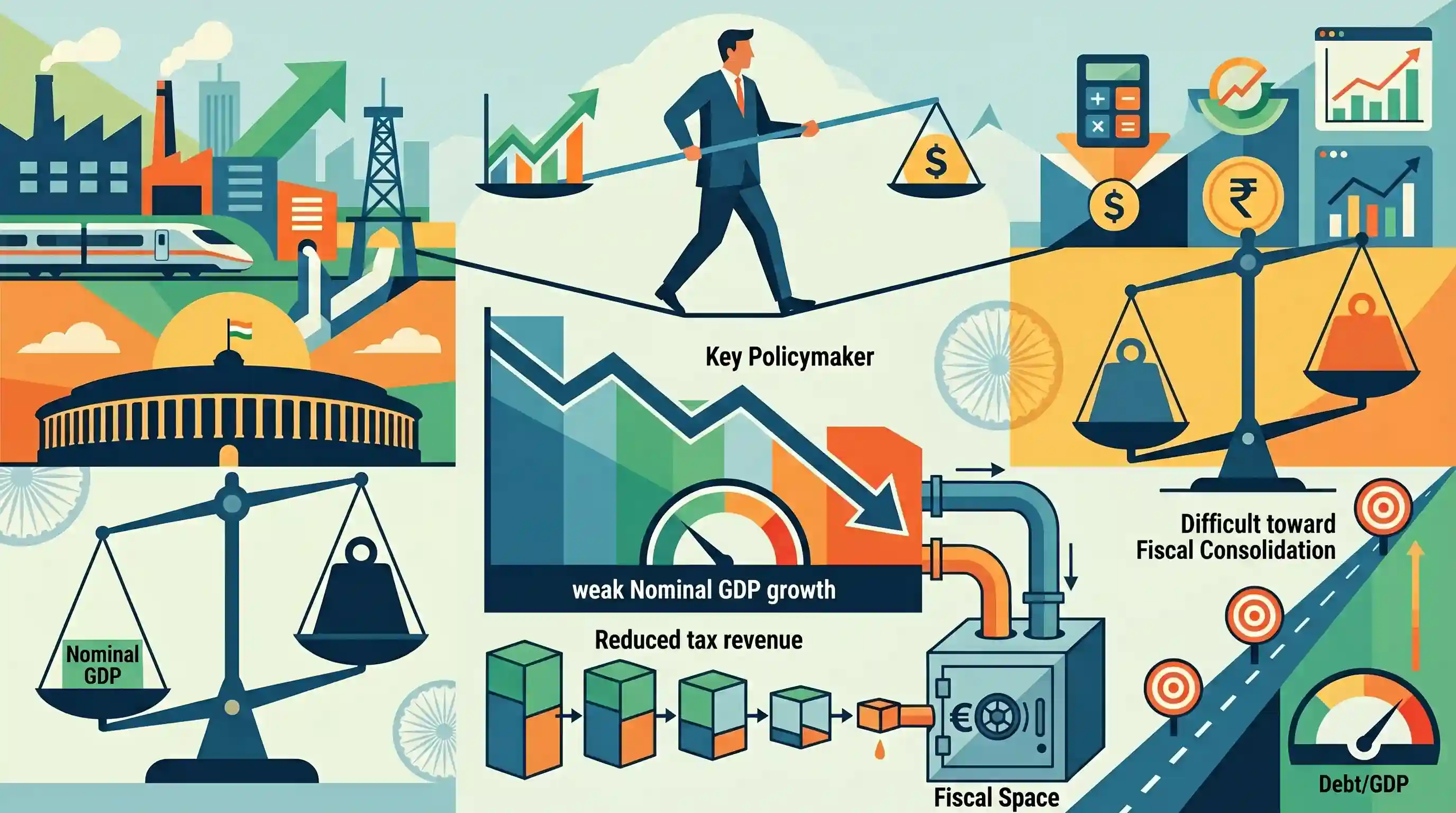
The article analyzes the macroeconomic concerns ahead of the Union Budget 2026, emphasizing weak nominal GDP growth as a primary worry for the Indian economy. Although real GDP indicates output growth, nominal GDP forms the mathematical base for the government's tax revenue projections. A slowdown in nominal GDP growth directly impacts tax collections, squeezing the government's fiscal space. Furthermore, because fiscal deficit and public debt are measured as a percentage of nominal GDP, a smaller denominator complicates the government's path to fiscal consolidation under the FRBM framework. This dynamic forces policymakers to navigate a tightrope between funding crucial capital expenditure to spur growth and maintaining macroeconomic stability.
Key Points
- While real GDP measures the actual volume of economic output, nominal GDP (which includes inflation) is the critical base for calculating government revenues and fiscal ratios.
- Weak nominal GDP growth implies lower tax buoyancy, resulting in constrained revenue collections for the government.
- Fiscal targets such as the fiscal deficit and debt-to-GDP ratio are calculated as a percentage of nominal GDP; a slower-growing denominator makes fiscal consolidation significantly harder.
- The upcoming Union Budget 2026 faces the challenge of balancing the need for sustained capital expenditure to stimulate the economy against the limited fiscal space caused by subdued nominal growth.
Important Terms
Nominal GDP

The total market value of goods and services produced within a country, calculated at current market prices without adjusting for inflation. It serves as the base for tax revenue projections.
UPSC context
GS Paper 3 (Economy); relevant for understanding fiscal ratios and the denominator effect in debt-to-GDP measurements.
Real GDP
An inflation-adjusted measure of economic output that reflects the actual quantity of goods and services produced, calculated using constant prices from a base year.
UPSC context
GS Paper 3 (Economy); tests the ability to distinguish between price-driven growth and actual increase in production.
Fiscal Responsibility and Budget Management (FRBM) Act
A 2003 law enacted to institutionalize fiscal discipline, reduce the fiscal deficit, and ensure long-term macroeconomic stability through rule-based financial management and transparency.
UPSC context
GS Paper 3 (Budgeting); essential for understanding India's fiscal roadmap, deficit targets, and accountability frameworks.
Fiscal Deficit
The gap between the government's total expenditure and its non-debt receipts (revenue), representing the total borrowing required by the government to bridge its spending excess.
UPSC context
GS Paper 3 (Economy); a primary indicator of financial health, inflation risk, and crowding out of private investment.
Fiscal Consolidation
Policy measures aimed at reducing government deficits and debt accumulation as a percentage of GDP to maintain investor confidence and debt sustainability.
UPSC context
GS Paper 3 (Government Budgeting); focuses on the tradeoff between fiscal discipline and growth-stimulating expenditure.
Capital Expenditure (Capex)
Government spending used to acquire, build, or upgrade physical assets like infrastructure and machinery, which creates long-term value and has a high multiplier effect on growth.
UPSC context
GS Paper 3 (Economy); tested for its role in expanding productive capacity and as a tool for countercyclical policy.
Prelims Trap
Higher inflation inherently worsens a country's public debt-to-GDP and fiscal deficit-to-GDP ratios.
False. Ratios use nominal GDP as the denominator. Higher inflation inflates nominal GDP, mathematically lowering (improving) the debt ratio. Low inflation makes fiscal consolidation harder.
Static Concepts Connected
What is Tax Buoyancy and how is it interpreted?
- Definition: It measures the responsiveness of tax revenue growth to changes in nominal GDP.
- Calculation: Calculated as the percentage change in tax revenues divided by the percentage change in nominal GDP.
- Significance: A value greater than 1 indicates that tax revenues are growing at a faster rate than the overall economy.
Why are fiscal deficit and FRBM targets measured against Nominal GDP?
- Current Prices: The government collects taxes and incurs debt at current market prices, which naturally include the impact of prevailing inflation.
- Mathematical Consistency: To maintain mathematical consistency, current-price fiscal metrics (numerator) must be divided by a current-price economic base (nominal GDP).
Cross-Topic Patterns
Monetary vs Fiscal policy math conflict
RBI's strict inflation targeting reduces nominal GDP growth. This mathematically limits the Finance Ministry's tax buoyancy and inflates debt-to-GDP ratios, squeezing the space for infrastructure spending.
CapEx-led growth vs FRBM strictures
India's heavy reliance on debt-funded capital expenditure (National Infrastructure Pipeline) directly rubs against the rigid debt-to-GDP ceilings proposed by the N.K. Singh FRBM review committee.

Expect a tricky 2026 Prelims question testing the counterintuitive relationship: 'Low inflation worsens the fiscal deficit-to-GDP ratio.'
Linked PYQs · 3
Linked PYQs · 3
- 2020MainsGS3
Define potential GDP and explain its determinants. What are the factors that have been inhibiting India from realizing its potential GDP?
- 2013MainsGS3
What were the reasons for the introduction of Fiscal Responsibility and Budget Management (FRBM) Act, 2003 ? Discuss critically its salient features and their effectiveness.
- 2018PrelimsGS1
Increase in absolute and per capita real GNP do not connote a higher level of economic development, if
