Fiscal Deficit and Contingency Fund Debates in Bihar Budget
Source:etvbharat ↗
Why It Matters
Understanding state budgeting practices, constitutional provisions governing public funds (Article 267), and macro-fiscal parameters (like GSDP and the FRBM Act) is vital for the BPSC Prelims, which frequently tests state-specific economic indicators and core polity concepts.
Summary
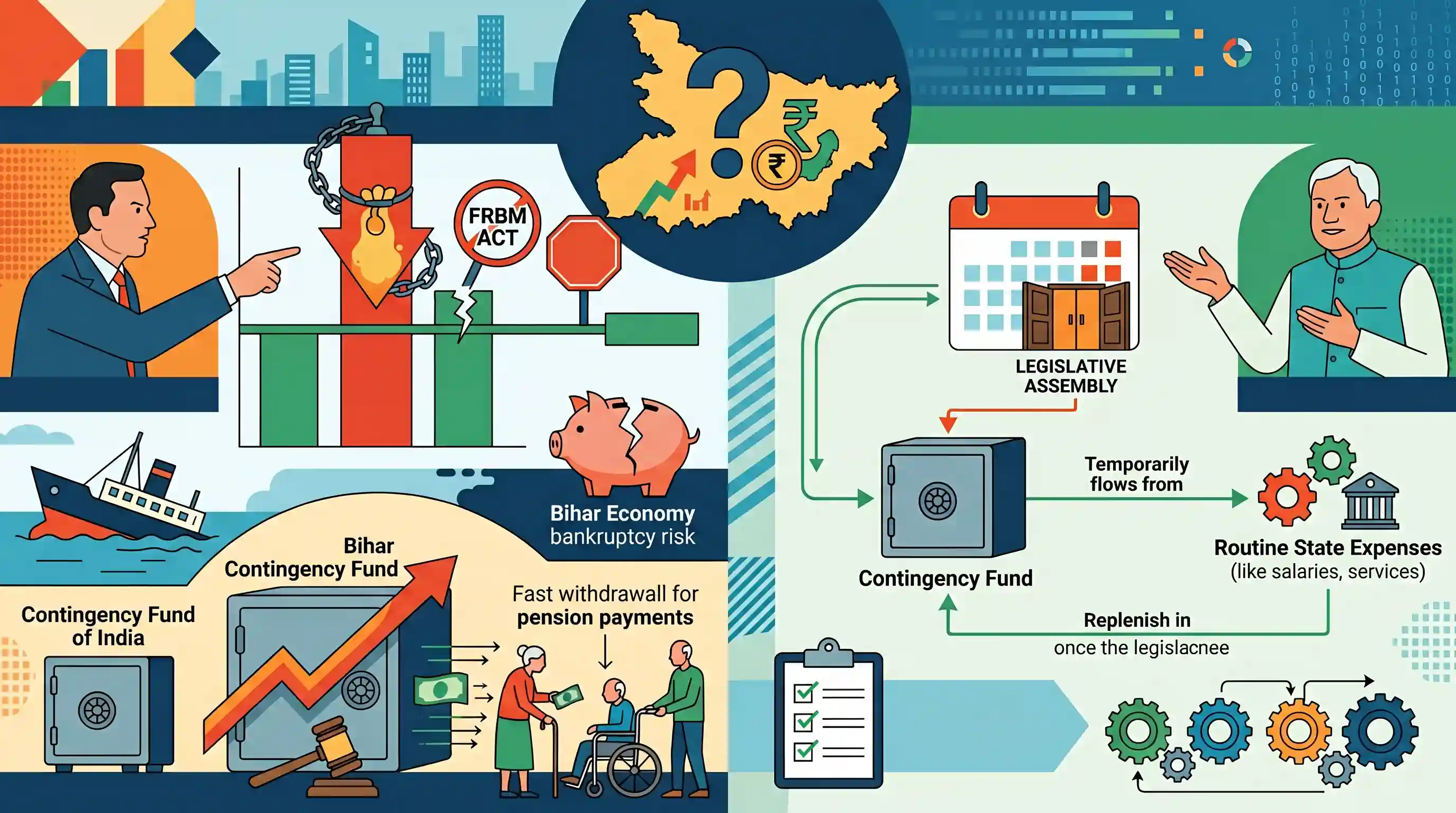
This article explores a growing political and economic controversy in Bihar, where Opposition Leader Tejashwi Yadav has accused the NDA government of pushing the state into bankruptcy. Yadav highlighted critical fiscal indicators from Bihar's FY 2026-27 budget, such as a fiscal deficit reaching 11.9% of GSDP, which far surpasses the 3% limit mandated by the Fiscal Responsibility and Budget Management (FRBM) Act. He also criticized the state's reliance on the Bihar Contingency Fund to finance routine expenses like social security pensions, questioning the withdrawal of Rs 3,662 crore within the first three months of the fiscal year. Yadav drew attention to a state amendment allowing the Bihar Contingency Fund to expand up to 10% of the state's budget expenditure (translating to Rs 32,492 crore out of a Rs 3.25 lakh crore budget), making it larger than the national Contingency Fund of India (Rs 30,000 crore). Bihar Deputy CM-cum-Finance Minister Bijendra Prasad Yadav dismissed these claims, explaining that using the contingency fund for temporary expenses when the legislature is not in session is a standard administrative practice.
Key Points
- Rashtriya Janata Dal (RJD) leader Tejashwi Yadav accused the NDA government in Bihar of economic mismanagement, claiming that Bihar is on the verge of bankruptcy due to poor financial policies and high debt repayment.
- Under Article 267(1) of the Indian Constitution, the Contingency Fund of India is established under the President for unforeseen expenses, and its limit was enhanced from Rs 500 crore to Rs 30,000 crore via the Finance Bill, 2021.
- Under Article 267(2), State Legislatures can establish a Contingency Fund of the State placed at the disposal of the Governor to meet unforeseen expenditure pending legislative authorization.
- Bihar recently amended its rules to allow the state's Contingency Fund to be increased up to 10% of the state's budget expenditure for a financial year.
- With Bihar's estimated budgetary expenditure for FY 2026-27 at Rs 3,24,925 crore, this amendment allows the state's contingency fund to be raised to around Rs 32,492 crore—making it larger than the Contingency Fund of India.
- Tejashwi Yadav raised concerns over a high fiscal deficit of 11.9% in the Bihar budget, which far exceeds the standard 3% Gross State Domestic Product (GSDP) limit mandated under the FRBM Act.
- The opposition criticized the withdrawal of Rs 3,662 crore from the contingency fund for routine matters like social security pensions, while Bihar's Deputy CM and Finance Minister Bijendra Prasad Yadav defended the move as a normal process to meet expenses when the legislature is not in session.
Important Terms
Fiscal Responsibility and Budget Management (FRBM) Act

A 2003 parliamentary law enacted to enforce fiscal discipline, limit the central government's fiscal deficit (initially to 3% of GDP), reduce public debt, and ensure long-term macroeconomic stability and transparency in public finance.
UPSC context
GS Paper III (Indian Economy). Tests knowledge of fiscal consolidation, deficit targets, and the NK Singh Committee recommendations.
Finance Bill, 2021
The annual legislative bill passed as a Money Bill to implement budget proposals, which notably raised the corpus of the Contingency Fund of India sixty-fold from ₹500 crore to ₹30,000 crore.
UPSC context
GS Paper II (Parliament) and GS Paper III (Budgeting). Tests knowledge of Money Bills and legislative financial powers.
Bihar Contingency Fund Amendment
Legislative modifications to Bihar's Contingency Fund Act, 1950, enabling the temporary expansion of the state's contingency fund corpus up to 10% of its annual budget expenditure to fund unforeseen emergency expenditures.
UPSC context
GS Paper II (Federalism & State Finances). Tests understanding of state contingency funds under Article 267(2) and executive spending.
Prelims Trap
The contingency fund of a State cannot exceed the total corpus of the Contingency Fund of India.
Article 267(2) empowers state legislatures to set their own fund size by law. Bihar's amended limit (~₹32,492 cr) actually exceeds the Union's limit (₹30,000 cr).
Static Concepts Connected
What are the constitutional rules governing Indian Contingency Funds?
- Constitutional basis: Article 267(1) creates the Union fund, while Article 267(2) permits states to establish their own funds.
- Custody and control: Funds are placed at the disposal of the President (Union) and Governor (State) for unforeseen expenditures.
- Legislative authorization: Any spending from these funds must be post-facto authorized by the Parliament or State Legislature.
How does the Constitution regulate state borrowing and fiscal deficits?
- Article 293(3): States cannot raise loans without Centre's consent if any part of a previous Central loan is outstanding.
- FRBM framework: States enact domestic FRBM laws to cap fiscal deficit, normally targeting 3% of their GSDP.
- Finance Commission role: The Finance Commission recommends the fiscal consolidation path and conditional borrowing space for states.
Cross-Topic Patterns
Article 293(3) and off-budget state debt
Central limits on state borrowings under Article 293(3) push states to find alternative liquid channels, testing the boundaries of cooperative fiscal federalism.
Executive discretion vs Legislative control of purse
Using contingency funds for recurring expenditures bypasses prior legislative voting, undermining the fundamental constitutional principle of legislative control over public finance.

UPSC may contrast Article 267(2) state fund autonomy with Article 293(3) central borrowing consent limits in a 2026 federalism question.
Linked PYQs · 2
Linked PYQs · 2
- 2022BPSC_PRELIMSGS1
The fiscal deficit in Bihar during 2021-22 is estimated as
- 2023BPSC_PRELIMSGS1
Which of the following is/are the consequence(s) of invoking Article 360, declaration of a financial emergency? 1. The President may order the States to reduce the salaries and allowances of all or any class of employees serving in connection with the State affairs. 2. Money Bills or other financial bills passed by the State Legislature are not required to be reserved for the consideration of the President. 3. The President can issue directions for the reduction of salaries and allowances of all or any class of employees serving in connection with the affairs of the Union, including the Judges of the Supreme Court and the High Courts. 4. Money Bills or other financial bills are to be reserved for the consideration of the President after they are passed by the Legislature of the State.
