Seasonal Triggers of Delhi Air Pollution Crisis in October
Source:Indian Express ↗
ఇది ఎందుకు ముఖ్యం
Air pollution in the National Capital Region (NCR) is a recurring, severe environmental and public health crisis. Understanding its seasonal triggers (meteorological factors, inversion, stubble burning) is vital for GS3 Environmental Pollution and governance mechanisms like GRAP.
సారాంశం
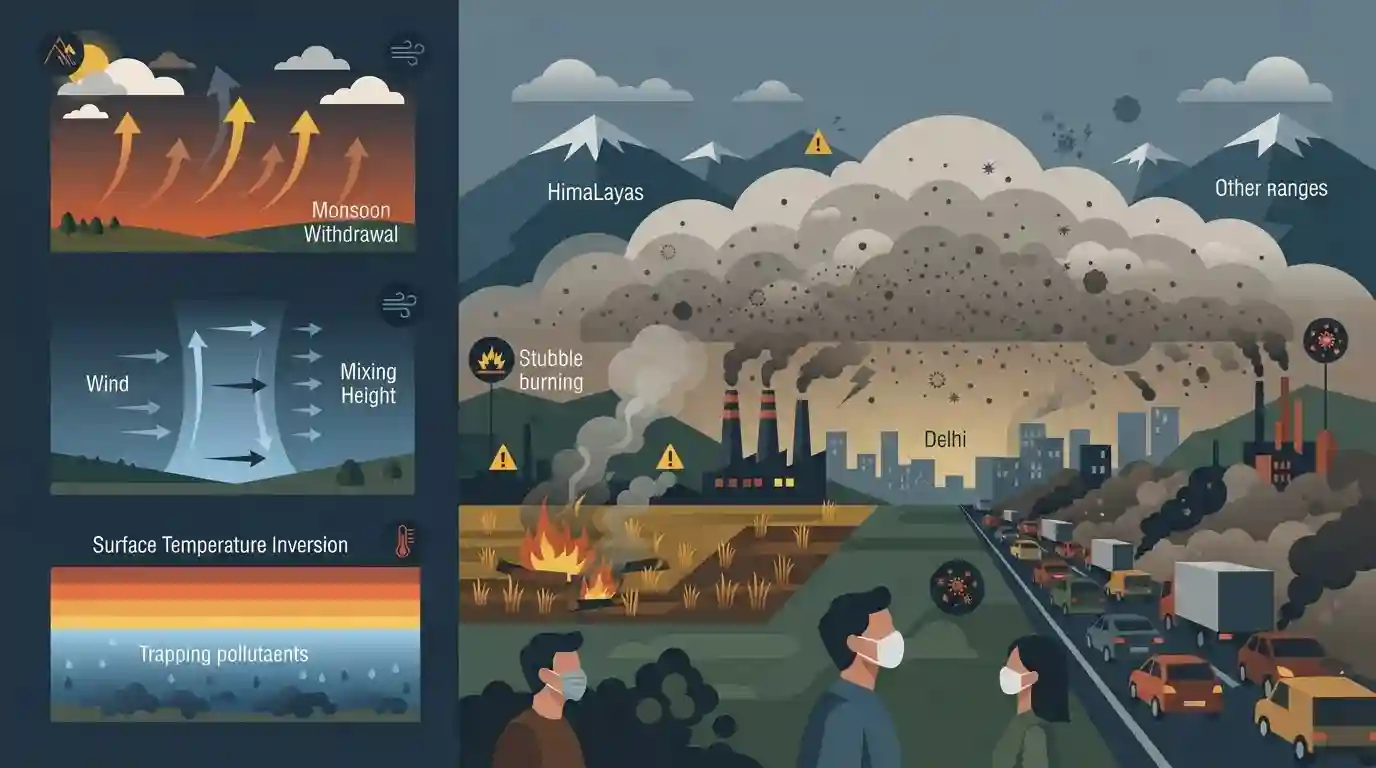
The article explains the structural and seasonal factors responsible for the rapid deterioration of Delhi's air quality starting in October. It highlights how meteorological transformations—such as the withdrawal of monsoon winds, reduction in wind speed, lower mixing heights, and surface temperature inversions—combine with seasonal stubble burning in neighboring states and continuous local emissions to trap toxic pollutants in the Indo-Gangetic plain.
ముఖ్య అంశాలు
- Delhi's air quality typically witnesses a sharp decline in October due to a combination of meteorological changes and local/regional emission sources.
- Key meteorological shifts include the withdrawal of the monsoon, transition to calmer winds, lower temperatures, and the onset of winter inversion layers that trap pollutants near the surface.
- Regional contributors include paddy stubble burning in northwestern states like Punjab and Haryana, coinciding with post-harvest clearing cycles.
- Local contributors involve vehicular emissions, construction dust, biomass burning for heating, and municipal waste burning.
ప్రిలిమ్స్ ఉచ్చు
Paddy stubble burning in northwestern states is the primary cause of Delhi's poor air quality throughout the year.
Stubble burning is often misidentified as the sole or primary year-round cause of Delhi's pollution, whereas local vehicular and construction emissions persist continuously while meteorology and stubble burning trigger the acute October-November spike.
అనుసంధానమైన స్థిర భావనలు
What is a surface temperature inversion and how does it impact winter air quality?
- Inversion Mechanics: Temperature inversion occurs when a layer of warm air traps cooler air near the earth's surface, preventing vertical mixing and dispersion of pollutants.
- Winter Intensification: During winter nights, rapid terrestrial radiation cools the surface, intensifying the inversion layer and lowering the atmospheric mixing height.
- Pollution Trap: Trapped particulate matter (PM2.5 and PM10) accumulates near the surface, causing severe smog episodes in bowl-shaped regions like the Indo-Gangetic Plain.
అంతర-అంశ నమూనాలు
Air Pollution + Regional Topography Linkages
Delhi's winter pollution crisis is exacerbated by regional topography (Indo-Gangetic Plain) trapping pollutants under stable atmospheric inversion layers, rendering standard local municipal emission controls insufficient without airshed-level management.
Stubble Burning + Federal Governance Co-ordination
The transition from monsoon to northwesterly winter winds acts as a transport vector for agricultural residue smoke, highlighting the governance challenge of coordinating multi-state stubble burning interventions under agencies like CAQM.

Expect a multi-statement Prelims question pairing meteorological phenomena (temperature inversion, mixing height) with seasonal pollution drivers.
అనుసంధాన PYQలు · 2
అనుసంధాన PYQలు · 2
- 2019PrelimsGS1
Consider the following: 1. Carbon monoxide 2. Methane 3. Ozone 4. Sulphur dioxide Which of the above are released into atmosphere due to the burning of crop/biomass residue?
- 2020MainsGS3
What are the key features of the National Clean Air Programme (NCAP) initiated by the Government of India?
