Delhi Air Quality Deterioration and Meteorological Factors in October
Source:Indian Express ↗
Why It Matters
Understanding the cyclical nature of Delhi's air pollution crisis is vital for civil services aspirants to evaluate current policy interventions, structural lacunae in stubble management, and long-term mitigation strategies under frameworks like the National Clean Air Programme (NCAP).
Summary
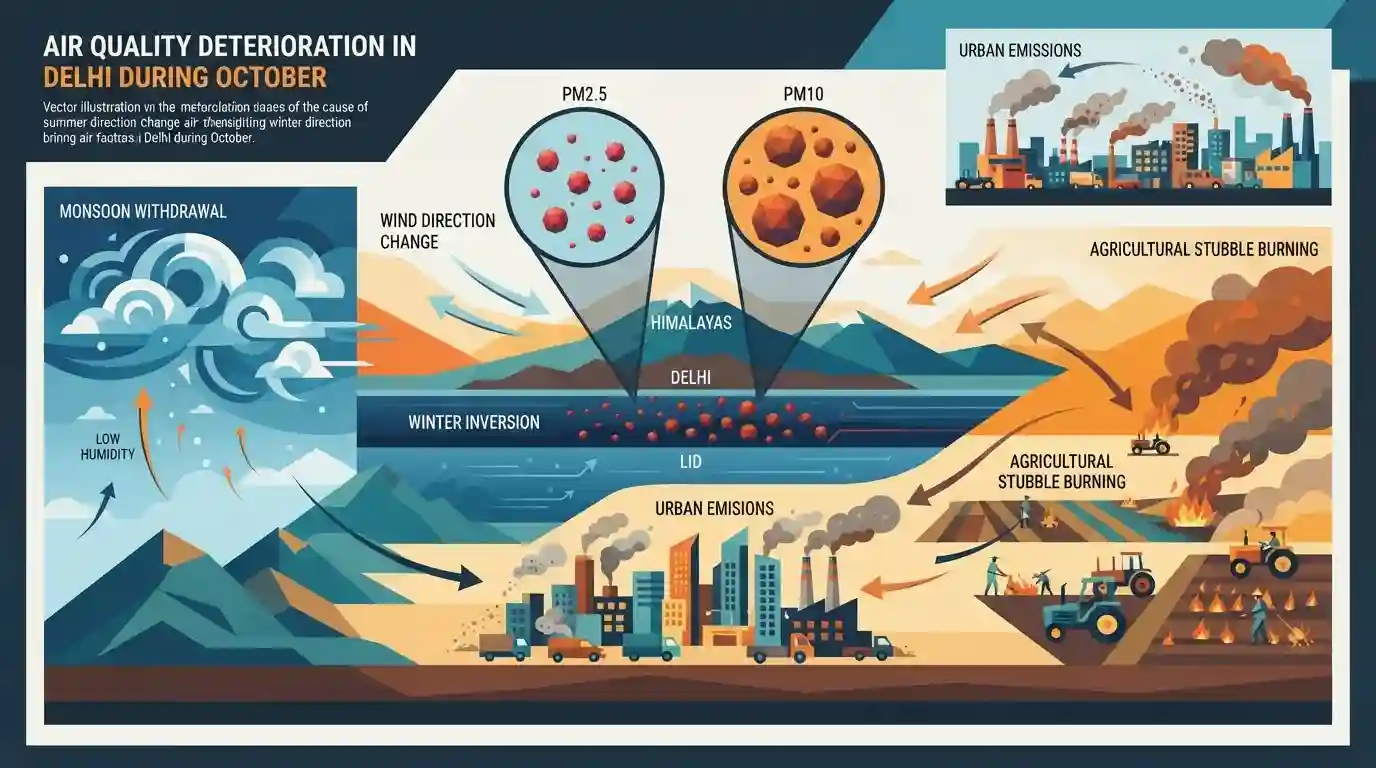
The article explains the structural and seasonal factors responsible for the sharp deterioration of air quality in Delhi during October. It highlights how the withdrawal of the monsoon, onset of winter inversion, changes in wind direction, and agricultural stubble burning in neighboring states converge to trap high levels of particulate matter (PM2.5 and PM10) in the Indo-Gangetic plain.
Key Points
- Delhi's air quality sharply deteriorates every October due to a combination of meteorological changes and local/regional emission sources.
- Shifting wind patterns (north-westerly winds) transport smoke from stubble burning in Punjab and Haryana towards the National Capital Region (NCR).
- Lower temperatures and calmer wind speeds lead to inversion layers, trapping pollutants close to the surface and preventing dispersion.
- Local pollution sources, including vehicular emissions, construction dust, and Diwali firecrackers, compound the seasonal crisis.
Important Terms
National Clean Air Programme

India's flagship comprehensive national framework launched by the MoEFCC in 2019 to reduce particulate matter pollution (PM2.5 and PM10) across non-attainment cities through coordinated, target-driven action plans.
UPSC context
UPSC Prelims & Mains (GS Paper III): Environment & Ecology – Pollution control strategies, governance mechanisms, and national environmental targets.
SAFAR
An indigenous initiative developed by IITM Pune under the Ministry of Earth Sciences to provide real-time air quality monitoring and advance forecasts for major metropolitan cities in India.
UPSC context
UPSC Prelims: Environment & Ecology – Pollution monitoring frameworks, scientific indices, and institutional mechanisms.
Indian Meteorological Department
The principal government agency under the Ministry of Earth Sciences responsible for meteorological observations, weather forecasting, and tracking atmospheric parameters influencing air pollution dispersal.
UPSC context
UPSC Prelims & Mains (GS Paper I & III): Geography & Environment – Meteorological factors affecting regional air quality and seasonal inversions.
Prelims Trap
Agricultural stubble burning is the primary year-round driver of particulate pollution across the National Capital Region.
Stubble burning is the dominant year-round cause of Delhi's pollution. In reality, it is a seasonal peak that compounds persistent local baselines like vehicular and construction dust under inversion conditions.
Static Concepts Connected
What is atmospheric temperature inversion and how does it impact winter pollution in northern India?
- Thermal Gradient: Normal gradient, in which air temperature decreases with increasing altitude, reverses during winter nights under stable conditions.
- Trapping Layer: A warm air layer traps cooler, denser air near the surface, preventing vertical mixing and pollutant dispersion.
- Himalayan Barrier: Topographical barriers like the Himalayas restrict horizontal air drainage, worsening smog accumulation in the IGP.
Cross-Topic Patterns
Smog + Indo-Gangetic Physiography
Winter temperature inversions trap pollutants across the Indo-Gangetic Plain, linking Delhi's smog directly to physiographic barriers like the Himalayas and seasonal wind reversals.
NCAP + Urban Governance & Federalism
NCAP targets 40% PM reduction in non-attainment cities, blending cooperative federalism, urban governance, and fiscal allocations under MoEFCC.

Winter inversion + north-westerly stubble transport + NCAP targets likely to feature in a multi-statement Prelims question.
Linked PYQs · 2
Linked PYQs · 2
- 2020MainsGS3
What are the key features of the National Clean Air Programme (NCAP) initiated by the Government of India?
- 2019PrelimsGS1
Consider the following: 1. Carbon monoxide 2. Methane 3. Ozone 4. Sulphur dioxide Which of the above are released into atmosphere due to the burning of crop/biomass residue?
