Meteorological and Regional Causes of Delhi October Air Pollution
Source:Indian Express ↗
কেন এটি গুরুত্বপূর্ণ
Understanding the multi-faceted causes of Delhi's seasonal air pollution crisis is crucial for evaluating policy interventions like GRAP, stubble management strategies, and regional air quality governance frameworks tested frequently in UPSC Mains GS3.
সারসংক্ষেপ
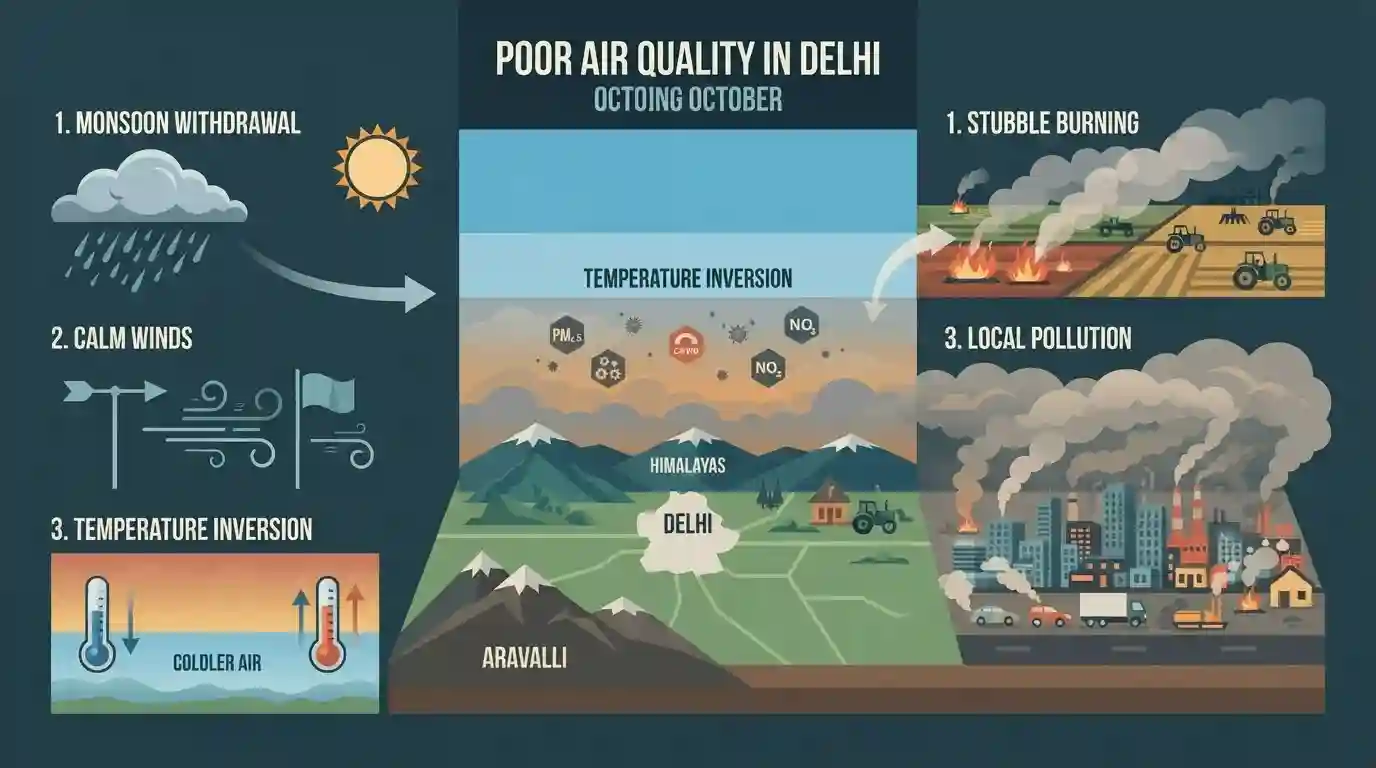
The article explains the structural and meteorological reasons behind the annual deterioration of Delhi's air quality in October. It highlights how the withdrawal of monsoons, calm wind speeds, temperature inversions, stubble burning in neighbouring agrarian states, and local pollution sources converge to trap pollutants in the Indo-Gangetic plain.
মূল বিষয়
- Delhi's air quality typically begins a sharp decline in October due to a combination of changing meteorological conditions and external local/regional emissions.
- Transition from southwest monsoon withdrawal brings calm surface winds, lower temperatures, and inversion layers that trap pollutants close to the ground.
- Stubble burning in northwestern states like Punjab and Haryana picks up during October as kharif crops are harvested, adding significant particulate matter (PM2.5 and PM10).
- Local sources including vehicular emissions, construction dust, and open waste burning compound the seasonal spike, triggering emergency response protocols like GRAP.
গুরুত্বপূর্ণ শব্দ
Commission for Air Quality Management (CAQM)

A statutory body established to coordinate, monitor, and resolve air quality issues across the National Capital Region (NCR) and adjoining areas, replacing earlier ad-hoc committees like the EPCA.
UPSC context
UPSC Prelims/Mains (GS Paper III): Important statutory bodies, environment governance, and regulatory frameworks for pollution control in Delhi-NCR.
Graded Response Action Plan (GRAP)
A set of emergency incremental anti-pollution measures enforced step-by-step based on AQI levels (from Poor to Severe Plus) to prevent further air quality degradation.
UPSC context
UPSC Prelims/Mains (GS Paper III): Environment pollution management, emergency response mechanisms, and administrative measures against smog.
National Clean Air Programme (NCAP)
India's flagship national strategy launched by the MoEFCC to reduce particulate matter (PM2.5 and PM10) concentrations by up to 40% in targeted non-attainment cities by 2025-26.
UPSC context
UPSC Prelims/Mains (GS Paper III): Government policies, national conservation programs, and urban air quality targets.
সংযুক্ত স্থির ধারণা
What are the primary meteorological and topographical factors causing severe winter air pollution in the Indo-Gangetic Plain?
- Temperature Inversion:: Temperature Inversion occurs when a layer of warm air traps cooler air near the surface, preventing vertical dispersion of pollutants.
- Wind Speeds:: Calm Surface Winds during the withdrawal of the southwest monsoon fail to horizontally disperse heavy particulate matter (PM2.5 and PM10).
- Topographical Basin:: The Indo-Gangetic Basin acts as a vast topographical bowl flanked by the Himalayas, restricting lateral airflow and locking in smog.
আন্তঃবিষয় প্যাটার্ন
Air Pollution and Cooperative Federalism Dynamics
Delhi's winter pollution crisis links atmospheric science (temperature inversions) with cooperative federalism failures, as states battle over stubble burning jurisdiction and air quality management commissions struggle to enforce cross-border mandates.
Indo-Gangetic Topography and Regional Development Limits
The Indo-Gangetic Plain acts as a natural air basin, showing how geographical terrain and topography dictate the ecological limits of regional industrial and agricultural development policies.

Expect a multi-statement Prelims question pairing meteorological drivers like inversion layers with transboundary sources like stubble burning in October.
সংযুক্ত PYQ · 3
সংযুক্ত PYQ · 3
- 2019PrelimsGS1
Consider the following: 1. Carbon monoxide 2. Methane 3. Ozone 4. Sulphur dioxide Which of the above are released into atmosphere due to the burning of crop/biomass residue?
- 2020MainsGS3
What are the key features of the National Clean Air Programme (NCAP) initiated by the Government of India?
- 2021MainsGS3
Describe the key points of the revised Global Air Quality Guidelines (AQGs) recently released by the World Health Organisation (WHO). How are these different from its last update in 2005? What changes in India's National Clean Air Programme are required to achieve these revised standards?
